Faith · poetry

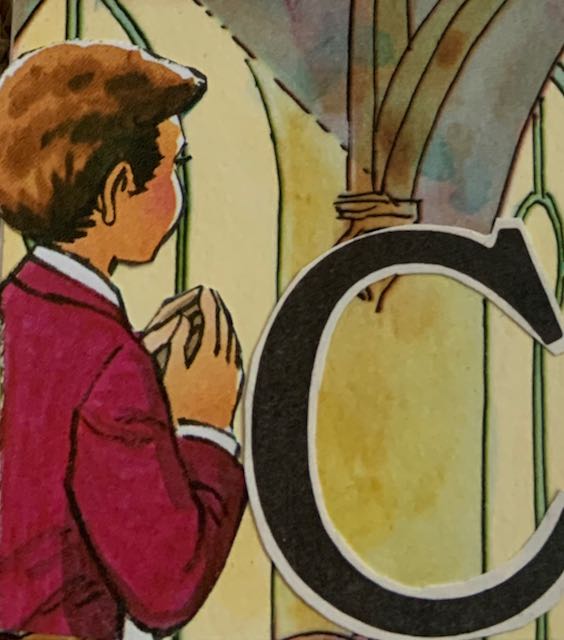
In Church

Praying in a pew on well worn kneeler
Darkness flickers while light streams
Sinner. Beloved. Which?

That shadow in the back — did I see something?
Tiny glimpse of disquiet
Lurking, lurking, lurking

Yet, there is light casting rainbow colors
Through tow’ring stained glass windows
Overwhelming peace

Praying in a pew on well worn kneeler
Tiny glimpse of disquiet
Overwhelming peace


This is my response to this week’s W3 challenge — to write a Garland Kimo on the theme of good vs evil.

The ‘Kimo’ is a short syllabic poetic form of three lines. The syllable count per line is 10/7/6.

Also, the kimo is focused on a single frozen image (kind of like a snapshot). So it’s uncommon to have any movement happening in kimo poems.

The ‘Garland Kimo’ is a series of four ‘Kimo’ verses, in which the fourth Kimo verse is composed of lines taken from the previous three Kimo verses, using the 1st line from the 1st Kimo, the 2nd line from the 2nd Kimo, and the 3rd (last) line from the 3rd Kimo.

    Faith · Life · Sermon Recap

    Crippling Grace (and a sermon recap)

    There’s a poem I’ve read over every morning for the past week or so — mostly because I’m still not sure I’ve unpacked it. I probably never will. It’s called “No accident” by Norman MacCaig. Here are some bits from to give you the gist:

    Walking downhill from Suilven (a fine day, for once)
    I twisted a knee…

    I didn’t mind so much. Suilven’s a place
    … [where] a heaven’s revealed, in glimpses.
    Grace is a crippling thing. You’ve to pay for grace.

    The heaven’s an odd one…
    …hiding
    Forevers and everywhere in every thing — including
    A two-mile walk, even, and a crippled knee.

    You reach it by revelation. Good works can’t place
    Heaven…
    …in the hard truth that, if only by being
    First in a lower state, you’ve to pay for grace.

    “You’ve to pay for grace.” I think those words bothered me, because Christianity teaches that grace is free.

    But Sunday’s sermon was from 2 Corinthians 12 where Paul talks about his “thorn in the flesh.” I’m sure it wasn’t a twisted knee. I know the scholars propose an eye affliction. But I don’t think Paul is saying anything much different from Norman MacCaig, though, when he says that God’s grace is sufficient and that power is made perfect in weakness. (1 Cor 12:9)

    My take-away from the sermon was this quote from Fr. Nathan — “Our weaknesses, our scars, our really big wounds — these are the places where God can work in our lives.”

    I needed to hear that reminder. The challenges in our life are how we pay for grace — or God pays for it. It’s where He works.

    Faith · Sermon Recap

    Sermon Recap 06.02.24

    Preaching from Mark 2:23-3:6

    “What does the human heart need? Grace.”

    Of course, Fr. N’s answer listed other things.

    Of course, he expounded on it all.

    Of course, I was semi-exhausted and kept dozing off while he was preaching. (I must cut back somewhere in my life!)

    But that was the one coherent line that I had scribbled in my bulletin. And, if you think about it, it says a lot.

    Faith · poetry · Sermon Recap

    Sermon Recap 05.26.24

    I look for what I should be doing
    Since I am captain of my soul
    What is it I should be pursuing?
    What should I do to be made whole?

    Surely, I can make some changes
    In my approach to living life
    Surely I can rearrange this
    Remove all this unneeded strife

    And yet, and yet, and yet again
    I know I am not in control
    I bow my head, contrite amen –
    So be it, God — I yield the goal

    To “not my will, but Yours be done –“
    It’s not my race, but Yours I run


    A few weeks ago I had decided to try to process the Sunday sermon by taking notes and writing something later.

    Last week was my first week doing it. It accomplished these things:

    First, I went to church. I’ve been skipping so much lately.

    I told Fr. N. that I was mad at God.

    “Is that okay?” I asked.

    “Absolutely,” he replied. “Go ahead and swear at God. Tell Him this is shitty.”

    It’s just that I spent so much time and effort praying about a situation that did not resolve the way I wanted to do. What’s up with that, God?

    Second, I semi-paid attention. Okay — I was distracted that morning. I pulled myself away from the distraction long enough to write a single line which I read back to Fr. N. later in the week.

    “You paid attention!” he said. That may have been an overstatement. Here’s the line:

    The places where we have fallen flat on our faces — those are the places where God comes.

    Third, I wrote a post to process it. It turned out to be pretty personal so I didn’t publish it. I realized that writing something and NOT publishing is okay, too. It felt good to write and process, though.


    This week, I went to church in part because the lectionary readings (and therefore the sermon fodder) were some of my favorites passages: Isaiah 6 and John 3.

    Fr. N. went with John 3. I settled in, waiting for him to talk about the wind. You know, how it “blows where it wishes, and you hear its sound, but you do not know where it comes from or where it goes.” (John 3:8)

    It’s verses like that that encourage me to embrace the mystery. Too long I attended churches that knew all the answers.

    Fr N, however, didn’t get the wind memo. He went in a different direction: baptism.

    He talked about how Nicodemus wanted something that he, Nicodemus, could do, and instead Jesus told him something that was impossible.

    Rereading my notes from yesterday’s sermon led to today’s sonnet.

    It’s not entirely what Fr. N said, but it’s what I needed to hear.

    Faith · poetry

    Adrift

    Adrift
    In a coracle
    No oar
    Unmoored
    Belonging only
    To the One
    Who authors
    Currents
    And winds


    This is my response to the W3 prompt this week which is to write a free verse poem of not more than 12 lines with a theme of belonging.

    I’ve been feeling a bit at loose ends lately, like I’ve lost my footing. Even my faith, which has been my bedrock, has felt shaky. Belonging to a church feels like a crock. Speaking Christianese, which once felt so natural, now feels false.

    I am, indeed, unmoored — and yet I belong.

    A to Z Blogging Challenge · Bible Study · Faith · poetry

    Many

    What are they for so many? — John 6:9

    A few loaves?
    And two fish?
    What are they?
    Futile wish

    That somehow
    These would feed
    A crowd? Ha!
    No, indeed.

    And yet once
    Broken, they
    Did just that —
    “How?” You say

    Magic? Was
    It Divine?
    I don’t know –
    Yet, I dine


    This year for the A-to-Z challenge, I’m challenging myself to write a Cethramtu Rannaigechta Moire every day. I can’t pronounce it, but I can tell you that it’s an Irish poetic form that requires 3 syllable lines in quatrains. The second and fourth lines rhyme.

    Additionally, I’ve been collecting questions for a few years — specifically questions from the Bible. I have so many questions.

    Turns out the Bible is full of questions.

    So, I’m using questions from the Gospel of John for this challenge.

    A to Z Blogging Challenge · Bible Study · Faith · poetry

    Judge

    “Does our law judge a man without first giving him a hearing and learning what he does?” — John 7:51

    people are
    quick to judge
    then often can’t
    even budge

    when they hear
    facts that tell
    another
    tale. Lord, quell

    my judgment
    change my mind
    let me be
    open, kind.


    This year for the A-to-Z challenge, I’m challenging myself to write a Cethramtu Rannaigechta Moire every day. I can’t pronounce it, but I can tell you that it’s an Irish poetic form that requires 3 syllable lines in quatrains. The second and fourth lines rhyme.

    Additionally, I’ve been collecting questions for a few years — specifically questions from the Bible. I have so many questions.

    Turns out the Bible is full of questions.

    So, I’m using questions from the Gospel of John for this challenge.

    A to Z Blogging Challenge · Bible Study · Faith · poetry · questions

    Blind

    John 9: 2 His disciples asked him, “Rabbi, who sinned, this man or his parents, that he was born blind?”

    First, forgive me for the language, but this question from the Bible irks me. It really does. I think “who sinned” in modern vernacular would be spoken today in the words I chose.


    Who f*cked up?
    Someone did!
    Remember –
    Adam hid

    When he f*cked
    Up and ate
    That apple!
    Think we’re great?

    We can’t see.
    Humans fail.
    All people
    Are so frail!

    Yet some one
    Not like me
    Must be flawed.
    We should see

    Who is at
    Fault, or who
    F*cked up. We
    Have no clue


    The thought behind the question is what irritates me. Whose fault is it that someone is blind? Is it his? Is it his parents?

    How small minded we are!

    Here are the questions I would ask — and do ask! How can I help this person? What can I learn from this person? I’ll bet they have some amazing stories; would they share them with me?


    This year for the A-to-Z challenge, I’m challenging myself to write a Cethramtu Rannaigechta Moire every day. I can’t pronounce it, but I can tell you that it’s an Irish poetic form that requires 3 syllable lines in quatrains. The second and fourth lines rhyme.

    Additionally, I’ve been collecting questions for a few years — specifically questions from the Bible. I have a big problem with people who think they know everything, especially religious people.

    The more someone thinks they know God, the converse is probably true. I know less about God today than I did last year or five years or twenty-five years ago. I have so many questions.

    Turns out the Bible is full of questions.

    So, I’m using questions from the Gospel of John for this challenge.