Alzheimer's · Faith · family · poetry

The Weight of Struggles

In 2011, my mind was spinning with all the information being thrown at me.  Bladder cancer.  Catheter care.  Chemotherapy.

That summer, my mother had been diagnosed with bladder cancer.

As if Alzheimer’s wasn’t enough.  As if a second bout with breast cancer wasn’t enough.  As if my father needing a pacemaker wasn’t enough.

In the midst of all this, I wrote a poem based on Milo of Croton, the legendary Greek wrestler who began each day lifting a calf.

Okay -- not lifting a calf here.
Okay — not lifting a calf here.

The legend goes that by lifting the same calf every morning, Milo could eventually lift a full-grown cow or bull. I didn’t need to lift a physical cow, rather a heavy load of struggles, one that was increasing in size.

If I lift the same calf every day
Could I someday lift a cow?
It seems logical and sensible
But impossible somehow.

Somehow I become broken
And it’s more than I can take.
Will I see failure coming?
Or do I need to break?

Or do I need a break
From lifting up the cow?
Am I stronger then, or weaker,
When I start to bow?

To bow under the pressure that’s
So heavy on my soul
That the spirit and mind and body
All begin to show the toll;

When can I say “Uncle”
And deal with this no more?
I strain under the calf-turned-cow
My cheek pressed to the floor,

Trying to lift up the cow,
But the Lifter of my head
Says, “Let Me help. Stop a while.
I’ll put others in your stead.

“Let friends come beside you.
You can take a rest.
Trust Me; it will be okay.
I really know what’s best.”

But the habit formed of lifting,
Lifting, lifting every day
Is scary to give up.
Lord, show me the way.

During that time I felt God answering every prayer I ever prayed about knowing Him more, trusting Him more, and resting in Him more completely.

The funny thing about challenges is that the harder they are, the deeper we grow.

I couldn’t meet the challenges.

At least not alone.

I found myself clinging to my faith during that challenging time.

Faith is not a crutch as some might say.  It is a Strength.

It’s also faithful friends — that hands and feet of Christ.

I wrote Milo of Croton 5 years ago — and I think I still haven’t learned to yield.

But I’m certainly stronger.

Thanks be to God.

Faith · family · flowers

Christmas Flowers

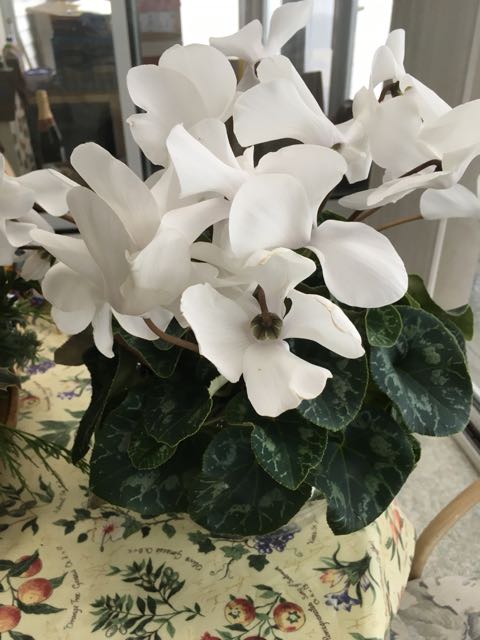
img_1016On Sunday the pastor announced that anyone who wanted Poinsettia or cyclamen was welcome to take plants home. The front altar had been filled with plants for the holiday season — so, so lovely.

The cyclamen on the piano had caught my eye. It was looking droopy and sad, kind of worn out. I understood how it felt.

We are invariably among the last to leave. Bud loves to visit with people and I try to wait patiently (albeit awkwardly). I watched plants leave the sanctuary, one by one, but so many still waited to be adopted. The cyclamen on the piano drooped even more. I  grabbed it and a poinsettia to take home before we left.

For my mother — you know? She loved plants. When she was alive, she always had Poinsettia at Christmas. Her Christmas cactus burst into bloom on cue with the season, as did her Crown of Thorns at Easter. It was magical.

Here is part of  a post I wrote nearly 5 years ago:

At the tower of Babel, God scattered the languages of the world, “so that they may not understand one another’s speech.” (Genesis 11:7)  But He left us some universal languages.

Music crosses cultures and generations.

Art speaks and moves me, though I may know not a word in the native tongue of the painter.

And flowers — God Himself uses this language to speak to us through their beauty.

Flowers may have been the language my mother understood best.  She worked tirelessly in her garden, weeding, tending, making it beautiful for all to enjoy.  Inside the house there was always something blooming — Poinsettia, Christmas cactus, Amaryllis, the crown of thorns, Easter lilies, mums.  She understood the language of the flowers and plants, and they understood her and responded.

As my mother descended into dementia, the plants in the house looked more and more sickly. Nearly all the plants eventually died. Her huge Christmas cactus and Crown of Thorns are gone.

As I left the sanctuary on Sunday holding my sad cyclamen, Bud noticed a healthy one in the vestibule. “Do you want this plant instead?” he asked.

“No,” I told him. “I want to try to revive this one.”

It’s amazing what a little water and sunshine will do.

img_1030

I used to tell myself that I had a black thumb and that I could never grow plants the way my mother did, but I understand better now. It’s not the color of my thumb, it’s the care and attention.

It holds true with plants.

It holds true with people.

dementia · Faith · family

If You Say So

The following is an edited version of a post first published on January 2, 2012. I wrote it when my mother was still living at home and I was trying to help my father with her.

My sister and I can carry on conversations using just things my mother says.

For instance, my mother often says, “If you say so.”

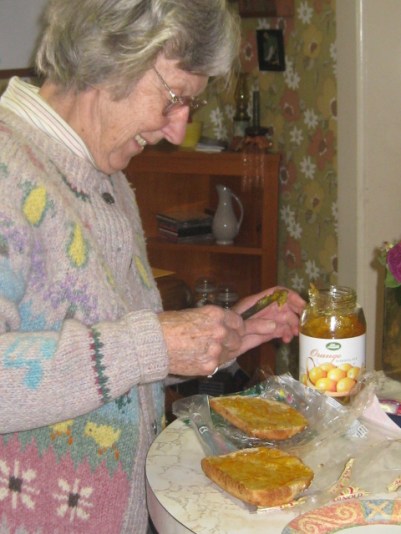
Making the sandwich #1This is usually in response to something she doesn’t believe to be true.  Like, she’ll be preparing a meal for, say, 150 people.  (150 is her favorite number.)  I’ll say to her, “Mom, there are only going to be five of us for lunch today — You, me, Dad, Mary and Laurel.”

She’ll look at me with a look that says, I don’t believe a word of that.  But out of her mouth will come the words, “If you say so.”

It’s a phony acquiescence.  She’ll continue right on making 150 sandwiches.

Or, she’ll be getting ready for church, and I’ll say, “Mom, today is Tuesday.  There’s nothing going on at the church today.”

She’ll answer, “If you say so,” and then continue getting ready for church.

She started saying it as a cover for her memory loss.  It was easier than arguing.

The reason I wanted to start off the new year with those words, though, is because they tie in so beautifully with something else I’ve been thinking about.  I’ve been thinking about how the earthly life of Christ was book-ended with two statements of yielding.

First, when the angel told Mary she was going to have a baby, she responded with,

Behold, I am the servant of the Lord; let it be to me according to your word.

Luke 1:38

I’m quite sure there must be a translation out there that translates her words as, “If you say so,” not in an I-really-don’t-believe-a-word-of-it way, but in the way I would like to be able to say them to God. A yielding.

When Jesus was praying in Gethsemane before his death, he said these words,

Father, if You are willing, remove this cup from me.  Nevertheless, not my will, but Yours, be done.

Luke 22:42

Can’t you just hear the “if you say so” in there?

“Father, take this cup away from me, but, if you say so, I’ll do it.”

When God asks me to go through something, I’d like to be able to say, “Okay, God, if You say so.”

I want 2012 (and now 2017) to be an “If You Say So” kind of year, a year of yielding to the Father’s will.  I want to be like Mary and Jesus,  who, facing trials and uncertainty, still trust God’s overarching plan.

However, I want to be sincere in my words — not like my mother  just saying words to smooth things over.

If you say so.

Simple words from a person with Alzheimer’s.

Words also to live by.

Faith · family · Writing

Leaning In

“What’s your theme for 2017 going to be?” my friend asked.

I could barely remember what my theme for 2016 was. If 2015 was hard with the death my mother, 2016 was … um… I don’t even know. Rich? Full? Exhausting?

And where did 2016 even go? A snap of the fingers, and — poof! Good thing this isn’t a 2016 recap because I can’t remember.

My life is rich and full, mostly because of these people —

img_0990-2
Christmas 2016
Starting on the top step — Amanda and Philip
Owen and Emily
Sam and Donna
Me and Bud
Jacob, Helen, and Laurel
Karl, Henry, and Mary

But my 2017 theme is coming from the exhausting part of my life.

My theme is “Leaning In” — the idea of embracing my challenges.

On Christmas Day,  I was standing in the laundry room, seeking solitude and a brief escape from an irritating situation, Helen asked if she could help.

“What can I do about this?” I asked her and told her what was bothering me.

Among her suggestions — write it out.

Write it out.

That’s why I had started this blog in the first place — to make sense of the difficult, to find good in the bad, to untangle the knot — all by writing it out.

So — leaning in. In 2017 I am going to lean in — and part of my embrace will be to write again here.

I thought of three general concepts that relate to leaning in —

  1. Leaning in, as a horse leans into a harness to pull a heavy load. Head down, not high and haughty. Muscles straining– it is hard work. Moving forward, little by little, not giving ground, but gaining and pressing on.
  2. Leaning in, as in a team huddle. Sharing strategies. And concerns. Supporting others — and they supporting me. I can’t do it alone.
  3. Leaning in, as one paying attention to detail. I can’t gloss over things, nor do I want to. Little things are sometimes so much more important than big — and I need to remember that.

Specific goals for 2017 —

  1. Postaday — I’ll write again (or try to), but I may also dust off old posts that I have taken down. My daily posts will be a mix of old and new.
  2. People — I need to cultivate relationships with people who can be part of my team huddle. Again, I see this as a mix of old and new. Friendships needs attention and time. I need to reach out to others on a regular basis — get together with other people, share joys and sorrows, pray, laugh, eat, walk, send cards, write letters, talk on the phone.
  3. Pursue beauty — I toured the Lackawanna Coal Mine once. It was dark and scary, but men found something of value there. Same with my life. I need to look for those places of beauty and goodness. They’re there. I know they are.

So forgive me if my writing muscles are a little rusty. It may take me some time to get my groove back —

But 2017 — here I come.

Faith · family

Graceball


IMG_8900Cleaning off the shelves in my father’s study reminded me of the things he loves to read about — history and baseball. The older I’ve grown, the more I’ve loved reading about those things as well.

I’ve always loved reading about baseball. Not modern baseball, but the old days. Like the deadball days in The Glory of their Times by Lawrence Ritter, one of my favorite baseball books ever. Or the Brooklyn Dodgers. Or the Negro Leagues, both awful and beautiful.

So I grabbed a book on my dad’s bookshelf called The Teammates by David Halberstam. It’s a story about the enduring friendship between four ballplayers: Ted Williams, Bobby Doerr, Dom DiMaggio, and Johnny Pesky.

Ted Williams was one of my father’s heroes. An unlikely hero, in my mind, because he was a hero with baggage. He was foul-mouthed and arrogant. Loud. He wasn’t gracious, wouldn’t tip his cap to the crowd, even in his last game, at his last at-bat, where he nailed his last home run.

John Updike, in Hub Fans Bid Kid Adieu, said about Ted Williams, “Gods do not answer letters.”

But Ted Williams could hit the ball.  Lou Boudreau came up with the Williams Shift for a reason. Why Ted Williams, in that instance, didn’t follow Wee Willy Keeler’s motto — “Hit ’em where they ain’t” — is a mystery to me.

The Teammates softened my thoughts on Ted Williams. It showed a more human side to him.  One Ted Williams story lingers with me.  In the words of Bobby Doerr  —

“… and when lunch was over Ted turned to us and said he wanted to take and show his dad’s photography shop.  And so we went across the street from the hotel, and there was a building there, all the offices empty now, nothing there but an empty building. Then he began talking about his father, who had not been successful, was out of work a lot, and had been drinking a lot. And as he talked you could just see it roll out, this little kid in this terrible world, all the unhappiness, all the things which had never gone away, and which had been stored up for so long. It was clear that his dad had never been there for him.  And then when we came out he took us to this nearby corner, and he said, ‘This is where my mother made me march with the Salvation Army, and I would try and hide behind the bass drum.’ As he talked I could see it all, the little boy back then, the shame, and the pain, and the broken home, and how much he hated all of it. As we were walking around, and he was letting us into his childhood, I was thinking to myself, ‘This is where it all started.’ I’ll never forget that day when he took us around because all you could feel was the sadness of it. The sadness of that little boy, and the sense that it had weighed on him so heavily for so long.”

As I read that story i understood better how baseball is a game of grace. The very best players fail two-thirds of the time when they get up to bat. A batter is allowed three strikes. A pitcher is allowed four balls. A team three outs.

Baseball is not like the pure athleticism of a race, where the first one to finish wins. It’s a game of trying and trying again. Perseverance. Moving on past a failure. And another failure. And another failure. Grace.

The whole game is grace. There’s always another pitch, another at-bat, another game, another season.

It’s why the battle cry of the Red Sox — “Wait till next year” — rings true.

Hope is a cornerstone in baseball. It exists at every single base.

*****

Today my daughter Mary follows in my footsteps (and her aunt’s) by starting a job at the Baseball Hall of Fame.

When combined with the Daily Prompt: “Childhood”, and the fact that this post turned up when I did a draft folder search of that word, you can understand why I’m posting this today.

Originally written last October. Never posted till now.

A to Z Blogging Challenge · Faith

Safe and Swim

Originally my plan was to write about “safe” for the letter S.

About a month ago, I overheard a conversation while waiting for my father. He was visiting friends and I was sitting in the front lobby of the nursing home after an unsuccessful attempt to visit Mary  Three octogenarianesses (octogenarianettes?) sat down opposite me.

Their conversation was at an octogenarian level, so I couldn’t help but overhear.

“I just need to feel SAFE,” one said. “That’s why I would come HERE.”

The last word of every sentence was the loudest, and I found it an interesting way to punctuate.

A different lady, the one they were visiting who was obviously a resident, said, “My children kept telling me that I couldn’t do this, that, or the other thing. After I fell…” Her voice trailed off and she spread her arms to highlight the wheelchair she was in.

The third woman said, “I just don’t have the pep to do everything at home any more.”

“When the house sells, I’m coming HERE,” said loud-final-word.

Resident lady said, “I should have come here when I was 70. Now I’m 87, going on 88.”

#3 said, “It’s at the point where I have to do something.”

Loud said, “SAFE. I just need to feel SAFE.”

But as my mind wandered over this “safe” conversation, I thought about Laurel’s water safety presentation that she’s working on, and I thought about how I missed swimming now that it’s over and the pool is closed, and I thought about how unsafe the water can be and water safety is so important and… you see the currents that my mind drifted along, like a lazy river ride that had no definite end.

So S is also for Swimming.

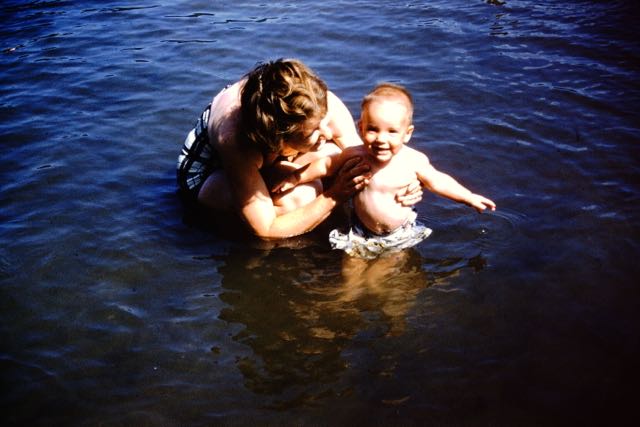
My parents made sure we all could swim — and I’m sure my love of the water began at a very early age.

Mom and Stewart
Mom and Stewart
Mom and Stewart, Donabeth, and Peter
Mom with Stewart, Donabeth, and Peter
The only picture I could find of me. What form!

I can remember being in the watch-me stage when I was about 5 at Mirror Lake at Fort Devens. My mom was sitting on the beach and I was in the shallow water, stretching my legs out behind and walking my hands along the bottom.

“Look, Mom! I’m swimming,” I called, but I’m sure I didn’t fool her for a moment.

I remember playing and playing in the water — and I think that may be why I’m a big proponent for kids playing in the water. Kids can learn so much through play.

The thing is, though, water is never really safe. Kids drown in small amounts of water. Elite-level swimmer Fran Crippen drowned in an open water race. Being around water requires vigilance.

Bodies of water are like Aslan — not safe.

But good.

Each time a swimmer slides into the water, he or she is baptized into a new way of moving and breathing.

I think that’s why I love it.

That’s why I go to the POOL.

A to Z Blogging Challenge · Faith · family

Community

John 5 begins with the story of Jesus at the Bethesda pool where lay “a multitude of invalids.” The belief was that after an angel troubled the waters, the first one in was healed. Jesus spoke with a man who had been there for thirty-eight years.

“Do you want to be healed?” Jesus asked him.

“Sir, I have no one,” the man replied. No one to put him into the pool when the water is stirred. A multitude of invalids, but each concerned for himself.

To have no one.

In contrast —

C is for Community.

My father and mother enjoyed traveling after my father retired, but as my mother’s dementia grew worse, traveling became more difficult.  One night in New York City, my father awoke to hear the heavy hotel door click shut and realized that my mother was no longer in the room. He found her in the hallway. Another time she got away from him at the airport, and still another time she wandered off in Greece.

On that trip to Greece, their last big trip, the other ladies in the tour group saw the need and began watching out for my mother. What began as a group of strangers ended as a caring group.

My mother and father on their trip to Greece
Strangers at the start, friends by the end

“Without a sense of caring, there can be no sense of community.”  Anthony J. D’Angelo

Community doesn’t have to be intimate to be functional.  Even a small thing, like holding the door open for someone struggling with mobility, can be an act of community. It says, “I am willing to help you, even if it inconveniences me a little.”

Sometimes community is very intimate. I was horrified to see that my mother had had an incidence with incontinence while visiting an old friend of my father. “Oh! I’m so sorry!” I had said when my mother stood to go. “Let me get something to clean that!”

“No, no,” the woman had said. “Your job is to take care of your parents. I can clean this up.”

Community.

Looking out for one another.

Circling the wagons in Greece, in Florida, in Cooperstown.

We can be community to those we encounter. We just need to be willing.


Faith · prayer

Resurrection Branches

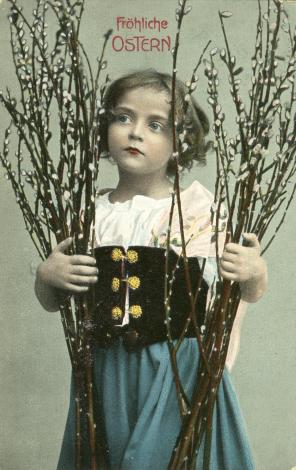
OsterpostkarteI was delighted to learn that the pussywillow is waved on Palm Sunday in many Eastern and Slavic churches.

“The Pussy Willow is also our Easter symbol,” said Father Czeslaw Krysa, rector of St. Casimir’s Church in Buffalo, in a 2013 article. He said that it is “one of the most prominent Easter symbols, because of the fact out of this dry, kind of twig all of a sudden bursts forth this beautiful flower of life, and it is the first bush that blooms.”

They call them “resurrection branches.”

Reading about them reminded me of a poem/prayer that I wrote back in January.

Oh Lord
I need a pick-me-up
For I am feeling down
Outside the snow is glittering, cold,
Inside my heart is brown
And dry and brittle, mostly dead,
Like last month’s Christmas tree
Weeping prickly needles
Which need be swept by me

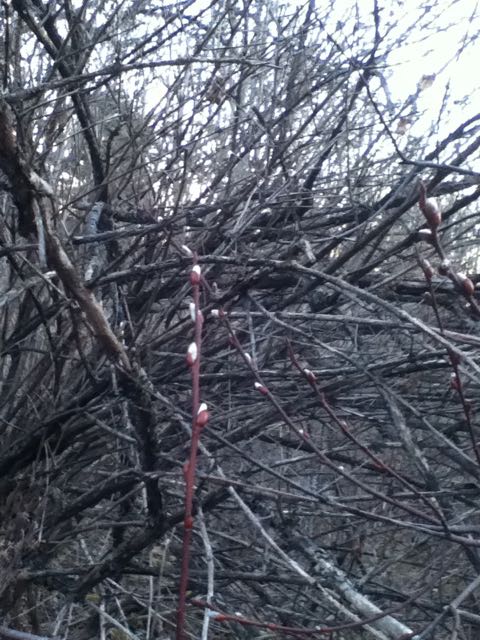
IMG_8480I know You can’t restore the tree
To vibrant verdant green
— Well, yes, You could
And yes, You did
When Aaron’s rod was seen
Budding,
Blossoming,
Bearing fruit
— Can You do that with me?
Of course, You can —
but would You, Lord?
Miraculously use me?

For, Lord, You know I have this fear
I’m one of the eleven
Sticks that stayed quite dead and brown
Not bearing fruit for heaven

I fear I too am dead inside —
Like Lazarus, I stink —
Roll back the stone –
Call out my name –
Pull me from this brink

Of hopelessness
Of deadfulness —
I need to be made new
Please water me
Sunshine me
And let me grow in You.

Today the rocks and stones and pussywillows are crying out “Hosanna!”

Faith · family

Isaiah 56: 3-8

“Here’s the thing,” says God.
“Don’t you go saying that you don’t belong to My family,
And don’t you go thinking that because you don’t ‘produce’ I’m going to throw you out.
I don’t work like that.
At all.
If you love Me
If you embrace activities and ideas that please Me
If you hold fast to the promises I have made to you
Then I will give to you something better than any fame, fortune, or power you might receive from the world for something you did
What I have to give you is better than a large family or even one successful child
What I have to give you is a name —
A name that will forever tie you to Me.”

“And if you think you don’t belong in My family,
let Me ask you this —
Do you love Me?
Do you serve Me?
Do you help others because you know Me?
Do you set aside time
when you aren’t working
and just think about Me?
Do you lay in a grassy field on a Sunday afternoon,
look up at my blue sky, and utter a simple thank-you?”

“My door is always open to you
because you are family.
Mi casa es su casa.”

“You are family.
You are welcomed with great joy
and big bear hugs
(even though you say you don’t like hugs).”

“Come.
Sit with Me in the quiet.
Whisper to Me.
I am always listening.”

“You may think that you’re an outcast,
but I am gathering you in My arms
and holding you close.”