dementia · family

Old Photographs

One of my kids told me, “I pulled some pictures out of the garbage by Grampa’s chair yesterday.”

“What?!” I said.

I knew my father had been going through old photographs. It’s something he enjoys. He’ll sit there for hours sifting through and resifting.

“Hey! Have I ever shown you this one?” he’ll ask as I walk past.

I’ll pause and squint to see the glossy black-and-white snapshot in his hand. “This is the house I used to live in,” he’ll explain, and sometimes launch into a story of how his cousin lived right next door and that there was a path worn through the trees, or how he and his father hid time capsules under the floorboards or in the walls.

“This is my father,” he’ll say. “He was a pretty handsome fellow, don’t you think?”

“Here’s one of my old girlfriends,” he’ll say, and my stomach gets a little squeezy because I don’t want him thinking about old girlfriends even though I know that’s silly.

As my son was telling me about the photographs that had been in wastebasket, he looked in. “Here they are again,” he said, and he pulled several out.

I was upset and a little bewildered. Why was my father discarding these old photographs?

“I think it was just an accident,” my son said, reading the unhappy look on my face.

No, the first time could have been an accident, but twice in two days seems pretty intentional.

I’ve heard my father say, in very general terms, “I don’t know who’s going to want all this stuff.”

“What are you wondering about?” I’ll ask.

“That Johnny Damon statue,” is a common reply. He went through a period convinced that we needed to take Johnny Damon to the Baseball Hall of Fame. Surely they would want it. 

I’m not so sure.

Maybe he was thinking that no one would want these old photographs.

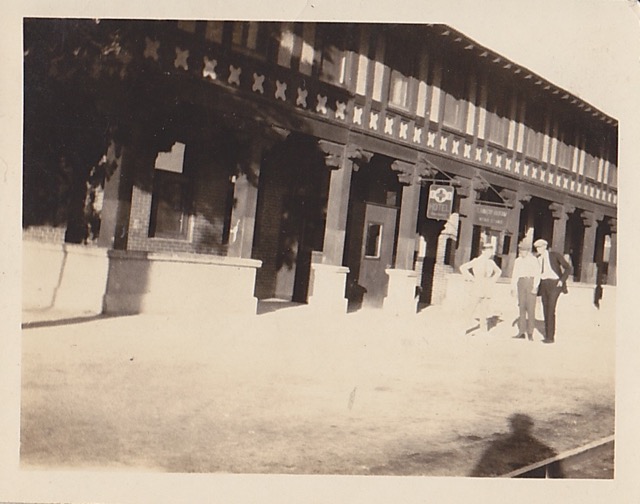
I looked at the most recent batch pulled from the garbage. They were all taken in Seligman, Arizona, in 1924.

The story goes that my grandfather and some friends had driven a car across the country in 1924, stopping in towns along the way to sell advertising on the side of the car and work for a short stint to earn money for the next leg of the journey.

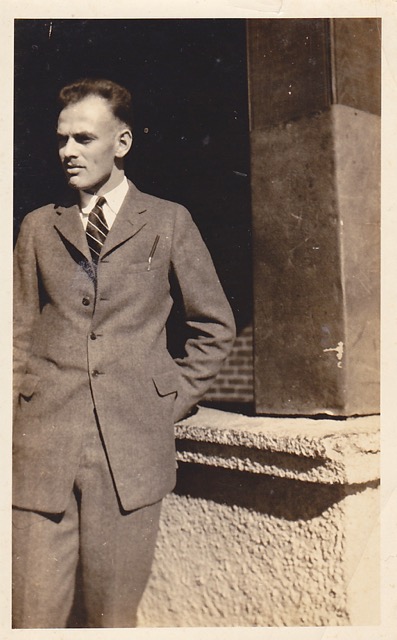
Here’s my grandfather.  He is a handsome fellow.

This is the Harvey House where I think they stayed. I know that because my grandfather was very good about writing words on the backs of photographs to identify the picture.
Except he didn’t identify this one but I think it’s him and his friend and the car and a roadside picnic.

I’ll have to ask my uncle or my aunt.

My father’s memory is dwindling.

And his thinking is muddy.

Otherwise, I doubt he would have thrown out the pictures.

In any event, they’re safe now.

dementia

It’s like I never made a sound

I was scribbling times and notes to myself on my meet program when I heard two boys talking behind me. Despite the loudness of the pool area — the splash of water, coaches yelling, parents cheering — their conversation caught my attention.

“You know, the water isn’t wet until you touch it,” said one.

“What are you talking about?” asked the other.

“The water isn’t wet until you touch it,” the first boy repeated.

“It’s always wet,” said the second boy.

“Nope, not until you touch it,” said the young metaphysicist.

I quickly wrote the quote into my program so I would remember it.

That conversation reminded me of a Dear Evan Hansen song which then ran through my head for the rest of the day. The song, Waving Through a Window, had nothing to do with water or wetness, but had everything to do with metaphysics of perception, but on a deeper level.

Evan Hansen had taken the classic question — if a tree falls in the forest and no one is around to hear it, does it make a sound? — and morphed into a question of something more.  The original question really is: can something exist without being perceived? That’s exactly what my young swimmers were discussing. Is water wet if no one touches it?

The question Evan Hansen asked was: when you’re falling in a forest and there’s nobody around, do you ever really crash or even make a sound?

The whole song is sad, about being on the outside looking in and never really feeling like you belong.

It’s about the pain and insecurity of being vulnerable, and so choosing not to participate in society.

It’s about isolation.

Sometimes I think about the hidden-ness of what I do. Nobody sees the dishes, the laundry, the putting away of books and papers that will be gotten out again tomorrow by a man who doesn’t remember. Nobody sees the toilet cleaning or the sheet washing or the cleaning of unmentionables in unmentionable places.

People see me at the store. They ask how my father is doing, and I hesitate in my answer. He mixes up the Jumbles and puts wrong answers in the crossword. He makes comments that make me blush, or make me upset, but ultimately remind me that he grew up in a different era. He needs help finding things — his wallet, his hearing aids, his pens — and I help him.

But when someone asks how he’s doing, all those things run through my mind and I say none of them.

Yesterday a woman placed her hand on my arm while I hesitated. “I know,” she said. “I know.”

And I knew that she knew.

If you are a caregiver and never tell people all the things you do, it doesn’t mean you don’t do them.

Like the tree crashing in the forest, people who have heard that sound know that it exists. Other caregivers know what goes on in the home.

I believe that water is wet even before I touch it, and that trees make a sound when they fall, and that when people struggle, even if nobody sees them, the struggle is still real.

That thought is a comfort to me.

And reminds me to be kind.


Taking a page from Osyth‘s playbook — I used  a line from the song for my post title.


dementia · family

Roots

I need to apologize to Osyth. A few weeks ago in her blog, Half-Baked in Paradise, she wrote about moving. Something about her words broke my heart. Maybe it was this:

My heart felt the leaden weight of sorrow because my safe-place, my home, my warm hug, my protective cloak, call it what you will has gone.

When she posted again, I didn’t even go read it. I couldn’t — I was still grieving over her move. Then she posted again, and I read it. In fact, she started re-blogging a series about her home, and the renovations there, and I binged. She’s posting day by day. Like a glutton, I looked the whole series up and read it, laughing — actually revelling with her — at the great adventure she has been on for some time. (Start here: Coup de Coeur: Part One)

Sorry, Osyth, for not waiting for you to repost them all. I’m just the kind of person who likes to read the end of the book before I read the middle.

Home is something so dear to me. One of my many started-and-discarded blogs had the tagline, “I love where I live.”  And I do. I love upstate New York.  I love Cooperstown. I love the four seasons, the Susquehanna River, Otsego Lake, the trees, the village streets, the country roads, the people, the cows, even the tourists. This is my home — and the thought of living elsewhere is almost unthinkable.

My father keeps asking me what brought me to Cooperstown.

“What do you mean?” I ask him.

“What made you come here?” he’ll say, as if that clarifies anything.

“Are you asking about why I first moved to Cooperstown?”

“Yes,” he replies.

“We moved here as a family in 1967,” I say. “You took a job at Bassett Hospital as the head of their General Services department.”

“Yes, that’s right,” he replies, every time, remembering, or acknowledging the plausibility of this story.

“I was a child,” I remind him, “your child. I didn’t have a choice.”

“Where did Bud come from?” my father asks, trying to piece together my family.

We’ve gone through this many times now. I know the questions that are coming, but it’s sad because he has lost a large chunk of my life.

“I took a year off from college and met Bud while I was working at Bassett,” I say.

He nods, but I’m not sure he remembers anything about this.

Long pauses punctuate our conversation.

“Where did you come from?” This question often comes next. It’s another one that needs clarification. I’m sure he’s not asking about the birds and the bees, so I name the army base where I was born.

“How long did you live there?”

My mom and the children she moved with all by herself

“Six weeks,” I tell him. “When I was a baby, Mom loaded me, Stewart, Donabeth, and Peter into a station wagon to join you in Fort Riley.”

Yes, I was 6 weeks old. My oldest brother was 5 years old, my sister not quite 4, and my middle brother only 21 months old. Whenever I asked my mother about my birth and first year of life, all she would say to me was, “That was a hard time.” I’ll bet it was. The legend of a super mom.

“I don’t remember any of that,” my father says, and, of course, he wouldn’t because he was busy working at his fledgling career as an army doctor.

Another long pause. I begin to focus on whatever it was I had been doing before this conversation began.

“So what made you come here?” my father will ask, and we’ll start the whole thing again.

“You did, Dad,” I tell him. “You did.”

Alzheimer's · dementia

Self-diagnosis

My father was reading Time magazine the other day.

“Can you read the date of this?” he asked me when I came in the room.

I squinted and read, “July 17, 2000.”

“So it’s current,” he said.

“No, Dad,” I told him. “This is 2017.”

“Well, it’s pretty current,” he said, “you know — it’s in our lifetime.”

I shook my head, not sure how to respond to that. The world has changed so much.

When that issue of Time came out, airplanes hadn’t flown into buildings. Airport security wasn’t a thing. Donald Trump wouldn’t be firing would-be apprentices for 3 1/2 more years and I doubt anyone would have imagined him becoming our 45th president. The first iPhone wouldn’t be released for 7 more years.

2000 was a lifetime ago. We had just gotten over the worries of Y2K. Mary was baby and Laurel not even imagined.

“So it’s current,” he said again.

“It’s in our lifetime,” I conceded, and went back to what I had been doing.

Later, he found me in the kitchen where I was prepping dinner. He was still holding that old issue of Time magazine.

“This is fascinating,” he said. “I’m reading an article about Alzheimer’s.”

It was, in fact, the cover story for the issue.

“I think I may have Alzheimer’s,” he said. He looked at me and paused before asking, “Do you think I have it?”

I stopped shredding cheese and turned to face him. “Well,” I said slowly, “you do have trouble remembering things.”

“That’s right,” he said. “I feel like my brain is squashed.”

That’s a description he has used a number of times. Rotten fruit and roadkill always come to mind when he says it – not a pleasant picture.

I looked at the cover of the magazine which compared the brain of an Alzheimer’s sufferer with a normal brain. His description may be more right than he knows.

I didn’t know what to say to him. Silence settled over us as we both stood in the kitchen.

He leaned on his walker, and finally said, “It was interesting to read.”

Interesting. Not sad. Not heart-wrenching. Not hand-wringing. Just interesting.

A dispassionate diagnosis.

And life goes on.

Every night I hear him whistling as he gets ready for bed. Sometimes he even sings.

O Danny boy —
The pipes, the pipes are calling.
From glen to glen and down the mountain side.
The summer’s gone, and all the roses falling,
It’s you, it’s you must go and I must bide.

It’s such a sad song. My heart aches a little.

But he seems so happy. I can’t ask for more.


dementia · elderly · family

Barefoot Girl

“Oh, I see you’re a barefoot girl this morning,” my father said, looking at my feet.

I was indeed barefoot, as is often the case when I’m still in my pajamas.

“A barefoot girl with shoes on,” he continued, smiling as he said it.

My daughters are often barefoot in the summer — and he says the same thing to them.

A barefoot girl

“What’s he talking about?” one of them asked once.

“It’s a poem he memorized,” I told them.

I asked him about it — and he dutifully recited two verses:

‘Twas midnight on the ocean,
Not a streetcar was in sight,
The sun was shining brightly
For it had rained all night.

‘Twas a summer’s day in winter
The rain was snowing fast,
As a barefoot girl with shoes on,
Stood sitting on the grass.

More verses are available on the internet, all unattributed, but those are the two he remembers.

Poetry and music get stored in a different part of the brain, I think — one that survives longer unscathed by dementia. It’s fascinating to think about.

Yesterday, he said something about Laurel going to the skating rink when I was taking her to the pool. He pulls up the wrong word often.

I also had a tough time convincing him that R2D2 wasn’t a radar unit. He was working on a crossword puzzle. R2D2 was the clue and he needed a 5-letter word beginning with R.

“R2D2 is a robot, Dad,” I told him.

“Why doesn’t radar work?” he asked, in all seriousness.

“Because it’s a robot. Robot will work there,” I said.

He made his if-you-say-so face and went back to the crossword.

Maybe if I made up a poem about it and had him memorize it, he would remember.

dementia

Lost in the Hospital

Today I lost my father.

No — it’s not what you think. I misplaced him, or he misplaced himself.

It felt a little odd to tell people, “Umm… I can’t find my father.”

He had a doctor’s appointment this morning, so I dropped him at the hospital door and went to park the car.

Every single other time that I have done this it has worked. He slowly makes his way to the registration, answers the questions about black lung benefits and whether he has traveled outside the country in the past three weeks — and somewhere in the midst of this I catch up with him and shepherd him to the appropriate clinic.

This morning, however, I had trouble finding a parking spot. By the time I got inside, he was nowhere to be seen.

I ran up the stairs to the second floor where the Prime Care clinic was. He wasn’t in the waiting room.

I ran back down the stairs to registration. “I lost my father,” I told the woman at an open registration desk. “Can you verify for me whether he checked in or not?”

After answering a few questions, she confirmed that he had registered for an appointment in Prime Care.

Up the stairs again — but he still wasn’t in the waiting room. I went to the reception desk there. “I lost my father,” I told the woman who helped me. “Can you call back and see if he has already gone back into an exam room?”

“Oh,” she said, “did you want to go back with him?”

“I need to be back with him,” I told her. “He’s 87 and has some dementia.”

She called the nurses’ desk immediately and then said to me, “No, he’s not back there.”

I ran to the third floor. He goes there for cardiology appointments. Maybe he was confused about what clinic to go to. But nope.

I ran to the first floor. Maybe he went to surgical clinic. We’ve gone there a few times recently. No sign of him, though.

I ran back up to the second floor. I was getting my stair workout in early. There was still no sign of my father.

My last idea was for them to page him over the loudspeaker in the hospital, but, to be totally honest, I wondered if he would even hear it. And where would I ask him to be directed to? I was running out of ideas. But I approached the reception desk anyway.

“I still can’t find my father,” I said.

She looked at me sympathetically. “Do you want me to try to put an announcement on the PA?”

I sighed, and looked around hopelessly.

Just then, who should come shuffling along with his walker? My father.

“I went up and down on that elevator,” he said. “It’s a terrible thing to not know where you are.”

Yes, I thought, it was a terrible to not know where you were.

dementia · family

Helpful Words

A foggy morning (that has nothing to do with the post)

“It happens to all of us, you know,” someone said to me when I was talking about my father’s latest foggy episode.

Yesterday morning, when my father was studying his watch, I asked him what time he had.

“Hmmm,” he said, studying the hands and the numbers, “it looks like it’s two minutes past… past… I think it’s two minutes past Tuesday.”

I texted my sister. “I have the title for the book about Dad and dementia — Two Minutes Past Tuesday.”

Funny — but so not funny. Not even remotely funny the more I think about it.

Later in the day he had essentially forgotten my oldest brother, or, at the very least, key elements of Stewart’s life.

“It happens to all of us,” this person said to me, when I told about the things my father had said. “It’ll happen to you. It’ll happen to me. It happens.”

Such a glib response made me wonder if I talk too much about my father and his struggles. I try not to.

The other day when two of my children had a discussion that devolved into nastiness, I said, “Let’s try this again. First she said this (fill in the blank), and then you responded with this (fill in the blank) — but what could have been a better response?”

We talked through possible responses that could have diffused rather than ignited the situation.

It probably won’t work. The next time, they may get after each other again, but maybe a seed has been planted. A seed with a better fruit.

Last night as I lay in bed thinking about the unhelpful response thrown my way, I wondered what I really was looking for in sharing the story of my Dad’s poor thinking. What would have been a better response?

Nobody can really fix the situation. It is what it is.

But here are a few things that may have sounded better.

My sister’s response — “Oh my.” Two words show that she feels the same dismay that I do.

“I’m sorry.” It can be a pat response, but it can also be very sincere. It shows compassion and sympathy.

“That must be so hard.” Yes, yes, it is. I appreciate when people acknowledge that.

“Is there anything I can do?” Yes, there is. You can visit him. Don’t worry about whether he’ll remember your name or not — because the visit isn’t about you. Don’t worry if there are long periods of silence while he searches for words, or if he loses his train of thought altogether. He loves having people sit with him, talk with him, and listen to the same stories (or story fragments). Don’t feel that it’s a waste of time because he may not remember. For that hour that you’re there, he’s loving it. I’m loving it, too, because he’s being fed mentally by the presence of another person.

“How are you doing?” Some days I’m not doing terribly well with all this. Thanks for asking.

dementia · photography

Fog

Yesterday my father kept commenting on the fog.

“I can’t believe how foggy it is out there,” he said every time he looked out the window.

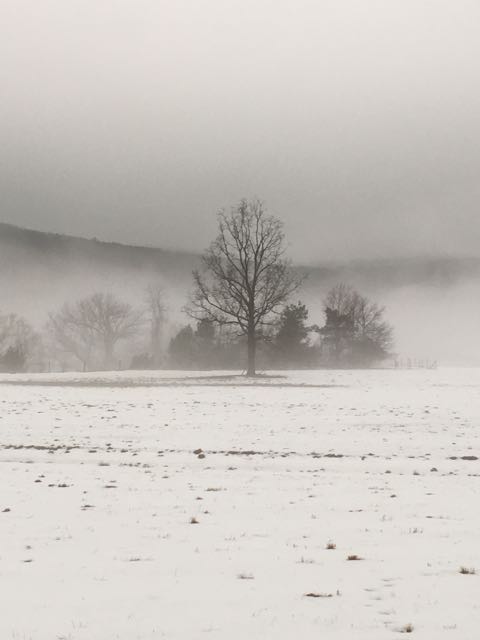
The dense fog lingered all day. When I went for my evening walk, a heavy mist still rested on the fields.

My father had been bemoaning it. “It sure would be nice to see some blue skies,” he said.

But I thought the fog was lovely.

I could still see the farm buildings.

I knew the river lay beyond the trees because I know this land. I’ve walked this road a thousand times.

The road I’m walking with my father is newer territory, though.

Even though my mother had dementia, my father was her main care-provider. When he made the decision for her to go to the nursing home, we all knew it was the right thing to do. The nursing home was well-staffed, and we knew she would receive good care. I helped, but I wasn’t the main care-provider.

Now I am. I marvel at the job my father did. Often, though, I don’t feel equal to the task. I wonder about the cost to my family.

On my foggy walk last night, I stopped and looked at one tree for a long time.

It was so lovely against the backdrop of fog. Strong and independent.

Maybe as I walk this road with my father I need to look for those beautiful places.

We may not have blue skies, but there’s such beauty in the fog.

dementia · elderly

In the Parking Lot

I never know what I’m going to see in the parking lot at the local grocery store.

In the village of Cooperstown, there is one — yes, only one — grocery store.

I go there often. My father’s refrigerator is small, and we go through perishables fairly quickly. I started keeping a chart of how often I go to the grocery because I felt like I was going every day. It turns out that out of 50 days, I only went 36 times.

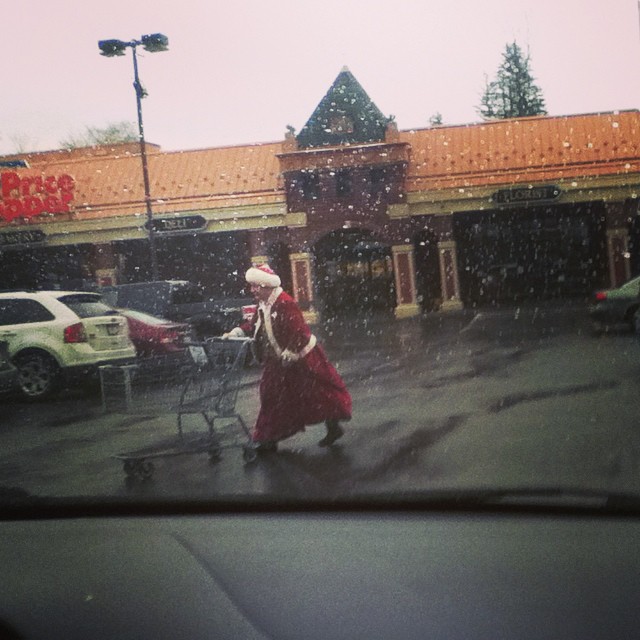
I never know what I’m going to see there. Once, I saw Mrs. Claus pushing a shopping cart up the parking lot hill to her car.

Yesterday, I stood behind an elderly man at the check-out. He paid for his groceries and handed his change back to the cashier.

“I think I owe you this,” he said. She shook her head in protest and smiled at him.

As he headed for the door, he turned and said to her, “See you tomorrow.”

Another person who goes to the store nearly every day.

As soon as he was out of sight, she put the loose change he had just given her into the container at the checkout for the this month’s charity — I think it’s Muscular Dystrophy.

“I tell my boyfriend that I have a sugar-daddy,” she said to me. “He gives me quarters every day.”

We both laughed, and she told me how he comes in every day and goes through her line.

“Once he brought me a poem,” she said. “It was strange and I didn’t understand it.”

Poetry can be like that.

I thought about my father and the way he focuses on young women who smile and are friendly. With him, I get irritated about the whole thing. It’s a fixation that bothers me, but I know that it shouldn’t.

The man at the grocery store didn’t bother me in the least. I could see how lonely he was. And old. And slightly confused.

I paid for my groceries and headed out to the parking lot. The man was standing in the middle of it, a look of consternation on his face.

“I can’t find my car,” he said, and I could hear the panic in his voice.

“What kind of car do you have?” I asked him.

“It’s a blue Ford, but I can’t find it anywhere,” he said, one hand on his cart, the other fumbling with his keys.

“Well, let’s see,” I said, and I began to look around.

With minimal effort, I found a blue Taurus and pointed to it. “Is that your car?” I asked.

A huge smile broke out on his face. “Yes! Yes, that’s it,” he said. “Thank you so much.”

I watched him push his little cart to the car and was grateful I could help.

As I drove home, I hoped he could remember where he left his house.

I’ll have to ask the cashier about it when I see her today.

dementia · family

Remembering Birthdays

Threshold 085
At Laity Lodge

Three years ago for my birthday I was in the wilds of the Texas hill country, without cell coverage and with minimal wifi. Laity Lodge is great that way because it allows guests to make real connections.

But it was my birthday and I don’t think anyone there knew.

Not that it mattered, of course.

I called my husband on a land-line and talked with him and the kids. It was enough.

Stewart
Stewart

He told me that my brother Stewart had called and wanted me to call him back.

When I got home, I put off that call.

My brother died from a heart attack 11 days after my birthday.

When did I last hear his voice? I don’t know.

In my mind I can still hear him, though. I remember what my name sounded like when he said it. I remember his laugh.

Mom February 2015
Mom February 2015

My mother forgot my name altogether. I used to remind her.

“I’m Sally,” I would say, and she would repeat back, “That’s right. You’re Sally.”

I used to use photographs to help her remember the names of family members, naming each person as we touched them in the picture. She eventually couldn’t do that either.

I don’t remember the last time she said my name.

And I have more trouble remembering her voice — maybe because it turned dry and creaky. She didn’t sound the way I wanted to remember her.

This year for my birthday, I heard from all my children — most with a phone call or FaceTime. Mary, Laurel, Bud and I went to see La La Land and then went out to dinner. It was very nice.

My morning started with a birthday card in my coffee maker (from Laurel) and birthday stickers on the newspaper (from my brother).

I was curious to see what my father would say about the birthday stickers. I knew he wouldn’t remember my birthday without some sort of reminder.

“Oh! I see we have stickers on the newspaper this morning,” he said as he sat down at the kitchen table.

He peered at them closely.  “It says, ‘Happy Birthday,'” he read. “I don’t think it’s my birthday though.”

“No, Dad,” I answered, giving him his pills and his juice. “It’s my birthday.”

“Oh,” he said. “I guess that makes sense.”

IMG_9693And that was it.

No birthday wishes.

It wasn’t a slur against me. It doesn’t really matter.

But it did.

It does.

Because it means I’ve lost another little piece of him.

We lost my mother in dribs and drabs, an expression she used to use.

Now we’re losing my father the same way.

It’s almost certain that next year he won’t remember my birthday either. Dementia tends to only go in one direction.

I just hope he still remembers my name.