Life · people

Bruce

Seven years ago Bruce sat next to me on a flight out of Nashville. We both changed planes in Detroit and there I frantically wrote down as much of our conversation as I could remember. His heavy southern drawl forced me to listen to him carefully so I could mentally translate what he was saying as he spoke.

I remembered him, but my notes from that day sat unread — until this week when I pulled that notebook off the shelf while shelving last year’s journals. I leafed through and stopped on the page where I had written the heading “Bruce – Flight from Nashville to Detroit”. His story, even his voice, flooded back.

We had done the perfunctory small talk while waiting for take off. He told me he worked in aircraft manufacturing. I told him that I was a mother eight. I stared out the window at the other airplanes on the runway.

“I got me a Cessna,” he said, nodding toward a small plane that was in view. “One time I flew it out of Atlanta. That thang was like a wasp among eagles.”

I liked the imagery and smiled at it. Our plane took off. It’s my favorite moment of every flight — wheels leaving pavement.

“Lemme show you somethin’,” he said, pulling his wallet out of his pocket. He flipped through the pictures and stopped at a well-worn picture of a smiling little boy. “That’s my boy,” he said proudly.

“Very nice,” I said.

He tapped on the photograph. “17 years ago someone ran a red light and hit our car. He was six years old. Died instantly.”

“I’m so sorry,” I murmured, but it felt inadequate.

He flipped to another picture, that of a pretty young woman. “That’s my daughter. She’s a bad ‘un.”

“I’m so sorry,” I said again.  I didn’t ask for details and I couldn’t help thinking that 17 years before, she had been a little girl who lost her brother. Life is hard and sad — and we rarely know the other person’s story.

Bruce chatted with people across the aisle and in front of us. He was traveling with several people from his work.

He turned back to me. “You know, I just got done cancer treatments. Thyroid cancer. If I hadn’t taken this new job, probably wouldn’t have found it for a while. They found it on my pre-employment physical — and they still gave me the job.”

“That’s pretty amazing,” I said.

“My father died of lung cancer, you know. So the cancer — it’s kinda scary.”

Talking about his father led him to talking about him growing up. “We was dumb-ass poor growin’ up. Used to go haying with no driver in the pick-up.”

I used to help with haying here in New York, but it was purely for the fun of helping the neighboring dairy farmer. I loved riding in the hay wagon, but someone was always driving the tractor. I tried to picture haying with no driver.
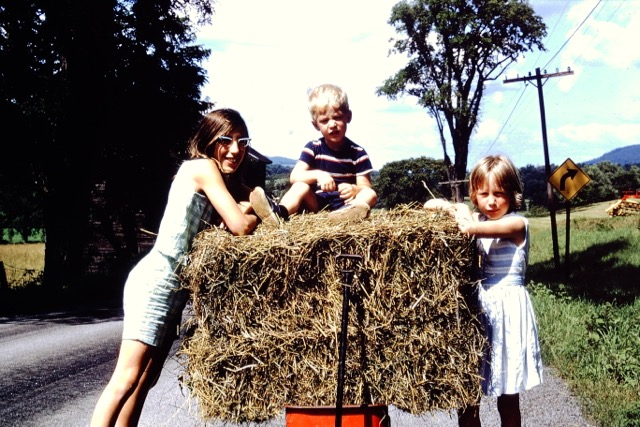
Taking a few hay bales home. I’m the tough cookie on the right.

“You know what the Mason-Dixon line is?” he asked. I was worried that he was testing my knowledge as a northerner.

“Didn’t it divide the slave states from the free states?” I asked.

“Nah,” he said. “It’s the line that separates y’all and you guys.”

He laughed like he had just told a good joke. I laughed because I hadn’t expected a linguistics lesson from this burly southerner.

“You like sweet tea?” he asked, but he said it “swait tay.”

“I’m not much of a tea drinker,” I confessed.

“Northerners don’t hardly know how to make sweet tea. I once had a waitress tell me that I could just add sugar to my tea, like she didn’t understand that the sugar gits cooked right in with the tea.”

Frankly, I didn’t know that either.

In Detroit, I wrote it all down — about his son and his daughter and his cancer and his poverty and sweet tea. I tried to write the phrases exactly as I had heard him say them. Our flight had been less than two hours but he had shared so much with me.

I once heard Christian singer Jason Gray tell a story about a mentor that he had. Jason respected his mentor and wanted to be like him.  Jason asked him, “How did you become you?” His answer: pain.

The hardships in our life shape us but they don’t define us. Bruce had known deep sorrow and in our brief encounter had shared some of the difficult times he had known, but he also knew how to embrace life.

I’m thankful I got to sit next to him for that flight and listen to his story.


Sabbath

Sabbatical

Walter Brueggemann, in his book “Sabbath as Resistance”, referred to the idea of “seven”-ing our lives. “People who keep Sabbath live all seven days differently,” he said.

I decided that 2018 will be my Sabbath year.

Each week, I hope to reclaim the Sabbath by turning off my phone and computer. Imagine 24 hours every week without the tyranny of the urgent!

I mentioned this to my co-early-morning lifeguard this morning and her reply was a little off-putting. She said nothing, as in not a word. I babbled on for a little longer about taking a break from devices. Still nothing — from a usually good conversationalist. Either this is the dumbest idea in my history of dumb ideas, or I struck a nerve, or she just didn’t “get” it, or it was some sort of weird allergic response. Note to self: don’t discuss device abstinence at 5:30 in the morning.

Even the computer games, which I have so often rationalized as a way to relax, will go.

St. Francis de Sales said,

For if we spend too much time in a game, it is no longer recreation, but occupation: we refresh neither our minds nor our bodies, but on the contrary, we depress and weary them.

St. Francis penned that 400 years ago, never imagining this world of handheld devices that entertain. Once a week, those games won’t even be an option for me. I will power down.

Brueggemann spoke also about the Sabbath year — “Every seven years [is] an enactment of the sabbatic principle.” Basically, this means spending the whole year living generously.

In the Biblical Sabbath year, the land lay fallow. (Fallow means “usually cultivated land that is allowed to lie idle during the growing season” Merriam-Webster) I tried to think what I could leave fallow.

And I settled here. This blog. My story.

This blog began as a place to write about my mother and my father, and caregiving, and the struggles of life in a large family. I wrote the story that I know best — my story.

For one year, I’ll set my story aside and (try to) tell other people’s stories.

Sort of like Humans of New York, on a much lesser scale. And not as good. And without photographs.

Of course, I’m in the story because I’m the narrator, but I hope to minimize me. It may be a skill that I’ll hone as the year goes on.

I’m starting with a man named Bruce. I listened to his story on a flight from Nashville to Detroit 7 years ago — and I still think about it.

Life

Augur’s Bookstore

Below is a semi-updated post from January 1, 2014:

davidsons_large1New Year’s Day is like the back room at the old Augur’s Bookstore

In Cooperstown, on the corner of Pioneer and Main, is a bookstore.  Well, it used to be a bookstore.  They still sell books there, but now they also sell  jewelry.  And toys.  And children’s clothes. (see update below for its current usage)

In the old days, it used to be a bookstore that also sold office supplies.

In the left-hand back corner of the store was a display case full of fine writing instruments.  Not 99¢ Bic pens, but Cross pens that were gold or silver, and fountain pens with ink cartridges.  I even think there were bottles of black India ink and blotters.

On the top of that glass case was a display Flair pens of every color imaginable.  I loved to try new colors.

To the left of the back left hand corner, tucked away where it was easy to miss, was a door that led to my favorite room in the whole store.  It might have been my favorite room on all of Main Street Cooperstown.  It was quiet and smelled like paper.

Often there was a man working back there at desk.  He sat with ledger books and an adding machine.  A glance at me over the top of his half-eyes told me that he knew I was there;  then, he would set back to work.

And I would begin my perusal.

Poster-board of many shapes and sizes stood in a rack as I entered.  I never cared much about poster-board.

Blank notebooks were neatly stacked and arranged on a shelf along the whole right-hand wall.  Nice paper, onion skin and bonded paper of varying weights, filled boxes and shelves.  Ledger books stood in one stack, and receipt books made up another.

It was a room of possibility.  Everything was blank, just waiting.  Waiting to be filled with all sorts of words or numbers or pictures.

I miss it.  Because Augur’s now has become more.  More stuff.  Less potential. It’s funny how that works.

But New Year’s Day — it’s like that back room.

Today, I can run my hands over the blank pages of the new year.

And imagine.


2018 update — now the store is called The Beverage Exchange. I went in there for the first time a few days before Christmas to buy a bottle of bourbon that one of my children wanted to give as a gift. Two things I never imagined — that Augur’s would one day become a glorified liquor store, and that I would ever be purchasing bourbon.

I asked to peek in the back room when I was there. I could see the open door and couldn’t resist.

“Sure,” said the store clerk. “That’s where things happen.”

It was part storage, part kitchen. In the evenings, The Beverage Exchange is a cocktail lounge — at least, that’s what the clerk said. A utility sink replaced the man at the desk. Boxes of who-knows-what replaced the countertop stacked with empty notebooks.

It was progress, I suppose.

But I felt sad.

Last year Owen had me for our gift exchange.  Funny how that worked — last year he had me, this year I had him.

Part of his gift to me was two unassuming blank journals.

I have a “thing” for blank journals and I think it can be traced back to Augur’s.

Over 2017, I not only filled the journals that Owen gave me, but I stockpiled a small arsenal of new blank journals.

2018 will be the Year of the Journal. I have so many plans for them.

So much possibility lies in those clean pages.

And in 2018.

Leaning In · Life

The Gift

’twas nine days before Christmas
and my throat was so sore
my muscles so achy
I couldn’t ignore

So I drove to a walk-in
and waited a bit
before being ushered to
a new place to sit

With my butt on blue vinyl
and my foot on the step
I told the provider
“I need a rapid-strep”

Looking over her glasses
she tried to assess
this hoarse bossy patient —
should she say yes?

“I’ve no time to be sick,”
I tried to explain.
“A script for penicillin
and I’ll be on my way.”

A swab of my throat
a twenty minute wait
a knock on the door
then came the update —

No strep.

Dang. It was not the news I was hoping for. Not that anyone hopes for strep throat, but it’s a known quantity and a relatively easy fix.

“I could check for flu,” she said, but I declined. I doubted it was flu. I had no fever and I wasn’t feeling that bad. Just a sore throat and achy joints.

But the sore throat got progressively worse. Over the next few days I couldn’t swallow without pain. My children watched while I grimaced to swallow the Advil that brought some level of relief but I had to take twice my normal dose and repeat it every 4 hours.

I stopped eating. Well, mostly. Yogurt slid down with minimal pain. If I cut the thing I wanted to eat into tiny bits and chewed them a gazillion times, I could swallow, but it would take a good half hour to eat a single piece of toast with peanut butter on it.

Christmas loomed on the horizon. I really didn’t have time to be sick.

“Just make it go away,” I prayed. Surely God understood how inconvenient this was. I longed to wake up in the morning and swallow painlessly. But it didn’t happen.

I made an appointment, this time to see a doctor.

“Do you have a primary care provider?” the scheduler asked.

“No, I haven’t for a few years,” I told her. The older I get, the less I like to go to the doctor.

“Would you like to see a male or female provider?” she asked.

“I really don’t care. Just put me in with the next available,” I said.

She set up an appointment for the Thursday before Christmas with a new female provider.

When I met Dr. Cerna, I immediately liked her. She was pleasant and thorough. She listened well. She respected my concerns. Then she gave my problem a name: Gastro-Esophageal Reflux Disease.  She drew a little picture of it for me on the back of a piece of paper.

“I’m not a very good artist,” she said apologetically, but I could recognize the esophagus, the stomach, and the duodenum. Then she added little arrows showing the direction things should be going and more little arrows that showed the direction things were going.

Finally, she sent me on my way with a follow-up appointment scheduled, information about Gastro-Esophageal Reflux Disease which included dos and don’ts, and a prescription.

So here I am, one week later, and I can swallow again. I can eat without pain. In fact, I feel pretty darn good.

AND — I’m ready for 2018 with some new eating guidelines.

  • Small meals.
  • Small bites.
  • Chew well
  • No rushed eating

I’m going to keep a food diary, to hold me accountable, and to see which foods affect me negatively.

Over Christmas, when I failed to eat properly, my body reminded me. GERD (Gastro-Esophageal Reflux Disease) feels almost like a gift, forcing me to slow down, allowing me to gain control over an area of my life that I have often felt is beyond my control.

Sometimes gifts come in the most unexpected packages and arrive in the most unexpected ways. The quick fix isn’t always the best thing. Good things don’t always feel cozy.

My “theme” for 2017 had been “Leaning In.” I didn’t post every day, one of the goals I set for myself — but I did pursue relationships and I tried to train myself to find the beauty in things.

So finishing the year with GERD felt like a final exam. Lean in. Embrace this thing. Find the beauty in it.

I can’t wait for 2018.


family

Zaengle Family Gift Exchange 2017

This is for Leah. She said she wanted to hear about our family gift exchange this year.

We do two gift exchanges within our family. Sam nicknamed them — Nifty and Thrifty.  The Nifty exchange is a “real” gift, with a spending limit of $50 (although we aren’t terribly strict about that). The Thrifty has a spending limit of $10 and can be something from a yard sale, thrift store, or something homemade (and we aren’t terribly strict about that one either).

We draw names about two months before Christmas and then commence with plotting, planning, and fretting. We’re a family of givers — and everyone wants to give the best gift.

This Christmas Eve, when the family was gathered — although some joined us from afar through the magic of FaceTime — I asked, “How do we begin this?”

Donna and Sam on the big screen

Someone started giving me the history of the whole thing. “I think we decided to draw names, like, five years ago when…”

But I interrupted. “No. How do we begin? Like, how do we begin the gift-giving?” I honestly couldn’t remember. I’m not sure anyone else could either, so we drew names out of a hat. And then, because my memory is poor, I’ve already forgotten who went first.

Helen was early on. I remember that. Philip handed her a huge box.

She sat in front of the camera so our Canadian family members would have a good view as she opened it.

“This is every little kid’s dream,” she said, “getting the giant box for Christmas.” It’s not every child’s dream to get a crockpot for Christmas, though. That would be a young adult’s dream — to come home to a delicious-smelling apartment with dinner ready to eat.

I had drawn Owen’s name for the big gift and gave him chickens. Not actual chickens then and there. I gave him a feeder, a waterer, and some other chicken paraphernalia. My father gave him a gift certificate for a place that sells chicks. I had debated between chickens and bees, seeking advice from knowledgeable friends, and the chickens won.

Laurel had drawn my name. She gave me spatulas — the one thing on my list — and then teamed up with Donna (who had drawn Bud) to give us a gift certificate for a nice restaurant in town so Bud and I can go on a date sometime. I really appreciated that. Bud and I don’t have enough time together.

You know your children are adults when some of the nifty gifts are bourbon. Others got clothes.  All in all, the big gifts are always an opportunity to purchase one nice thing for a family member.

My favorite, though, is the thrifty. It’s an opportunity for thoughtful creativity. Laurel made bath bombs. Mary made homemade oreos. Emily gave Mary her old ukulele.

Amanda had drawn my name. She gave me some maple candy from Mexico. Mexico, NY, that is. Upstate New York is delightfully confusing with towns named Cuba, Poland, Chili, and Mexico, not to mention Copenhagen, Rome, Amsterdam, and Warsaw.

I purchased a groupon for a photo book (to stay within the spending limit) and made a little photo book for Philip with poems to go with each photo.

Each poem tells a little story about young Philip. My hope is that he’ll read them to Henry.

Here’s the poem that I’m reading in the picture. The last line is what Philip said to me when I went to the hospital in labor for Owen:

Mommy had a baby growing in her belly.
Little Philip said to her, “I want you to tell me –
Where did the baby come from?
How did he get in there?
When will I get to meet him?
What will the baby wear?
Can the baby see me?
Can he peek out somehow?
Will you let me hold him?
Why can’t we see him now?”

So after months of questions
And Mommy growing rounder
One day she went to hospital
And Philip waxed profounder –
“I don’t know what to call this thing
That you’re about to do
But it has to do with baby,
and it has to do with you
And from everyone’s reaction,
it’s a GOOD thing, there’s no doubt.”
So he kissed Mommy and whispered,
“Have a good baby-coming-out.”

And that’s pretty much it. Any questions?

family · photography

Best of 2017

Every year is filled with ups and downs, unexpected trials and undeserved mercies.

My favorite time in 2017, was the week in May when my brother, my sister and her husband, and my husband and I all traveled with my father to tour Normandy and Paris. The picture is of Bud and me in the Eiffel Tower. Our time together is so limited. Having a whole week together was amazing.

My second favorite time was this, learning to shred cabbage the Bosnian way.

I love my home, but traveling sure was fun. I may have to do it again in 50 years.

Merry Christmas everyone. Looking forward to the adventures of 2018.

family

Carpet

“How long do you think the new carpet smell will last?” one of my co-workers asked.

I had to leave work early because the carpet guys were coming.

“I have no idea,” I replied. “Is that like the new car smell?”

My family replaces carpet every 45 years or so whether it needs it or not. This particular carpet had reached replacement age. It was the color of cat vomit, which, I suppose, was both a pro and a con. The new carpet, grey-ish brown, will hide dirt well, but probably not cat vomit. Oh, well. I guess you can’t have everything.

When my husband and I bought our first house, we immediately tore all the carpet out. Lovely hardwood floors were hiding beneath it and we wanted to enjoy them.  Bud hacked the carpet into manageable size chunks to roll up and put in the alley for the garbage man.  About halfway through the task, he noticed that the rolls were disappearing from the alley. Back in the house, he watched as our new neighbor on the other side of the alley went out to scavenge the latest roll. She was carpeting her garage with our discards.

The second house we purchased had green plush carpet throughout the second floor. When we first looked at the house, Bud said, “We can pull this up and replace it.” I agreed. Seventeen years later, when we moved out, it was still there.

The third house had mostly hardwood floors, but upstairs, in one bedroom, a previous owner had laid orange shag carpet. It was hideous. “This has got to go,” Bud said. I agreed. Eleven years later, it’s still there.

The carpet we replaced is at my father’s house. As we reclaimed this particular room — it had become the depository for so much stuff that there was no place to sit — everyone has enjoyed it, even my father. Maybe especially my father. Whenever we have a fire in the fireplace, he loves to sit back there and enjoy its beauty and warmth.

Yesterday he asked about going back there.

“They’re putting in new carpet,” I told him.

“Can we walk on it yet?” he asked after the installers left.

I had no idea. My experience with new carpet is pretty meager. Actually, it’s pretty non-existent.

This morning I vacuumed so we could move the furniture back in. Pay no attention to the shelf of books that fell down during the night.  Or the fact that I didn’t vacuum neat straight lines, something Bud liked to do with that old green plush carpet when we were showing the house. Just note the carpet that’s NOT the color of cat vomit and picture a crackling fire in the fireplace.

Ah — new carpet for Christmas.

It smells okay — but once we put our Christmas tree in there, it will smell like Christmas.

And then, hopefully, it will begin to smell like home.

dementia · family

Roots

I need to apologize to Osyth. A few weeks ago in her blog, Half-Baked in Paradise, she wrote about moving. Something about her words broke my heart. Maybe it was this:

My heart felt the leaden weight of sorrow because my safe-place, my home, my warm hug, my protective cloak, call it what you will has gone.

When she posted again, I didn’t even go read it. I couldn’t — I was still grieving over her move. Then she posted again, and I read it. In fact, she started re-blogging a series about her home, and the renovations there, and I binged. She’s posting day by day. Like a glutton, I looked the whole series up and read it, laughing — actually revelling with her — at the great adventure she has been on for some time. (Start here: Coup de Coeur: Part One)

Sorry, Osyth, for not waiting for you to repost them all. I’m just the kind of person who likes to read the end of the book before I read the middle.

Home is something so dear to me. One of my many started-and-discarded blogs had the tagline, “I love where I live.”  And I do. I love upstate New York.  I love Cooperstown. I love the four seasons, the Susquehanna River, Otsego Lake, the trees, the village streets, the country roads, the people, the cows, even the tourists. This is my home — and the thought of living elsewhere is almost unthinkable.

My father keeps asking me what brought me to Cooperstown.

“What do you mean?” I ask him.

“What made you come here?” he’ll say, as if that clarifies anything.

“Are you asking about why I first moved to Cooperstown?”

“Yes,” he replies.

“We moved here as a family in 1967,” I say. “You took a job at Bassett Hospital as the head of their General Services department.”

“Yes, that’s right,” he replies, every time, remembering, or acknowledging the plausibility of this story.

“I was a child,” I remind him, “your child. I didn’t have a choice.”

“Where did Bud come from?” my father asks, trying to piece together my family.

We’ve gone through this many times now. I know the questions that are coming, but it’s sad because he has lost a large chunk of my life.

“I took a year off from college and met Bud while I was working at Bassett,” I say.

He nods, but I’m not sure he remembers anything about this.

Long pauses punctuate our conversation.

“Where did you come from?” This question often comes next. It’s another one that needs clarification. I’m sure he’s not asking about the birds and the bees, so I name the army base where I was born.

“How long did you live there?”

My mom and the children she moved with all by herself

“Six weeks,” I tell him. “When I was a baby, Mom loaded me, Stewart, Donabeth, and Peter into a station wagon to join you in Fort Riley.”

Yes, I was 6 weeks old. My oldest brother was 5 years old, my sister not quite 4, and my middle brother only 21 months old. Whenever I asked my mother about my birth and first year of life, all she would say to me was, “That was a hard time.” I’ll bet it was. The legend of a super mom.

“I don’t remember any of that,” my father says, and, of course, he wouldn’t because he was busy working at his fledgling career as an army doctor.

Another long pause. I begin to focus on whatever it was I had been doing before this conversation began.

“So what made you come here?” my father will ask, and we’ll start the whole thing again.

“You did, Dad,” I tell him. “You did.”

Coaching swimming · Life

Coaching Imogene Herdman

Yesterday I made a girl cry.

The head coach told me, “You did the right thing.”

When I told the story to one of my sons, he said the same thing. “That was the right decision,” he said.

Still, I went to sleep thinking about her and woke up thinking about her.

Basically, I’m coaching Imogene Herdman. If you’ve never read The Best Christmas Pageant Ever. The opening line in the book is, “The Herdmans were absolutely the worst kids in the history of the world.” Imogene is all Herdman.

In fact, I’ll call my swimmer Imogene for this post.

She’s mean. A real bully. Lots of name-calling. Shoving. Swimming over top of other kids. Always late — when she shows up at all. Mouthy.

I’ve said to my co-coaches more than once, “I need to figure Imogene out. Where does the mean come from?”

A lot of kids these days are from broken homes and blended families, so I don’t want to assume that’s the root, but I think it plays a part. She’s been displaced by a baby half-brother in her home. She’s a hers, but he’s a theirs.

My group of swimmers is developmental. They’re mostly around 10 years old and still learning the strokes. We practice Monday, Wednesday, and Friday.

On Tuesdays, however, I coach a different group, a higher level group, because their coach can’t make Tuesdays at all.

A few parents of swimmers from my group have asked about having their child practice on Tuesday with me. Piano lessons and other activities make it hard to make it to all the practices. I’ve answered that on a case-to-case basis.

Imogene showed up last Tuesday.

“Can I practice today to make up for some of my missed practices?” she asked.

I paused. “Can you be nice?” I asked.

“Yes,” she said, looking up at me so hopefully.

“Can you listen and do what you’re told?” I asked. She often doesn’t.

“Uh-huh,” she said, and gave me a please-please-please smile.

“Okay, we’ll give it a try,” I said.

She made it about 40 minutes before she started pushing and swimming over top of other kids.

The next day, she didn’t come to practice. She went to the locker room, though, and told the other girls, “I’ve been moved up to another group.”

“Was Imogene moved up?” my saintly swimmers asked.

“No,” I told them.

She came Friday in full-on bully mode, skipped the meet on Saturday, and then at Monday’s practice told me that she was coming on Tuesday.

“No, Imogene,” I told her. “Coming on Tuesday is a conversation I need to have with your parents. You can’t just decide that you’re coming.”

But she came.

And I made her get out.

“We talked about this yesterday,” I said to her.

“I have a note from home,” she replied, but didn’t offer to show it to me.

“I’d like to have a conversation, not a note,” I told her.

She stared at the deck.

“My problem, Imogene, is this,” I continued. “You aren’t always nice to the other swimmers in your lane. You don’t do what I ask you to do. You skip practices. You skip meets.”

Tears filled her eyes.

“I can’t go to swim meets,” she said, her lower lip trembling. “I have a baby brother.”

“Can you ask some of your friends for rides to meets?” I suggested, but as soon as I said the words, I knew the answer. She doesn’t have many friends.

The tears rolled down her cheeks. I thought of Amanda Beard’s memoir, In the Water They Can’t See You Cry. On deck, standing in front of me, I could see the tears.

“Tuesday practices are a privilege for our group,” I said. “I need to talk with one of your parents.”

With that, she left.

And I felt like crying.

“You did the right thing,” the head coach said. “She can’t run the show. You feel badly because you’re kind.”

I didn’t feel kind.

I felt like I had kicked Imogene Herdman out of the Christmas Pageant. At the start of Advent.

For me, swim team has always been about a thousand different things other than swimming. Now it’s about a Christmas Pageant bully.

How do I reach Imogene?

Alzheimer's · dementia

Self-diagnosis

My father was reading Time magazine the other day.

“Can you read the date of this?” he asked me when I came in the room.

I squinted and read, “July 17, 2000.”

“So it’s current,” he said.

“No, Dad,” I told him. “This is 2017.”

“Well, it’s pretty current,” he said, “you know — it’s in our lifetime.”

I shook my head, not sure how to respond to that. The world has changed so much.

When that issue of Time came out, airplanes hadn’t flown into buildings. Airport security wasn’t a thing. Donald Trump wouldn’t be firing would-be apprentices for 3 1/2 more years and I doubt anyone would have imagined him becoming our 45th president. The first iPhone wouldn’t be released for 7 more years.

2000 was a lifetime ago. We had just gotten over the worries of Y2K. Mary was baby and Laurel not even imagined.

“So it’s current,” he said again.

“It’s in our lifetime,” I conceded, and went back to what I had been doing.

Later, he found me in the kitchen where I was prepping dinner. He was still holding that old issue of Time magazine.

“This is fascinating,” he said. “I’m reading an article about Alzheimer’s.”

It was, in fact, the cover story for the issue.

“I think I may have Alzheimer’s,” he said. He looked at me and paused before asking, “Do you think I have it?”

I stopped shredding cheese and turned to face him. “Well,” I said slowly, “you do have trouble remembering things.”

“That’s right,” he said. “I feel like my brain is squashed.”

That’s a description he has used a number of times. Rotten fruit and roadkill always come to mind when he says it – not a pleasant picture.

I looked at the cover of the magazine which compared the brain of an Alzheimer’s sufferer with a normal brain. His description may be more right than he knows.

I didn’t know what to say to him. Silence settled over us as we both stood in the kitchen.

He leaned on his walker, and finally said, “It was interesting to read.”

Interesting. Not sad. Not heart-wrenching. Not hand-wringing. Just interesting.

A dispassionate diagnosis.

And life goes on.

Every night I hear him whistling as he gets ready for bed. Sometimes he even sings.

O Danny boy —
The pipes, the pipes are calling.
From glen to glen and down the mountain side.
The summer’s gone, and all the roses falling,
It’s you, it’s you must go and I must bide.

It’s such a sad song. My heart aches a little.

But he seems so happy. I can’t ask for more.