Plants weren’t watered while I was gone My son forgot The geraniums were wilted So jilted, fraught
A good watering – life appears Or reappears I should say – its posture improves – Life moves, cheers
Yes, cheers my heart. All is not lost Tiny buds burst Within days — I am delighted A righted thirst
The W3 prompt this week: Write a poem of three stanzas inspired by the phrase ‘A Wilted Flower’ —Rhyming: Optional
The story in the poem is true. I didn’t know I needed to tell my son to water the plants. Geraniums are so resilient. I wish I could say the same of some of my other plants.
I chose another unpronounceable Irish form: the decnad cummaisc, a form that employs quatrains with both end and internal rhymes. Here are the guidelines:
Four-line stanzas.
Eight syllables in the first and third lines.
Four syllables in the second and fourth lines, which both end rhyme.
The final word of line three rhymes with the middle of line four.
Bobby stood back staring at the figure sketched on the road. “It looks like I have no neck. AND it looks like I’m holding a bottled water.”
“You WERE holding a bottled water,” said Johnny.
“You said you would make it look like a hand grenade. That’s why I put my other arm up over my head — so it’d look like I pulled the pin and was about to throw it.”
“I know how we can make it really realistic,” Johnny said.
Bobby narrowed his eyes. “How?”
Johnny leaned in before he spoke. “Use a real grenade,” he said in a quiet voice.
Bobby smirked. “Yeah, right,” he sneered. “I suppose you have a whole box of them in your house.”
“I don’t,” said Johnny, “but my great-uncle Toby does. I know where it is.”
“A whole box of grenades?” Bobby questioned.
“Well, no — but he has a grenade. I’ve seen it.”
The two boys walked the few blocks to where Uncle Toby lived.
“He’s not home,” whispered Johnny. “He’s in Florida, but I know where the key is.”
Once inside, Johnny headed straight for the bedroom and pulled a box out from under the bed. “See,” he said, pointing to an olive-drab device.
Bobby picked it up. He hefted it in his hand.
“Yeah,” he said. “Yeah. This is real. Trace me holding this.” And he fiddled with the ring holding the pin.
My meager attempt at the Unicorn Challenge, which is write something (no more than 250 words) based on the photo.
Exhilirating is the word I’d use Walking on the beam to reach the loft Yes, barefoot! I had no use for shoes Down below, I knew the hay was soft
Walking on the beam to reach the loft Having climbed up, up, up in that old barn Down below, I knew the hay was soft My brother grabbed my arm as if to warn
Having climbed up, up, up in that old barn What we were about to do seemed unsure My brother grabbed my arm as if to warn But we both felt the danger was the allure
What we were about to do seemed unsure The warm and musty hay beckoned below But we both felt the danger was the allure The pigeons cooed, outside I heard a crow
The warm and musty hay beckoned below Would we do it? Would we take that leap The pigeons cooed, outside I heard a crow Our knees shook, we took a breath quite deep
Would we do it? Would we take that leap? A silent prayer, a silenter amen Our knees shook, we took a breath quite deep And once done, we’d do it all again
A silent prayer, a silenter amen Exhilirating is the word I’d use And once done, we’d do it all again Yes, barefoot! I had no use for shoes
This is my response to the W3 challenge this week: write a pantoum about a childhood memory. A pantoum is made up of a series of quatrains rhyming ABAB in which the second and fourth lines of a quatrain recur as the first and third lines in the succeeding quatrain; each quatrain introduces a new second rhyme as BCBC, CDCD. At the end, you loop and grab those A lines again.
When I was 7 years old, my parents bought a non-working farm with 100 acres and 4 barns to explore. It was idyllic — truly. One of the things my brother and I did was climb up into a hayloft in one of the barns and jump down into the pile of hay below. So scary. So much fun.
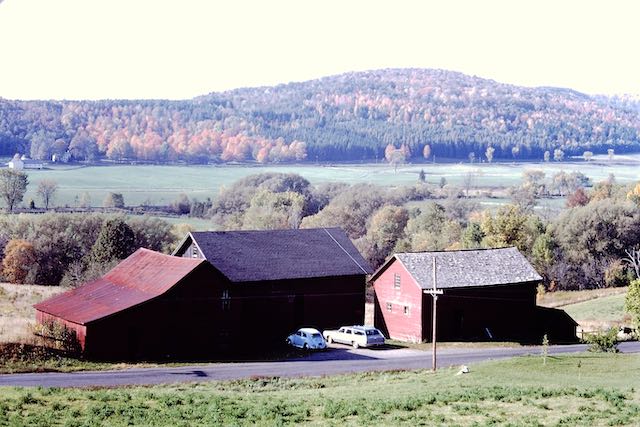
The middle barn held the hay loft where we jumped.
She couldn’t put her finger on any answers to all her whys. Why did he scare her? Why did he approach her to begin with? Why did he follow her when she veered away from him? Why did he quicken his step when she quickened hers?
Now she was running. Cutting through alleys, slipping through hedges, afraid to look over her shoulder in case he was still there.
She paused as she emerged from yet another alley. She could no longer hear him, but she was thoroughly lost. It looked like Uncle David’s neighborhood, but all the houses looked so much the same.
What was that rhyme he used to tell her?
If ever you’re lost in Uncle-David-land Keep your eyes open for the Eyeball Band
She had been so little when he made her memorize those silly words and showed her the secret door on the side of the garage.
Now she was, indeed, lost in Uncle-David-land. She stared around the street trying to decide where to go when she saw the scary man again. She ran in the opposite direction and ducked down another alley.
When she emerged, she spotted the Eyeball Band painted on the garage door. She ran straight to it and found the secret door.
Inside the garage stood Uncle David and her dad. They seemed to be waiting for her.
“Told you she was ready,” said Uncle David.
This is my response to this week’s Unicorn Challenge. It’s a simple challenge every week: no more than 250 words based on the photo prompt.
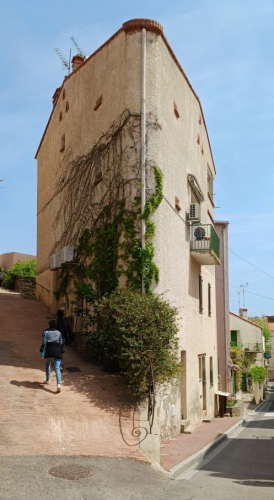
Is that a strange photo or what?
But, being someone who navigates using landmarks, I could SO picture someone using that door as the landmark where you should turn or stop or something.
“Please select Me!” She wanted to direct The gardener as he scanned, Hand
Already Full of flowers, gaze steady. He looked for one final bloom. Gloom
Just settled Over her. Her gold petaled Head drooped in an oh-so-sad Bad
Way. Downcast, Rejected, again outcast, Passed over. But then he stopped Dropped
His pruner “I wish I’d seen you sooner,” He said to her. “You are sweet! Meet
Your sidekicks.” [snip!] She joined the spray, transfixed By the beauty around her. “We’re
Delighted You can join us!” She sighted A welcoming rose and mum. “Come!”
This is for the W3 challenge this week. Heather (Sgeoil) challenged the participants to do a little personification. I had an idea for a flower being plucked from the garden for a bouquet (inspired in part by the bouquet that was on my bedside table when I stayed at my son’s house). My idea involved going in that sacrificial direction of losing life for the sake of something bigger. But, as you can see, it went in a totally different direction.
I wish I understood my own process.
AND — because I like Celtic forms, I went with a Deibide Baise Fri Toin, and Irish form with aabb rhyme scheme and syllable count of 3-7-7-1 for each stanza. The first two lines rhyme on a 2 syllable word and the last two lines rhyme on one syllable.
It even says it on their license plates, Beautiful British Columbia, as if our eyes are deceiving us. Yes, this is a beautiful place.
I had to fight the urge of pulling over on my drive up from Seattle to take some pictures. The mountains are breathtaking. The trees stand tall, erect, pointy and somehow brave.
It’s so very different from the Northeastern US, where the mountains are lovely, but older. The trees are also lovely, but more are deciduous; they seem to go with the flow of life instead of the unmoving strength of those giant pines.
Ah, I know, I’m probably way off base. The oaks and maples have deeper roots, right? And I’ve seen tall pines toppled with their root system, shallow and broad, turned on edge like a wall.
But this is my submission for Stream-of-Consciousness Saturday — a day late — and I’m not going to go back and correct what may need correction. When I saw that the prompt was “Photograph,” I thought, Yup, I’ve taken a few photographs over the past few days.
We’ve gone walking every day. Two days ago, my son and his wife wanted to take me to see some glorious vista — which I’m sure would have led to not a few photographs. However, we started up the logging road and it got steeper and steeper and steeper.
“Are we there yet?” I quipped two minutes into the hike.
Twenty minutes in, after a couple of rests, I asked them to guesstimate if we had gone a quarter of the way yet. He studied the map on his phone. “Umm…. maybe just under a quarter,” he said.
We turned back at my request. I walk A LOT, just not straight uphill.
Instead we walked along the Fraser River which was lovely. The only photograph from that walk was of an immature eagle who stared down on us as we passed.
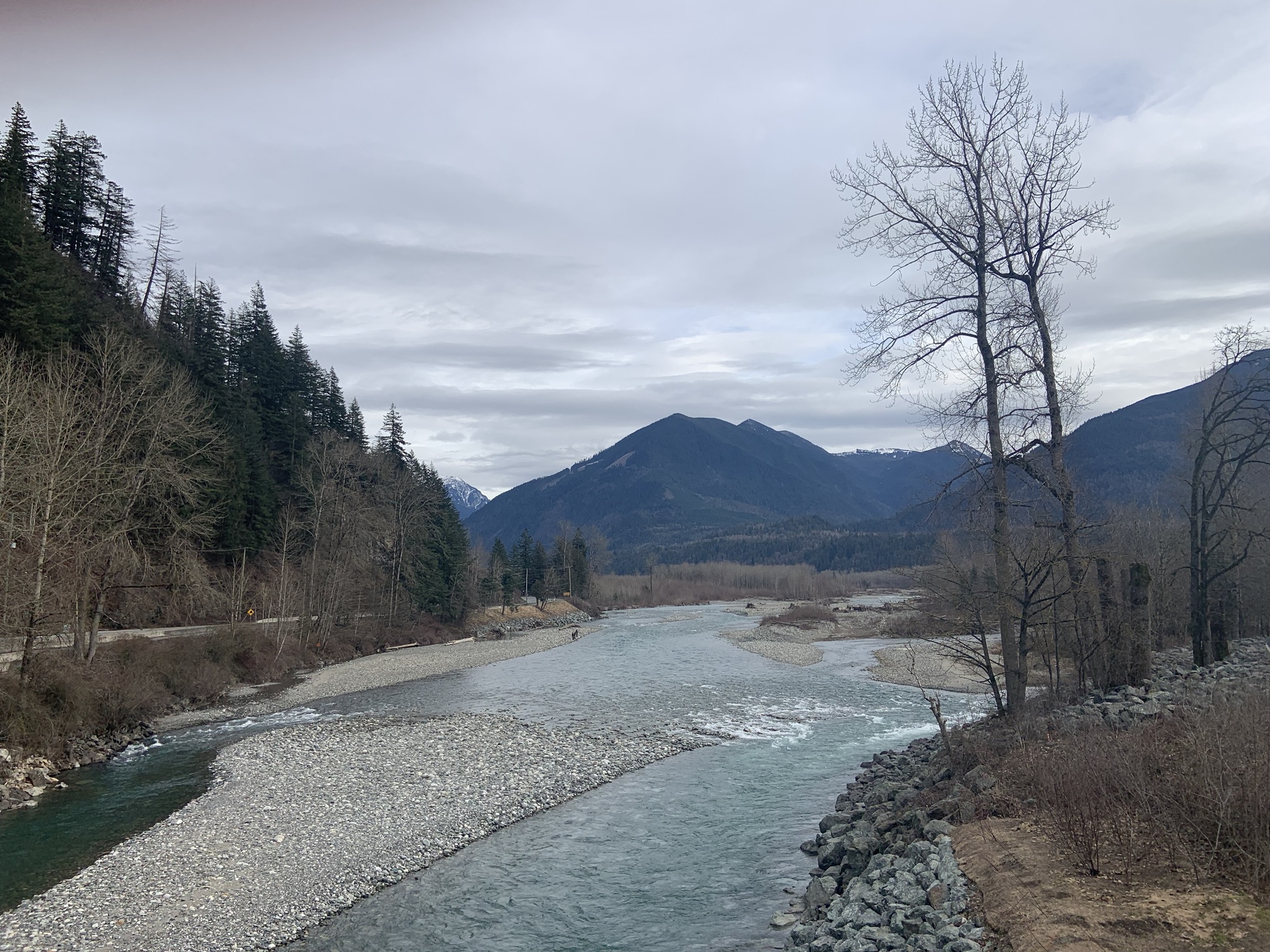
Yesterday, we walked along the Vedder River, a river which changes its name to Chilliwack once it passes under a bridge, so I saw the Chilliwack River, too. In fact, I only photographed the Chilliwack.
Chilliwack River
But my favorite picture of the day was one I took immediately as we started on the path. It made me laugh — and it still makes me laugh.
I love when people have a sense of humor.
I really want to know who thought of the poop fairy.
I had to come up with the next prompt (I chose an unpronounceable Irish form – Cethramtu rannaigechta moire – which requires 4 line stanzas with 2nd and 4th lines rhyming, and strict 3 syllable lines)
I have to choose the next Poet of the Week
Well, I’m traveling this week, so I chose a theme of travel.
Easy, right?
Wrong!
I’ve scrapped so many poems this week! The pressure is on! Between walks in beautiful British Columbia, I’ve tried to write and the struggle is real.
But I started a Lenten devotional on Ash Wednesday based on the poems of Mary Oliver so I tried to let her inspire me a little.
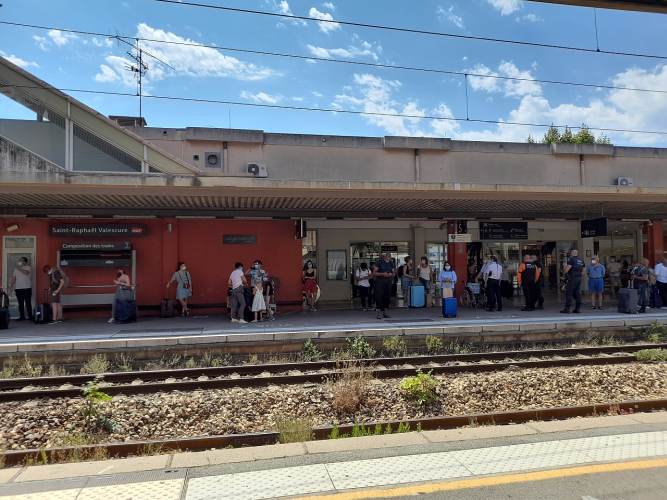
She couldn’t have imagined ever seeing the station filled with masked people.
Every single person — children, parents, elderly, middle-aged, travelers, security guards. It didn’t matter who they were; all were masked.
She was a studier of faces, now she became a studier of hands, of postures, of gaits.
Hands tell so much about a person. That young woman must have treated herself to a spa day recently. Her hands were as coifed as her hair. The gnarled hands of the older woman told of painful struggles with arthritis. The bandaids on the little boy’s hands (and knees) spoke of lessons learned hopefully amidst fun. Wedding rings (or lack thereof) said something, but she knew not to trust that clue. The rough working hands on the one security guard suggested a second job or hobby; she wondered which.
She watched an older man, his shoulders slumped, as he studied his phone. Was he lost, she wondered, or had he just received bad news?
A little girl was tugging at her father’s hand, peering up towards his face, clearly wanting something from him, but he was engaged in conversation with another adult and paid her no mind.
Then she watched the older woman bury her face in those arthritic hands. Her shoulders heaved.
Was she crying? she wondered. Can I help her?
Her nature was to reach out and help, but this damned pandemic had handicapped her handicap. Without the ability to read lips, she was even more isolated in a crowd.
This is my response to the Unicorn Challenge. Each week they post a picture. Those who take up the challenge write no more than 250 words based on that prompt.
One more lap, she told herself, and I should have it figured out.
The “lap” was a strange triangle of steep uphill, steep narrow stone stairs, and a broad, flat straightway.
She was on the hill segment. Her legs, lungs, and heart always complained on this part, but she would lean into it and push herself to continue the pace and ignore her body’s complaints.
It was that leaning in that made the laps so worthwhile. If it was easy, she wouldn’t think twice about anything. She would just la-di-da her way along and miss something significant.
No, the pushing-pushing-pushing, her heart beating harder and faster, her breathing strained, and her thigh muscles contracting and extending as she fought gravity to propel herself up the hill – that’s what helped.
This is my life, she thought.
Halfway up the hill, she almost allowed herself a rest. Almost. She pushed through it though because she didn’t want to lose momentum. She shifted her thoughts away from her ever-more-hurting body.
If I do this, she thought, he mightrespond with that. That would be bad.
But… if I don’t do it, she continued, we’re just stuck where we are.
She reached the top. The stairs beckoned — an easy step-step-step down to the bottom.
Walking the broad road gave her no insight, so up the hill she began again.
He placed his right hand just back of her waist She placed her left hand on his shoulder They danced with hands clasped in a stiff, awkward way Space between them? Well, it was well-spaced. That space closed midst the dance, he leaned in and told her, “Thank you for dancing. My wife died last year. Today is quite hard, our anniversary day.” Adding a hug, “Thank you for being here.”
This is my response to the W3 prompt this week: Write a San San poem.
The San San poetic form has three requirements:
Eight lines;
Rhyming: a-b-c-a-b-d-c-d;
Repetition: Three terms or images in the verse must be repeated 3x each.
For this challenge, it also needed to be inspired by a dance or a song about dancing. The song below was my inspiration. It always gives me that ache-y feeling.





 Hot Dogs and Marmalade