Recently a friend asked me, “What was the first sign of dementia with your mother?”
I knew exactly when it was. I wrote the whole story years ago in a post called, “Six Ways to Anywhere.” The gist of the story is that my mother, who never got lost, who had a Rand McNally Atlas lodged in her brain, couldn’t find her way back from the Post Office one day. That single event suddenly shed new light on so many other smaller things that she had done.
Yesterday, when I read what our President had said in response to James Mueller’s death — “Good. I’m glad he’s dead.” — brought me back to another moment in my mother’s dementia. We were at a concert in which one of my daughters was singing. It was in a large church. We settled into a pew with a good view of the stage. Another family was already seated in front of us. A few minutes later, they were joined by an obese woman who settled right in front of my mother. My mother turned to me and said in a loud voice, “THAT WOMAN IS FAT! FAT FAT FAT!” I cringed inside and wanted to leave.
It was her dementia talking. With dementia the filters for what is socially acceptable deteriorate. My mother would never have said that ten years prior, but she said what she thought regardless of propriety.
Our president continues to grow more and more crass and abhorent in what he says. I think he had a modicum of propriety in his first term, but it’s gone.
When we used to ask my mother about something, we knew that she could no longer recollect what that something was when she would say “the others.” “The others” did things, took things, were arriving for dinner, had left earlier that day — whatever she started talking about and we questioned her on because it didn’t make sense became the fault of “the others.”
When our president is asked about something that he spoke on the day before and it turns out not to be true or accurate, he defaults to, “I don’t know anything about that.” Honestly, the more I hear him say it, the more it reminds me of my mother and her dementia responses like blaming “the others.”
My father, in his dementia, would be up in the middle of the night — not typing posts on social media because he didn’t do that — but going about his day. Something isn’t right when times of day are mixed up like that.
I sat with my father multiple times for the cognitive screening. He was a smart man and passed even though I had seen in him signs of dementia.
In 2016, shortly after Trump became president, we were in the Emergency Room and the nurse asked my father the orientation/cognitive screening questions: Do you know where you are? Do you know what day of the week it is? Do you know who the president is? He answered the first two easily. For the third question he replied, “I refuse to say that awful man’s name.”
My father could ace the longer cognitive test, too. I watched him do it. He was given it multiple times because we knew something was going on. The first time he failed the clock part (draw a clock), his doctor looked up at me and our eyes met. She didn’t need to say anything. I knew.
With my mother, my father had a hard time initially acknowledging that she had dementia. He loved her. He wanted her to be whole. Finally it reached a point where, for her safety and the safety of others, something needed to be done.
Dementia is a sad, sad thing. I wouldn’t wish it on anybody.
However, spending time with people traveling that road makes one more aware and sensitive to those signs.
The people who are closest may not see it. They don’t want to see it. They truly love the person.
Forgetting or confusing names — like Greenland and Iceland — are a sign. Falling asleep in the day and being overly active at night — that is, confusing night and day — are a sign. Rambling, unable to focus or stay on task — these are signs.
“Good. I’m glad he’s dead.” — Those are not the words of a healthy human being. It’s a sign.
“I am a lighthouse,” said the child Hands on hips, feet firmly planted For one so small he looked quite wild Wild, crazed, perhaps enchanted
“When I turn on my light,” he stated Pointing to headlamp on head “I can change what has been fated I can warn what is ahead.”
“I am a lighthouse,” said the child Cars were whizzing by so fast He crossed through traffic quite unriled The median strip he reached at last
He stood as tall as eight years let him Changed the headlamp to rapid blink Though tears streamed down, his face was grim As he boldly faced that brink
Police were called, his mom tracked down (Frantic worry filled her heart) Traffic there was detoured ’round His mom tried not to fall apart
Policeman recognized the mom “Is this the day? Is this the place?” She nodded, anything but calm As tears rolled down her haggard face
Trembling she said, “His sister died here. He witnessed it and hasn’t spoken ’til today after a whole year! Finally, something has awoken.”
For this week’s prompt, you are the lighthouse.Write a poem in which the speaker is a lighthouse guiding something away from danger, toward safety, or both.
I struggled with this. A lot.
Finally, this cheesy story came out that didn’t meet the criteria. The author of the poem isn’t the lighthouse. Also, it was supposed to be 23-25 lines. There are a 28 lines up there.
Overheard Malicious whispers Between two Co-workers My heart grew cold at their words Squeezing in my chest
Breathing stopped Blackness obscured sight My fists clenched And unclenched Thoughts swirled like a tornado Unholy and wild
Office chair Calmed me in this storm I held on Took a breath Straightened my back and went out “I heard what you said”
This is my response to this week’s W3 challenge: to write shadorma poems.
The shadorma is a compact Spanish syllabic form built from a six-line stanza with a strict syllable pattern: 3 / 5 / 3 / 3 / 7 / 5 (26 syllables total). It is typically unrhymed, and a poem may consist of a single stanza or a series of stanzas.
For this challenge, the theme is Sensory Details.
Write a close-up study of a single inanimate object or a very specific moment. Think small and focused rather than narrative or expansive. The power of the poem should come from sensory observation—what can be seen, heard, touched, smelled, or felt.
Yes, this actually happened. It was a specific moment and I tried to write the sensory details of it.
Amelia’s knights neighed Her black pawn had tea with my white Our bishops talked “What are they talking about?” I asked “Hello,” she said, bobbing one up and down “How are you?” she said, bobbing the other similarly She giggled “This is more fun than checkers,” she said Amelia is in third grade “The pieces are people,” she stated “Can our queens be friends?” she asked I paused “That’s not how the game works,” I told her She pressed her lips together Then she reached over and touched her pawn The one that was head to head with my pawn “But they can still have tea, right?” she asked
When I read the Stream of Consciousness prompt for today — the word “distance” — this song is the first thing that came to mind.
I have a love-hate relationship with the lyrics. Allow me to — stream-of-consciously — dissect them.
On the surface, yes, it’s all so true:
From a distance, the world looks blue and green And the snow-capped mountains white From a distance, the ocean meets the stream
Yep — those pictures taken of the earth from space show our planet as green and blue. We can see water, land. We have to start zooming in, though, to see ocean meeting stream. We have to really zoom in to see the last line of that verse:
And the eagle takes to flight
If we were to really really zoom in, we would see that eagle swoop down and grab a living creature — a fish, a rabbit, or even someone’s pet. Hmmm…
From a distance, there is harmony And it echoes through the land It’s the voice of hope It’s the voice of peace It’s the voice of every man
Well, not EVERY man. I’m so disturbed by the words of our Secretary of War/Defense this week. He initially acknowledged the fallen troops, but then they became a PR problem to him. He accused the press of trying to make the president look bad. Seriously??
From a distance, we all have enough And no one is in need And there are no guns, no bombs, and no disease No hungry mouths to feed
From a distance, it may look that way, but it’s not true. It’s just not true.
From a distance, we are instruments Marching in a common band Playing songs of hope Playing songs of peace They’re the songs of every man
I actually like this verse. Music is a uniter. I think about the story from WWII of Germans and Americans singing Silent Night together, in their respective languages, on Christmas Eve. (I think that’s how the story goes.)
God is watching us God is watching us God is watching us From a distance
Umm…. the Christmas story is that God was born in a stable. The Lenten story is that after a dusty, dirty itinerant life — walking with us, eating with us, teaching, listening, healing through touch — God in human form died for us. God bridged the distance.
From a distance, you look like my friend Even though we are at war From a distance, I just cannot comprehend What all this fighting’s for
I’ll go back to that Christmas Eve story and I’ll say this, You, Iranian mom, are my sister. In 2017, I went to Bosnia and shared meals with people of a different faith. I learned they were also my friend/family. I’ll also go back to those powerful people in the world who move us around like chess pieces. I just cannot comprehend what all this fighting’s for.
The rest of the song is pretty repetitive of what’s already been sung.
It’s a lovely song. It really is.
I just wish it didn’t lean so heavily on God watching “from a distance”.
Perhaps it’s simply saying that God has the best perspective — “from a distance”. Hmm… I need to ponder that.
“Can I have a kitty?” itty- bitty me asked my father — rather, my mom put me up to it. It seems that she knew new kitten would equal no. No, unless she rigged the odds. Odds are he would say yes to me, mea- ning I asked, pleading, “Yes?” — “Yes.”
Ichibon — Ichi + bon — Japanese for Number One — our first cat
We were on an army base at the time. The family with the kittens had recently come back from Japan.
How could my father say no?
This is my attempt at an Echo Poem, this week’s W3 Challenge. An echo poem repeats the ending syllable (or syllables) of each line. That’s it. No strict rules about meter or length.
Smooth <— that’s the Saturday Stream of Consciousness prompt.
Honestly, I got nothin’.
The only thing that comes to mind — and KEEPS coming to mind — is the sarcastic “Smooth, real smooth” that I’ve heard when I’ve goofed up. Again.
Have I ever mentioned the fact that I’m a little awkward at times?
For my work, I have to call people, and it stresses me out. I think ahead to what I want to say when I have to leave a message — “Hi, this call is for [insert name]. This is Sally calling from the Membership Office.”
Sometimes, I get through the point of the call seamlessly.
Other times, though, someone will walk past my open door, wave, and I get distracted. That’s when I start babbling.
I think that as I grow older, it’s not just my body that loses some of its flexibility, but my brain also loses elasticity. I don’t multitask like I used. I forget names and/or words.
The Lens-Artist Challenge this week is “to explore juxtaposition as a photographic technique.”
Years ago, I heard Nat Geo photographer Sam Abell give a talk on his photography. He talked about waiting for days for the light to be in the right place and for everything to come together for an amazing photograph. Even with all his planning and waiting, there was a certain element of luck or serendipity or something that came into play with the best photos. That, and shooting rolls and rolls and rolls of film.
Anyway, I snap pictures because I want to remember something. That’s pretty much it. I’m not an artist; I’m a memory keeper — although I think the best artists probably are memory keepers. Amazing memory keepers.
The following are my juxaposition submissions — with a little explanation.
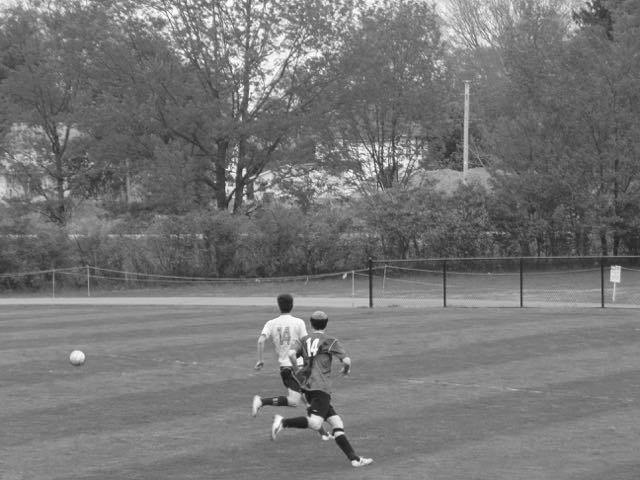
Two #14s in perfect synchronization (2016?). What also makes it interesting to me is that one player is my son and the other his cousin who was on the other team. I only wish I hadn’t taken the photo in black and white but I was playing with settings.
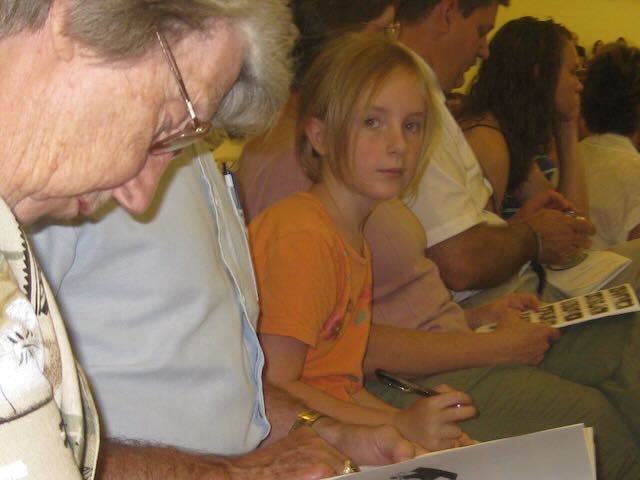
That’s my mother in the foreground “resting her eyes” at her granddaughter’s high school graduation (2010). And that’s my youngest daughter looking at the camera and, I’m sure, wondering how much longer her sister’s graduation will go on.
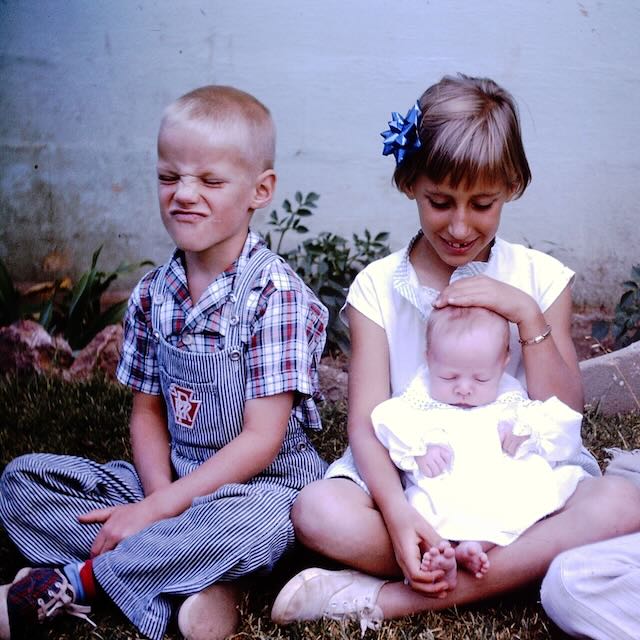
My sister with her two younger brothers (1964). Juxtaposition of facial expressions?
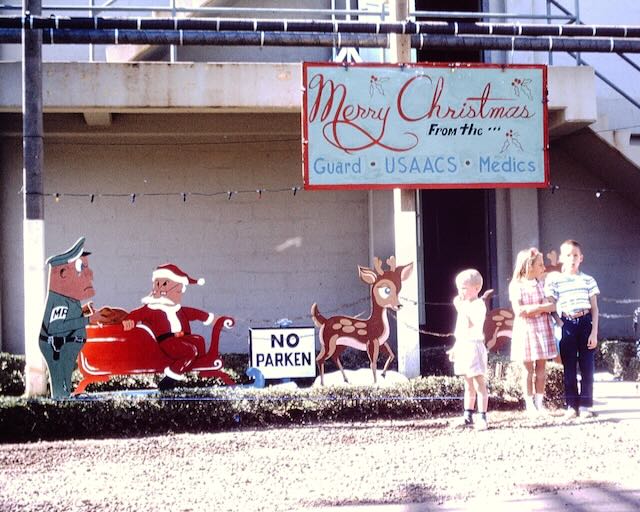
Is this a juxaposition photo? I dunno. I thought it was funny — kids waiting to see Santa who’s getting a parking ticket from the military police. (circa 1964)
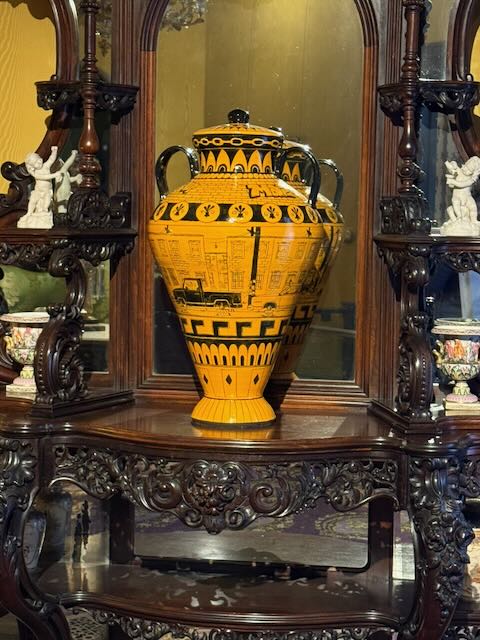
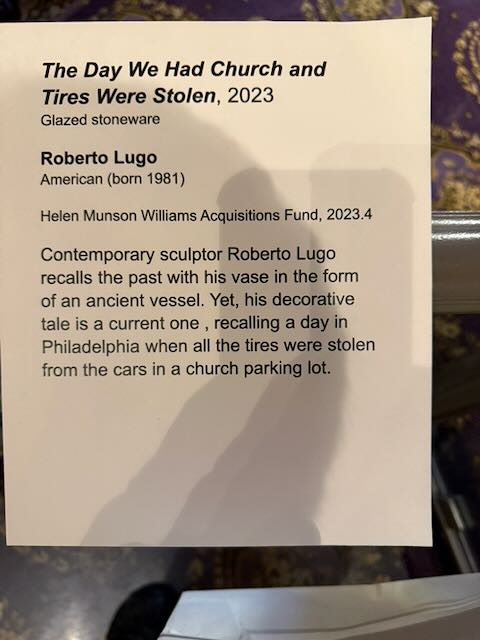
I took this photo today at the Munson Art Museum in Utica, NY. It made me laugh. Part of the museum is in an old Victorian house, with rooms staged with antiques, roped off with those red-velveted cords. Anyway, in one room full of glorious ornate pieces of furniture and statues and artwork, there was this yellow vase with a truck on it. Here’s the card that explains it:
I suppose tire theft isn’t funny, but I laughed. The artist, and the museum in the way it displayed his artwork, were very clever.

 Hot Dogs and Marmalade