Life · Writing

A Trip to Maine

This is my response to this week’s Writer’s Workshop prompts

12 things I learned and/or grew to appreciate this month week (because I’ve been in Maine for the week):

  1. I now know the difference between a tadpole, polywog, and froglet. This is a polywog:

          A tadpole doesn’t have any legs and a froglet has all four. This polywog, as you can see(maybe), only has two legs.

          2. Maine blueberries grow low to the ground and are tiny, compared to our New York blueberry bushes. They are harvested with special rakes. They have blueberry bushes in Maine, too, but those teeny berries from the ground plants are PACKED with flavor. Who knew?

          3. There is more than one Fort Knox. My dad was stationed in Fort Knox, KY, and it’s known for all the gold there. But before that Fort Knox, there was a Fort Knox in Maine built in the mid-1800s. It’s a massive granite fortress built on the edge of the Penobscot River.

          Fort Knox outside wall
          Fort Knox — the inside compound

          4. Perspective is always important. When you’re looking from the outside, you can’t see in very well (see top Ft. Knox photo). But when you’re looking from the inside out, the world just seems to open up.

          From inside Ft. Knox.

          5. The Penobscot Narrows Bridge is one of only five bridge observatories in the world. The other four are in China, Thailand, Slovakia, and South Korea.

          Looking up at the Penobscot Observatory from our car.

          6. Perspective is always important. (Yes, I already said that.) Looking down and looking up are totally different views.

          Looking down from the Penobscot Observatory at our car.

          7. Beaches hold amazing surprises.

          We found this crab shell on the beach full of… we didn’t know! It turns out they are Marine Springtails, a relative of the snow fleas I’ve seen at times in New York. They’re an important part of the beach ecosystem, part of nature’s clean-up crew.

          8. Museums are fun.

          We stopped at the Penobscot Maritime Museum, mostly because of this guy beckoning us in. I learned more about sardines than I thought possible.

          9. Sometimes kids don’t appreciate museums.

          “Boring who needs fishermen dont prezerve fishing”

          This was in a box of comments that I looked through. It made me laugh — and feel a little sad for the kid who wrote it.

          10. Museums can be very funny for kids (big and small) who engage with them.

          Captioned: Which animal is not stuffed?

          This photograph was hanging in the ladies room at the Penobscot Maritime Museum. It was taken by a turn of the 20th century photographer, Charles Coombs, who was also an undertaker and taxidermist. The picture made me laugh.

          11. Floating classrooms can be massive.

          The big ship in the back is called The State of Maine and recently came into Castine, home to the Maine Maritime Academy. Its primary purpose is for training Maine Maritime cadets while also being available for federal humanitarian assistance and disaster relief mission. We went to see it but couldn’t get any closer than this.

          12. Sunsets are beautiful everywhere.

          Blather

          1901

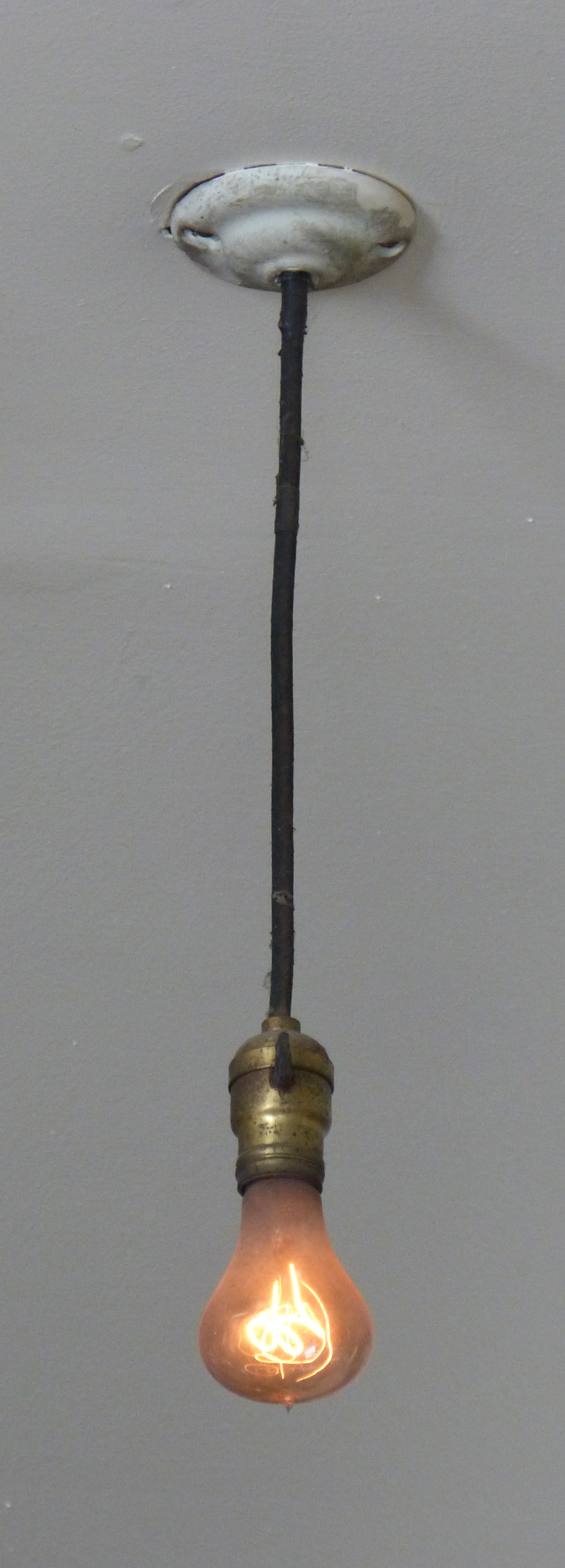
          On my way to work this morning, I heard a story on the radio about an incandescent light bulb that was lit in 1901 and is still burning.

          A photo of the Centennial Light Bulb pendant light in Livermore, California. This photo was taken in 2016.

          In 1901, my maternal grandmother was 5 years old. My paternal grandfather hadn’t been born, and wouldn’t be for another 2 years.

          However, here’s something contemporaneous with that 1901 light bulb: Walt Disney was born.

          Can’t you picture a cartoon light bulb appearing over Walt Disney’s head time and time and time and time again over the course of his life as he had one idea after another? I think that light bulb would look remarkably like this light bulb that was born the same time he was.

          poetry

          Dr. Purple Poem

          Ah, Dr. Purple. Now they’ve got me thinking about him again.

          Years ago, I wrote a lengthy poem about his life, thinking it would make a great children’s book. I sent it off to someone for feedback.  When she didn’t like my first two lines, I thought I should just nix the whole thing.

          And I did.

          I tucked it away — and had a terrible time finding it this morning. But the prompt today is “elixir” and I thought I could squeeze it into this poem. I couldn’t.

          Below is a portion of my poem, telling one story I learned through my research.

          the Moore Memorial Library where I spent many happy hours researching Dr. Purple


          Dr. Purple lived in Greene
          Back when the years began 18–

          To provide for his family, with children four,
          Dr. Purple opened a store.
          There he sold paper and books,
          Yankee notions, latches and hooks.
          Then, the Postmaster he was named,
          And he held the mail ’til it was claimed.

          Still he practiced medicine,
          For he loved to help his fellow men,
          And when an accident occurred,
          From his store he strode assured
          That he could help the injured one
          With bandage, salve, or anodyne.*

          In 1856, one February day,
          Mr. Mansfield drove his sleigh
          Over the canal bridge right in town,
          But the horse got spooked
          And wheeled around
          And tipped the sleigh onto its side.
          “Whoa there, Nellie!” Mr. Mansfield cried.

          But to the reins he held on tight,
          And helpless people watched his plight
          While Nellie dragged him forty feet
          To Darby’s shop on Genesee Street.

          Dr. Purple heard the cries,
          Left the Post Office,
          Ran outside
          To where the injured patient lay
          Unconscious on the ground that day.

          Dr. Purple got some men
          Who carried Mansfield to Whittenhall’s Inn.
          When Mr. Mansfield came around,
          He was quite bruised,
          But otherwise sound.

          Mansfield went back home that day –
          There was no hospital in which to stay,
          And Dr. Purple went back to work,
          Sorting mail, just like a clerk,
          And selling books and other stuff.
          For being a doctor wasn’t enough…

          *anodyne – a pain-killing drug or medicine


          The poem goes on with other stories of his life.

          He was an interesting man — acting as scribe at a local trial for Joseph Smith, testifying in many trials, publishing articles in medical journals and speaking to medical societies, proposing mandatory small pox vaccinations for school children long before that became law, deputized as US Marshall at one point to catch a mail thief, and more.

          The question to me is, would other people be interested in Dr. Purple?

          Uncategorized · Writing

          Dr. Purple

          Last week Mary and I went to a “talk” at the library.

          I had seen the sign posted at the grocery store and taken a picture of it so I would remember to mention it to Mary.

          But on Tuesday, March 14, everything was shut down in honor of Snowstorm Stella. I didn’t leave the house except to shovel for two days. By Thursday, the travel restrictions had been lifted and I made a trip to the grocery to pick up essentials. Someone had crossed out the date and handwritten Thursday, March 16, above it.

          It turns out that someone was the local librarian. He went to every poster and changed the date.

          And I was fortunate enough to see it in time.

          Mary and I drove in to town and parked in front of the library that night. The snow was piled high and very few people were out and about — still. Stella was a doozy.

          It turns out that Mary and I were two of six people, one of them the speaker, who ventured out that night.

          We met at a rectangular table. One of the men quipped, “We need to change our name.”

          The rest of the attendees were men. All over the age of 50.

          Mary felt a little awkward, I could tell. They all knew each other. They talked about this and that, things familiar to them. Mary and I spoke in low voices to each other.

          “You okay?” I asked her.

          “Yep,” she said.

          We’re both the kind of people who like to sit in the back unnoticed, but that was not going to happen at the Nights at the Round Rectangular Table.

          The speaker spoke about different types of local histories, using books pulled from the library shelves for examples. A memoir. A book of old photographs. His own scholarly work about the history of a local township.

          At the very end, he asked the librarian about checking out his book.

          “You’re checking out your own book?” I asked.

          He reddened slightly. “I’m in the middle of a move and all my books are boxed up.”

          Before that, when he had finished his prepared words and taken a few questions, he asked, “Now I’d like to know why you came to this.” He turned to the man at his left who gave some answer that indicated that he was a regular at these affairs.

          Mary was next. She looked like she was feeling more than a little awkward. She had already been put on the spot a few times during the discussion because she was so obviously the youngest person in the room. I tried to help her out.

          “She loves history,” I said. “I saw the sign at the store and asked her if she was interested.”

          They wanted to know what kind of history, what era, what she wanted to study. I think the whole reason the question had been asked in the first place was to find out what would bring a 17-year-old girl out on a snowy winter night to a talk about history.

          “She brought me,” Mary said, pointing at me.

          “And I came because of her,” I said, pointing back at Mary.

          We both laughed. The men around the table chuckled. “I guess they each blame the other,” one of them said.

          “Tell them about Dr. Purple,” Mary said.

          Few topics are as interesting to me as Dr. Purple, a physician in Greene, NY, in the 1800s. When I first learned that Greene had a physician named Dr. Purple, I thought it would make a great children’s book. I started researching him.

          One of the men at the table said, “Dr. Purple from Greene? That sounds like a children’s book.”

          “That’s what I thought,” I told him, and I launched into telling them some of the interesting things I had learned about the man.

          His life was messy, imperfect, but ultimately good. He was much loved by the townspeople.

          Telling the men that night about Dr. Purple — and seeing their interest in his story — fanned the little flame of interest I keep burning for him.

          The speaker gave me some suggestions on how to write such a book.

          Maybe I’ll pull out my notes again and start organizing them.