A to Z Blogging Challenge

Egg

Laurel has been practicing cracking an egg with one hand — with these:IMG_8539

“Please can I try it with a real egg?” she begged the other night.

“No,” I replied. I was tired and the likelihood of having to clean up an egg mess was unappealing.

“But, look,” she said, holding a green egg in one hand, “I can do it,” and she neatly opened the empty egg.

“No,” I said again. “Do it in the morning when I have more energy.”

“But I’m not going to make a mess,” she insisted. “And I’ll clean it up if I do.”

“No,” I said one last time.

The truth is I had gotten sad the day before when I was making waffles for my father. I had used the recipe my mother used to use.

But it calls for separating the eggs.

Every time I do it, whether I’m using the separator, the shell, or my hand, I start thinking about my mom.

She taught me to cook — to level off the flour in the dry measuring cup, to get eye-level with the measuring cup when measuring liquids, and to crack the egg with a sharp rap using the back side of a knife. She taught me to pull the eggshell apart with my thumbs. She taught me to always put the egg into a separate dish before adding it to whatever I was cooking — we had our own chickens, and sometimes what came out of the egg was an unpleasant surprise. She taught me to get the last bit of white out of the shell with a quick swipe of my forefinger. She taught me to separate eggs, not allowing any yolk into the white because if I did the white couldn’t be beaten to stiff peaks no matter how hard I tried.

When her dementia robbed her of her cooking ability, she was so lost. No more cooking for a crowd. No more delicious soups where she put something akin to magic in the pot. No more casseroles.

Food was whittled down to marmalade. On everything.

But I can still eat marmalade.

IMG_6067There’s just something about eggs. They make me think of her.

An egg is both strong and fragile.

It is life.

And hope.

An egg is three-in-one, like God.

But the word “egg” only appears once in the Bible.

Somehow, for me, an egg inextricably connects mother to daughter.

It is a mystery — a pearly, porcelain, alabaster mystery.

Today, I’ll let Laurel try cracking that egg with one hand. Success or failure, we’ll laugh and then figure out what to do with the eggs she opens.

Maybe someday she’ll look at an egg and think of me.

A to Z Blogging Challenge · family

Do

The very best advice ever given to me was given by my mother-in-law.

When I had just one little boy, life was fun. Oh, I thought it was hard because he didn’t sleep very well, but, all in all, it was fun. I had plenty of hands and plenty of help.

My mom, Philip, and me

When I went from one to two, life just got funner.

Two artists
Two artists

Going from two to three, though, meant that I ran out of hands, but that was okay. Backpacks and front carriers worked well.

Feeding seagulls
Feeding seagulls

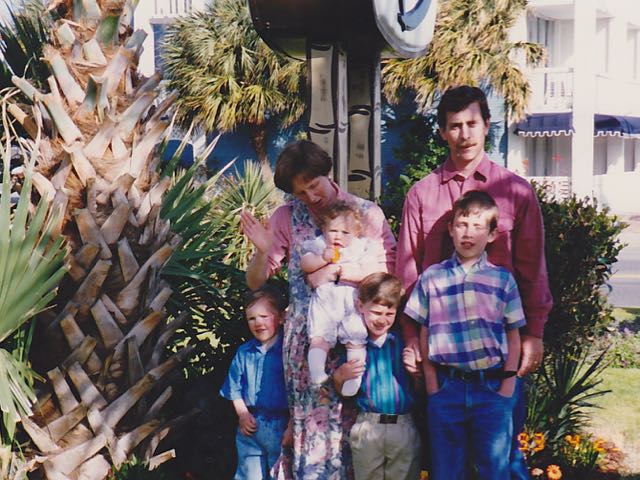
From three to four presented a problem. I had no where else to put a child.

Myrtle Beach - 1993
Myrtle Beach – 1993

Somewhere in that two-three-four child range, I realized I was really struggling to do this job. My mother-in-law raised thirteen children. Well, actually, fourteen, because a cousin came to live with them when her mother died. I asked my mother-in-law one day how she did it.

“You just do,” she said. That’s all there is to it.

D is for Do.

“Fred” asked me a riddle the other day, “How do you eat an elephant?”

I think he was hoping I would say, “With an elephant fork,” but I knew the answer — one bite at a time.

You just do.

You take one step forward. Then another. Then another.

That advice helped me through child-rearing, and later, in the midst of adult caregiving. Caring for someone with dementia is not unlike caring for small children.

When life is overwhelming, look around for something you can do — some small thing, a baby step you can take forward or even sideways, a tiny bite you can take of the elephant.

Do.

Family Reunion
My mother-in-law (center) surrounded by the fruits of her “do”-ing — 2011


A to Z Blogging Challenge · Faith · family

Community

John 5 begins with the story of Jesus at the Bethesda pool where lay “a multitude of invalids.” The belief was that after an angel troubled the waters, the first one in was healed. Jesus spoke with a man who had been there for thirty-eight years.

“Do you want to be healed?” Jesus asked him.

“Sir, I have no one,” the man replied. No one to put him into the pool when the water is stirred. A multitude of invalids, but each concerned for himself.

To have no one.

In contrast —

C is for Community.

My father and mother enjoyed traveling after my father retired, but as my mother’s dementia grew worse, traveling became more difficult.  One night in New York City, my father awoke to hear the heavy hotel door click shut and realized that my mother was no longer in the room. He found her in the hallway. Another time she got away from him at the airport, and still another time she wandered off in Greece.

On that trip to Greece, their last big trip, the other ladies in the tour group saw the need and began watching out for my mother. What began as a group of strangers ended as a caring group.

My mother and father on their trip to Greece
Strangers at the start, friends by the end

“Without a sense of caring, there can be no sense of community.”  Anthony J. D’Angelo

Community doesn’t have to be intimate to be functional.  Even a small thing, like holding the door open for someone struggling with mobility, can be an act of community. It says, “I am willing to help you, even if it inconveniences me a little.”

Sometimes community is very intimate. I was horrified to see that my mother had had an incidence with incontinence while visiting an old friend of my father. “Oh! I’m so sorry!” I had said when my mother stood to go. “Let me get something to clean that!”

“No, no,” the woman had said. “Your job is to take care of your parents. I can clean this up.”

Community.

Looking out for one another.

Circling the wagons in Greece, in Florida, in Cooperstown.

We can be community to those we encounter. We just need to be willing.


A to Z Blogging Challenge · family

Benevolence

My father and I went to dinner at the Council Rock Brewery last night for their Friday night fish fry. If you should ever be so fortunate as to spend a Friday night in Cooperstown, by all means, go to Council Rock for dinner and a beer.

Chardonnay and beer
Chardonnay (for me) and beer (for my dad)

The what’s-on-tap list was long and my father hadn’t looked at it before the waiter came to take our order.

“I’d like a beer,” my father said.

“Would you like a dark ale or something lighter?” the waiter asked, his pen poised over his pad.

“Yes, that sounds great,” said my dad.

One of my father’s hearing aids isn’t working right now.

The waiter looked at me, unsure what to do next so I pushed the list over to my father and repeated the question.

“He wants to know which of these beers you want,” I shouted so he could hear me above the pub hubbub.

The waiter bent over the table and put his finger at the bottom of the beer list. “These ones are dark,” he said, “and they get lighter as you go up.”

My father furrowed his brow as he studied the list. He finally pointed to the second beer from the top. “I’ll try this one,” he said.

When it was served, my father said, “That’s the right color.” He took a sip and pronounced it good.

I was glad he was happy with what he had ordered.

When my mother was early in her Alzheimer’s, I remember going to restaurants with her. She wasn’t hard of hearing, but she did struggle to order. She studied the menu, chose something, announced her choice to us, but then would have forgotten it by the time the server was taking her order.

Sometimes she ordered what the person before her had ordered.

Sometimes my father or I ordered for her or prompted her with what she had intended to order.

Drinks were a different story. When ordering drinks, she usually declined — which was fine. But when the server brought out drinks for people and brought nothing to her, she grew indignant.

“Where’s mine?” she would demand.

The flustered server would apologize and ask again what she would like.

We would offer our drinks to her.

Anything to make her happy.

Because the maxim, “If Mama ain’t happy, ain’t nobody happy” is still true when Mama has dementia and is at a restaurant.

At the neurologist’s office one day, after a failed clock assessment, a sign of dementia, I asked the doctor, “What can I do? How can I help?”

He said, “Be patient. Be understanding. Be kind.”

We all need to live by those B’s,  even without the presence of aging or hearing loss or fogged thinking.

So B is for beer.

And benevolence.

And the above-listed B’s.

Not just in restaurants, but everywhere — at home, in the store, at church, on the road, in political discourse.

Be patient.

Be understanding.

Be kind.

Be benevolent.


A to Z Blogging Challenge

Ache

My mother and father -- when they really were going to a dance.
My mother and father — when they really were going to a dance.

The day my mother got ready for the dance was a hard day in her dementia. She tried to dress in nicer clothes, but her fashion sense had gone awry and nothing really matched. Her lipstick looked garish. She perched on the arm of the wicker sofa, like a teenager would have, and kept glancing toward the driveway.

Occasionally, she would go out the sliding door and walk to the end of the driveway to peer down the road. Then she would come back to the house and wait.

It was a hot summer evening and I hoped she would grow tired of it or forget it or snap back to semi-normal.

“What are you doing, Mom?” I asked several times.

“I’m waiting to go to the dance,” she said, petulantly, with her chin at a teenager’s tilt. “They should be picking me up any time.”

“Who?” I asked.

“The others that are going.” These others never had names. These others never materialized.

Finally I offered to give her a ride. She gratefully accepted, not seeing the absurdity of her adult daughter giving her a ride to a high school dance. We drove into town and around the empty parking lot of the high school.

“See? There’s no one here, Mom,” I told her.

She just looked at the building with a blank expression.

So I drove around some more and finally ended up at my go-to for such situations — the local garden nursery. We got out of the car and walked around the greenhouse, admiring plants and forgetting dances.

My heart ached after that adventure.

A is for aging.

And Alzheimer’s.

And ache.

Not the ache that comes from working out.  As an on-again/off-again fitness person, I know too well the ache of walking down the stairs the morning after doing squats and lunges for the first time in two years.

Not the ache the comes from putting off an appointment to the dentist.

Not the ache that comes from lack of sleep or forgetting your glasses or drinking too much wine the night before.

All these aches are temporary.

The ache of a caregiver is a heartache that has nothing to do with EKGs or echocardiograms.

It’s a soul ache because a loved one is vanishing, like a wisp of smoke that cannot be caught.

And when that loved one is finally gone, the ache remains, but it’s not getting stirred up anymore and aggravated by phantom dances.

It settles — like dust.

And we remember that we are dust, and to dust we shall return.