elderly · family

Sights and Sounds

Yesterday my father told me that he was have vision problems.

“Everything is blurry,” he said, “and I feel like I’m seeing double.”

My heart sank. A stroke — the word ran through my mind, a leering devil of a word that filled me with fear.

He looked fine. He was standing, leaning gently on his walker. His speech was fine. He had walked from the porch to the kitchen with his walker and stood in the doorway talking to me.

“Let me wash your glasses for you,” I said, gently lifting them off his face. “Maybe that’s the problem.”

I carried them to the sink and ran water over the lenses, carefully washing first one lens and then the… oh my goodness — a lens was missing.

“You’re missing a lens, Dad,” I told him, and  showed him by poking my finger through the frame. We both laughed because this was a much better explanation for the double vision than some of the alternatives.

I began searching and quickly found it where it had fallen on the floor. It’s not hard to pop back in. I’ve done it many times. Within a few minutes, everything looked normal again.

This morning, when he came out, he said, “I’m having a devil of a time.”

“What’s going on, Dad?” I asked.

“WHAT?! I can’t hear you! I can’t find this hearing aid,” he said, pointing to his right ear.

“I’ll find it for you,” I told him, and went to his bedroom where I usually could locate things like missing hearing aids in pretty short order.

I looked.

And looked.

And looked.

I knew he was waiting for breakfast so I left the looking and went back to the kitchen.

“I can’t find it, Dad, but I’m sure we will,” I told him.

“What did you say?” he asked.

Later, when the home health aide came, we searched and searched. We stripped the bed, looked under every piece of furniture in his room, the garbage, pockets of clothes in the laundry, everywhere.

“My mother used to say, ‘It’s always the last place you look,'” I told the home health aide.

She laughed. My kids just get annoyed when I say that these days.

Finally, we gave up. “I guess I’ll have to call audiology,” I told her.

“Don’t call yet. It’s got to be here somewhere,” she said.

“I’ll wait until next week,” I said, hoping it would appear magically over the weekend.

We shouted the not-good news to my father while he sat reading the paper with his solitary hearing aid. Then I left to pick up Laurel at the pool.

No sooner was Laurel in the car than my phone rang. I handed it to her, asking to answer and put it on speaker phone.

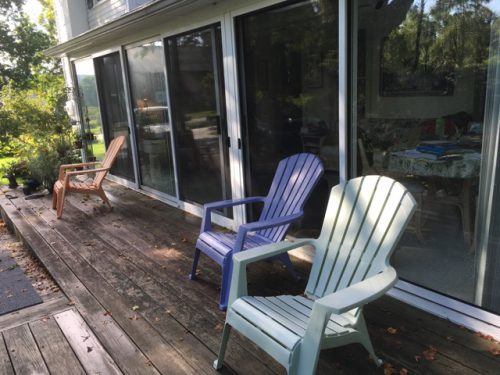
“Sally?” crackled the voice of the home health aide. “Sally? You’re not going to believe this, but I found it. It was on the floor of the side deck right by that purple chair he sits in. It got rained on, but it still works.”
Hallelujah!

The real mystery is how it got there.

I had walked my father into his bedroom at 10:00 the night before, and I’m 95% sure he had it in his ear then. Some time during the night, it mysteriously made its way outside.

I don’t want to think about it.

dementia

Lost in the Hospital

Today I lost my father.

No — it’s not what you think. I misplaced him, or he misplaced himself.

It felt a little odd to tell people, “Umm… I can’t find my father.”

He had a doctor’s appointment this morning, so I dropped him at the hospital door and went to park the car.

Every single other time that I have done this it has worked. He slowly makes his way to the registration, answers the questions about black lung benefits and whether he has traveled outside the country in the past three weeks — and somewhere in the midst of this I catch up with him and shepherd him to the appropriate clinic.

This morning, however, I had trouble finding a parking spot. By the time I got inside, he was nowhere to be seen.

I ran up the stairs to the second floor where the Prime Care clinic was. He wasn’t in the waiting room.

I ran back down the stairs to registration. “I lost my father,” I told the woman at an open registration desk. “Can you verify for me whether he checked in or not?”

After answering a few questions, she confirmed that he had registered for an appointment in Prime Care.

Up the stairs again — but he still wasn’t in the waiting room. I went to the reception desk there. “I lost my father,” I told the woman who helped me. “Can you call back and see if he has already gone back into an exam room?”

“Oh,” she said, “did you want to go back with him?”

“I need to be back with him,” I told her. “He’s 87 and has some dementia.”

She called the nurses’ desk immediately and then said to me, “No, he’s not back there.”

I ran to the third floor. He goes there for cardiology appointments. Maybe he was confused about what clinic to go to. But nope.

I ran to the first floor. Maybe he went to surgical clinic. We’ve gone there a few times recently. No sign of him, though.

I ran back up to the second floor. I was getting my stair workout in early. There was still no sign of my father.

My last idea was for them to page him over the loudspeaker in the hospital, but, to be totally honest, I wondered if he would even hear it. And where would I ask him to be directed to? I was running out of ideas. But I approached the reception desk anyway.

“I still can’t find my father,” I said.

She looked at me sympathetically. “Do you want me to try to put an announcement on the PA?”

I sighed, and looked around hopelessly.

Just then, who should come shuffling along with his walker? My father.

“I went up and down on that elevator,” he said. “It’s a terrible thing to not know where you are.”

Yes, I thought, it was a terrible to not know where you were.

dementia · family

Helpful Words

A foggy morning (that has nothing to do with the post)

“It happens to all of us, you know,” someone said to me when I was talking about my father’s latest foggy episode.

Yesterday morning, when my father was studying his watch, I asked him what time he had.

“Hmmm,” he said, studying the hands and the numbers, “it looks like it’s two minutes past… past… I think it’s two minutes past Tuesday.”

I texted my sister. “I have the title for the book about Dad and dementia — Two Minutes Past Tuesday.”

Funny — but so not funny. Not even remotely funny the more I think about it.

Later in the day he had essentially forgotten my oldest brother, or, at the very least, key elements of Stewart’s life.

“It happens to all of us,” this person said to me, when I told about the things my father had said. “It’ll happen to you. It’ll happen to me. It happens.”

Such a glib response made me wonder if I talk too much about my father and his struggles. I try not to.

The other day when two of my children had a discussion that devolved into nastiness, I said, “Let’s try this again. First she said this (fill in the blank), and then you responded with this (fill in the blank) — but what could have been a better response?”

We talked through possible responses that could have diffused rather than ignited the situation.

It probably won’t work. The next time, they may get after each other again, but maybe a seed has been planted. A seed with a better fruit.

Last night as I lay in bed thinking about the unhelpful response thrown my way, I wondered what I really was looking for in sharing the story of my Dad’s poor thinking. What would have been a better response?

Nobody can really fix the situation. It is what it is.

But here are a few things that may have sounded better.

My sister’s response — “Oh my.” Two words show that she feels the same dismay that I do.

“I’m sorry.” It can be a pat response, but it can also be very sincere. It shows compassion and sympathy.

“That must be so hard.” Yes, yes, it is. I appreciate when people acknowledge that.

“Is there anything I can do?” Yes, there is. You can visit him. Don’t worry about whether he’ll remember your name or not — because the visit isn’t about you. Don’t worry if there are long periods of silence while he searches for words, or if he loses his train of thought altogether. He loves having people sit with him, talk with him, and listen to the same stories (or story fragments). Don’t feel that it’s a waste of time because he may not remember. For that hour that you’re there, he’s loving it. I’m loving it, too, because he’s being fed mentally by the presence of another person.

“How are you doing?” Some days I’m not doing terribly well with all this. Thanks for asking.

family

The Rest of the Story (or, An Ethical Question)

If you knew that one phone call to an influential person would elevate the level of care received in a health care setting, would you make that phone call?

I delved into that question yesterday when I met with someone on an unrelated matter. After taking care of some business, our conversation detoured into my father’s most recent emergency room experience.

“Call me next time,” he said, and handed me his card. “Keep this in your wallet and call me.”

“I won’t call you,” I told him.

My parents raised me to believe that everyone should be treated in the same way. Everyone deserves dignity. Everyone deserves good care. Everyone.

Yet, despite my saying otherwise in this man’s office, I had, the day before, been searching for his phone number while sitting at Hallway 6 with my father. It turned out the website wouldn’t load because it was down for maintenance.

As my sister would say, “It was a God thing.”

I was ready to throw my principles out the window for a little respect for my father. See how shallow I am?

But God, or happenstance, kept me from calling, and my principles remain mostly intact.

Because, in the midst of this search for someone who could get us out of the hallway situation, Roy the cheerful PCA came along.

Tell him a story,” he said.

The rest is history — castles in Bosnia and a hallway bed that became a place for storytelling.

Next time, would I make the phone call? I like to think not.

When I sit quietly with my ideals, everything is clear. I am confident in how I would act given a difficult situation.

But in the midst of a trial, idealism and nobleness vanish like smoke. I need safety measures and reminders in place. I need websites to malfunction.

I intentionally did not put that business card in my wallet. I don’t want to be tempted.

A different hallway bed I sat beside last year.
The call bell for the hallway bed last year. My father didn’t even receive this.


elderly · family

Surgery

Each member of the surgical team looped through the room.  An introduction. Name and date of birth requested. The why-are-you-here question.

My mother didn’t know the answers when I had sat in the same spot with her some years before. I helped.

My father knew — for the most part.

“Did you have anything to eat this morning?” the anesthesiologist asked.

“Not too much,” he answered.

“He had nothing,” I said.

“Has the surgeon marked on you yet?” a nurse asked.

“No, I don’t think so,” he answered.

“Yes, he did,” I replied.

“Can you tell me about your other surgeries?” the surgeon asked.

“It’s been years and years,” my father answered.

“Last August he had a VP shunt put in, and a few years before that he got a pacemaker,” I answered.

He knew his name. He knew his birthday. He knew what the surgery was.

All in all, I’d say he did pretty well.

A few weeks ago, he had had an episode of chest pain that landed him in the Emergency Room. They ask a different set of questions.

“Are you still a full-code?” the nurse had asked, but then she looked to me for the answer. It’s an uncomfortable question.

“Well, I’m not ready to cash in yet!” my father answered.

“Would you like to be placed on life support?” she asked.

“I’m not going to live forever, you know,” he replied.

His mixed responses were confusing, but he and my mother had both very clearly written out their wishes many years ago. I told his doctor and she asked that I bring in a copy to put in his chart. Just so it’s there.

Last night, I went for a walk. The fields were fifty shades of green. The timothy alone was a full palette of color — spring green, grass green, grey green, a whispery pale green at the very edges of the flower-head.

The fields whispered with the breeze, carrying along its little breaths like a melody passed around an orchestra. The meadow swayed and danced, and the only audience for this performance was the deer, the red-wing blackbirds, and me.

When the Bible talks about grass, it’s usually in reference to transience.

“The grass withers, the flower fades…” (Isaiah 40:8)

The comparison isn’t that man will last forever. We are just as transient.

A surgery day is a time to remember that.

It’s a time to pause. Even if we’re not ready to cash in, it’s okay to remember that we aren’t going to live forever either.

*****

The surgery went well. He’s already home. He’s not ready to cash in yet — and neither am I.

family

My Mother’s Closet

My mother’s  closet has only been hers.

When my parents bought this old farmhouse 50 years ago, it had one closet — a tiny one, at that.

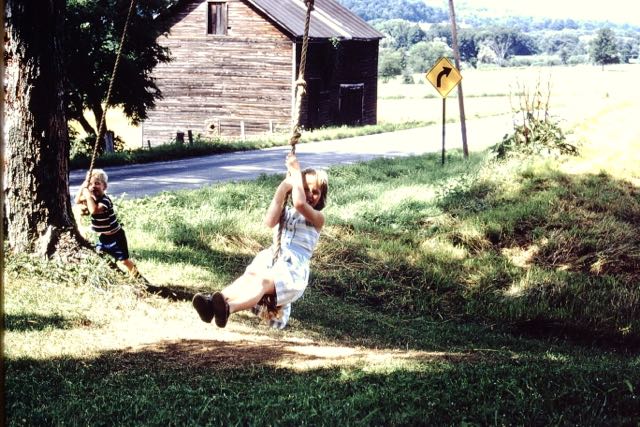
While we kids put up a rope swing, my father put in closets.

Putting up the rope swing
Swinging
putting in closets

Bi-fold doors must have been in then, because that’s what he installed — in his closet, my mother’s closet, my sister’s closet, and my oldest brother’s closet. The rest of us didn’t get closets; we had cardboard wardrobes.

I stood outside my mother’s closet the other day, hesitating to open the door. It has to be done — the cleaning of it, I mean. She’s been gone over a year and a half. My son is staying in that room. And he sure could use a closet.

But I stood there, not wanting to look again at what’s inside.

The brown wool plaid skirt. The green skirt with Greek meander border. The dress she wore at my wedding.

The ruffled blouses that she wore to dress up.

The sweaters.

The housecoats, even.

They’re housecoats, for crying out loud.

But I can picture her standing in the kitchen wearing them, making our lunches for school.

A woman I know lost her house in a fire recently.

Is that how you want to deal with your mother’s things? a voice whispered in my heart. I knew it wasn’t God, because He didn’t burn my friend’s house down. He doesn’t threaten to burn houses down. I saw, however, in my mind’s eye, my fingers being forcibly pried off the things I’m holding onto.

Is that how I want to deal with my mother’s things? No. Absolutely not.

But they must be dealt with.

Garbage? No. That’s wasteful. My mother was never wasteful.

A yard sale? No — I don’t think I could bear watching people paw through her things.

Donate to the church’s rummage sale? No — same reason.

I think I need to box it all up and take it to a donation point in another city. She would want some good to come of it all.

Then, I’ll have to look at an empty closet.

And mourn a little, allowing the closet’s history to move just a wee bit distant into the past.

Before my son moves his stuff in and the closet has its second occupant.


elderly · family · friendship · Leaning In

The Gift of Giving

About a month ago, I received a curious piece of mail.

When I opened the envelope, I found a folded-up piece of yellow construction paper. In red marker, the sender, Juliette, a little girl from our church in Greene, had drawn a heart, an elephant, a waterfall, and some flowers covered in dirt. (Her grandmother wrote explanations for me.) 

It also included a dandelion. I actually love dandelions. I loved when my own children were of the age of bringing me dandelion bouquets.

That letter made my day. It was so fun to receive something so unexpected. I knew I needed to respond, but, in the craziness of getting ready for France, I didn’t do it until the other day.

I made a card for Juliette. 

The rabbits were just a little too big to fit neatly on my card, so one rabbit’s ear and tail fold around onto the back. I guess you could say its back side is on the back side.

I asked her grandmother for Juliette’s address. She texted the address back and added, “She is fascinated right now with giving everyone the pictures she makes.”


Juliette is learning at a young age that giving is its own gift.

***

Last night at the dinner table, as my father repeatedly repeated himself, I found myself wondering at the wisdom of bringing my children here to live with him.

It can be frustrating and even, sometimes, a little irritating to listen to the same comments about the blueness of the skies and the greenness of the plants.

I’ve heard Mary patiently explain how to operate the remote control to the television and sometimes resort the explanation of “magic” when asked how she found the right channel. The other night I heard Karl trying to explain the remote control. Again.

My youngest children have to live in a house with rooms still full of items from previous occupants. My parents’ house became a repository for so many things from other family members that it’s hard to find space for its current residents.

I wonder repeatedly, is this good for them? Is it good for our family to be a little fractured for the sake of the eldest member? Is it good to stretch between two homes, and in so doing, to almost have no home? Is it good to see their grandfather needy and weak and forgetful?

But I remember my mother caring for her mother and mother-in-law. With patience, sacrifice, and great love, she did for them what they could no longer do for themselves.

I suppose I’m following in her footsteps.

It’s a different kind of giving from sending a sweet greeting in the mail.

Sometimes this kind of giving seems like a terrible gift, but I need to remember that it is a gift nonetheless.

I need to lean in. Embrace each moment. These gifts are good.

elderly · family · Travel

Ominous Beginning — Part 2

Traveling is a weary business. Especially when traipsing across time zones.

When you start in a rural area and end in a rural area, travel time is extended by the road time at either end.

We left Cooperstown around 12:30 PM and arrived in Bayeux around 1 PM the following day — which would have been 7 AM New York time.

A little walk, a little food, a little wine — and I was refreshed. When it got to be dinner time, my father didn’t join us because he wasn’t hungry. My sister stayed with him while the rest of us got some crepes.

The next day was to be our first day touring the Normandy beaches. I had gotten up early and been served a lovely tray of coffee in the lounge area downstairs. My sister joined me and we walked to a patisserie to buy some pastries. So far, everything was absolutely wonderful.

But…

an hour or two later…

I was in our room when my brother pounded on the door.

“I need you,” he said, and we hastily followed him back to the room he shared with my father.

My father was laying on the bathroom floor, his face roughly the same color as his t-shirt — white — and damp.

“I saw him hanging onto the counter,” Peter said, “like he was going to pass out, so I helped him lie down and got you.”

Bud quickly sat on the only available seat — the stool — and elevated my father’s legs.

We got a pillow for under his head.

And we discussed what to do.

Last year, right about this time, my sister stayed with my father, heard a crash, and found him on the bathroom floor.

My brother had gotten more than one call from Lifeline after my father had fallen.

I had seen him near-collapse and called the nursing service we use for home care.

Each of us had seen our father like this before —

And therein lies the blessing.

While it was scary, it was not unfamiliar.

“I think it’s a syncopal episode,” one of us said.

I remembered the nurse telling me that one of the causes can be dehydration. Had he drank enough while we traveled? Probably not.

I ran downstairs and got a glass of orange juice. By the time I got back upstairs, his color was much improved. My father felt like he could sit up, so my husband and brother lifted him to a chair.

Orange juice and pain au chocolat work magic

The episode passed. We had a reprieve. The rest of the trip went without incident.

He had a cardiology appointment when we got home. They interrogated his pacemaker and could tell that it hadn’t been a cardiac event. We had been correct in our assessment.

For one moment, I had visions of getting to know the French health care system — but because of my brother’s quick thinking to prevent a fall and our collective experiences with his syncopal episodes, we weathered that storm.

Sometimes, in the midst of a terrible situation, it’s hard to see the good.

And maybe the good is never really good, but becomes a relative goodness — one where you’re able to say a little thank you for a terrible thing that previously happened.

elderly · family

Wandering Words on Travel and Life

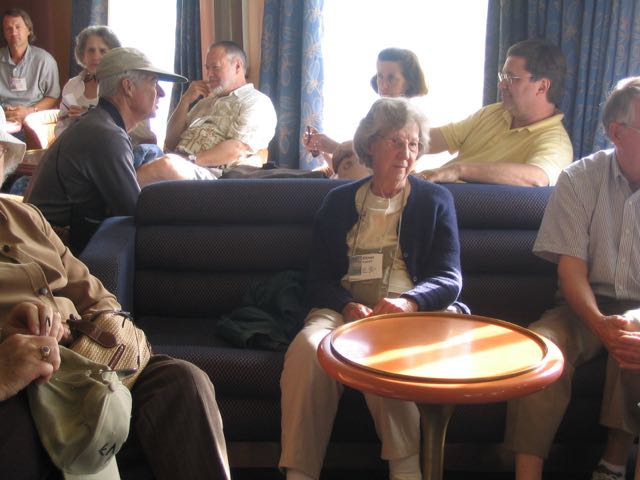
This was a picture I thought about posting yesterday. Same trip — to Greece and Macedonia — but the look is one I recognize from later years.

As Alzheimer’s slowly took her from us, her face became less and less expressive.

We could still coax a smile out of her, but it wasn’t the same.

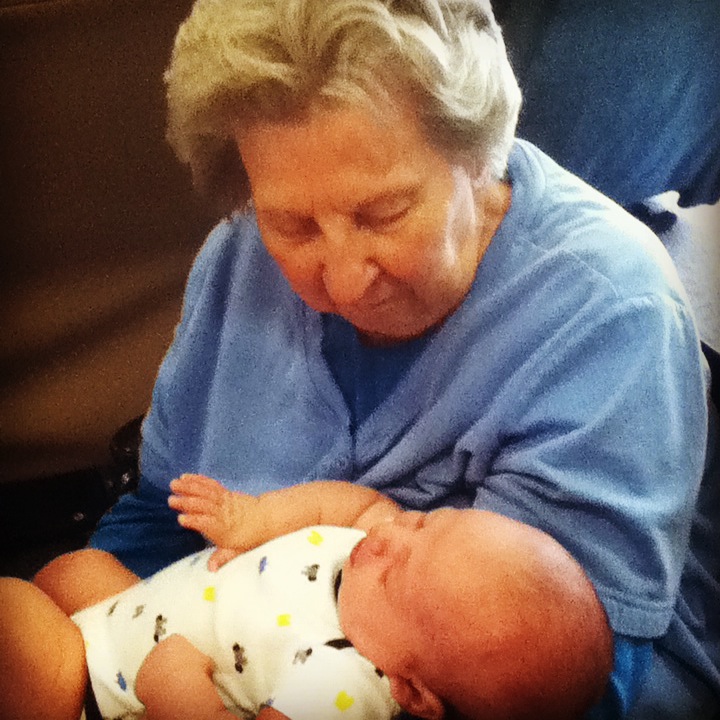
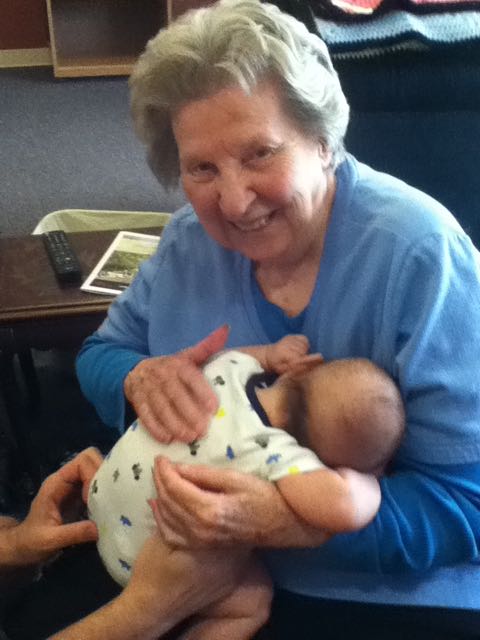
When she first held her great-grandson, she stared and stared. I didn’t think she would ever smile.

He was sleeping when we placed him in her arms. His mother and father hovered, hands ready to catch the precious cargo should she forget what she was doing.

We watched.

We told her over and over that this was her great-grandson.

Other women residents in the nursing home moved closer, wanting to see, wanting to touch this new life. Perhaps some youth would rub off on them.

But we tried to keep this as her moment. It was, after all, her lineage. Her family.

Finally, the baby squirmed — parent hands moved in closer to avert potential disaster — and turned his head toward her breast.

She smiled a real smile that reached her eyes.

So I look at that travel picture of my mother sitting on a bench, alone, slightly lost — and I know that trip was a milestone, but not in the good sense.

It’s almost like we were at the base of Heartbreak Hill — and we were about to tackle the toughest part of the course. But we didn’t fully comprehend it at the time.

And that’s the trouble. I DO comprehend it now. I’m not ready to do it again.

But my father forgot someone yesterday, a person that he had known well for many years but yesterday he had no recollection of her at all.

So, if I feel a little panicked about this trip to Normandy, it’s because I’m thinking of this other journey that I’m on.

What’s that cheesy saying?  “Each day is a gift. That’s why we call it the present.” Sometimes cheesy is good and true.

I need to remember that.

family · Travel

Travel

I suppose this doesn’t look like a terribly dangerous picture, but I still get that squeezy feeling in my stomach when I look at it.

This was from the last overseas trip my parents took together. Nine years ago they went on a tour of Greece and Macedonia — I think it was called something like, “Footsteps of Paul.”

My father had been so excited about this trip. He had ordered all the books and done the recommended reading.

My mother, however, was declining in her mental capacity.  At first, my father was in denial about that. Little things are easy to excuse. As the trip grew closer, it became more and more undeniable. I wrote a post several years ago about that trip and called it “Scary Travels With Alzheimer’s.”

But there she is, in the picture above, smiling, because she has no clue how close she will come to being lost in Greece. (She wandered out of the hotel room without my father but was seen by other members of the tour and kept safe.)

After that trip, my father said their traveling days were over.

Now we’re preparing to take him on a trip. For years he has talked about wanting to go to Normandy to see the beaches of the D-Day invasion. Every time one of his friends came back from Normandy, he would smile and shake his head sadly, saying, “I’d really like to get there someday.”

When my mother was still alive, he wouldn’t leave her. Then his own health issues overlapped with her final days. It’s been a tough go.

So we (my siblings and I) decided it was now or never. We’re going to Normandy. We’ve arranged for a private guide so everything can be done at my father’s pace. We’ll see the beaches and hear the stories, then we’ll spend a few days in Paris.

Yes, danger — on so many levels and so many fronts.

I’m praying it all goes well.