Blather · poetry

Two Roads — FWIW

Two roads diverged in a wood, and I
(I should be telling this with a sigh)
Stood at that fork and took it
Hey Yogi! Hey Raffi!
Look it! Look it! Look it!
You know what came next?
(What came next?)
A knife and spoon!
(clink, clink)
So I kept on walking down the road
With a fork-knife-spoon as my load


On Saturday I was supposed to go to a poetry reading. Mind you, I have done that only once before in my life and it was a terrifying experience. Thankfully an excuse presented itself and I bowed out. The friend who had invited me offered to read my poems for me. I gave her two — neither of which had been the poem I planned to read.

She messaged me later, telling me that the poems were well-received, that I was a rare talent.

To prove her wrong, I’m going to go ahead and publish last week’s tripe, my response to the W3 prompt. The POW gave a lovely challenge: to use 1-2 lines from Robert Frost’s “The Road Not Taken.”

Unfortunately Yogi Berra infiltrated my brain regarding that poem. Yogi once said, “When you come to a fork in the road, take it.” It’s one of many Yogi-isms for which he is famous. Like, “It ain’t over, ’til it’s over,” and “You can observe a lot by watching.”

Suddenly, too, while writing, I was doing battle with Raffi, who kept singing at me (in my head) about a time he went for a walk.

Sheesh.

Sometimes the muses either just aren’t there or are a couple of clowns.

Anyone else struggle with this?

poetry

The One that Got Away

Do you remember that fish?
The one that got away?
Yeah — that humongous one
That amazing summer day

Oh yeah — do I remember!
That battle ‘twixt you and it
?
You were so gol’darn mad
You said that you could spit

[He laughed a hearty laugh]
Oh, man, yes, you are right!
The one that got away
’cause it put up such a fight!

[So, the both of them chuckled
As they stared into the sky
And nibbled on summer timothy,
Then heaved a mighty sigh]


Yes, this is my own submission to my own W3 prompt.

A few weeks ago, I went with a friend to the Arkell Museum in Canajoharie, New York. They had at least 20 Home Winslows as part of their collection!

If you’ve never been to (or heard of) Canajoharie, let me tell you, it’s a tiny town on the Mohawk River in upstate New York. When I was a kid, we went on a field trip to the Beechnut factory there, where baby food was processed and made. Some summers later, I worked at a camp in Middleburgh, New York, where I passed Beechnut fields coming and going — beautiful, rich, farming field of whatever produce Beechnut needed.

Honestly, the whole area was/is as idyllic as a Winslow Homer painting.

In Canajoharie, as part of their village library, they have an art museum called the Arkell Museum. That’s where they had this collection of Winslow Homer paintings.

Anyhoo — I had just seen (and been blown away by) Winslow Homer, up close and personal. He made (and makes) my heart ache. Hence the prompt.

Honestly, I love that grew up in, and now live in, rural upstate New York. I don’t think there’s any prettier place in the world.

As far as the big one that got away? — boy conversation since the beginning of time. Right?

poetry

Seasons

From there to here and here to there
From that to this and this to where
From seed on wind to in the ground
New growth, slow growth — changes abound

In winter earth and trees are bare
From there to here and here to there
Snow and ice yield to subtle Spring
Or not-so-subtle — hear it sing?!

As birds return and leaves burst out
Flowers bloom. They whisper. They shout
From there to here and here to there
Summer comes with flamboyent flair

Flaunting sunshine on sparkling lakes
Eagles, herons, doves, ducks and drakes
Some migrate south on cool fall air
From there to here and here to there


This is my response to the W3 Challenge this week — to write a quatern on the theme of transformation.

What’s a quatern, you ask? Well, it has four quatrains (four-line verses). It’s syllabic: each line has eight syllables. It may rhyme, but rhyming is not required. It has a refrain. The refrain of a quatern repeats the 1st line of stanza one (S1) as the 2nd line of S2, the 3rd line of S3, and the 4th line of S4.

I feel my Dr. Seuss influence is showing in this one.

poetry

In my hand

The nothing weight of a bird
(the word is zero zilch nil)
In my hand, I thought it dead
But its head moved. Later still

The indigo bunting flew
Brilliant blue away on wing
Wonder, marvel, such splendor
I surrender to this thing

This idea that beauty
(nature’s duty) is oft found
In small overlooked moments
Whose components astound

When examined or seen
Like the green praying mantis
Spindly legs folded in front —
A hunt? Or holy practice

The wooly bear in my palm
A psalm of security
As it curls up –in that pose
Choosing to trust surety

I would get it ‘cross the road.
I sing an ode to efts (or
Are they newts?) turtles, toads
Crossing roads. Yes, I adore

The fact that I can hold them
Avoiding mayhem of cars
Moments of peace in my hand –
So grand – if we but stop, ours


This is a Welsh form: Awdl Gywydd (pronounced “ow-dull gee-youth”)

  • Four lines
  • Seven syllables per line
  • The final syllable of the first and third lines rhyme with the 3rd-5th syllable of the following lines
  • The second and fourth lines rhyme.

It’s my response to the W3 prompt this week. Selma Martin (the poet of the week) challenged us to write a poem of any form on the theme of the beauty and perpetuity of the natural world that surrounds you. I am a nature-rescuer, in my own very small way, helping small cross the road on a daily basis, and very occasionally, like the indigo bunting, being surprised at life where I assumed death.

Faith · poetry

In Church

Praying in a pew on well worn kneeler
Darkness flickers while light streams
Sinner. Beloved. Which?

That shadow in the back — did I see something?
Tiny glimpse of disquiet
Lurking, lurking, lurking

Yet, there is light casting rainbow colors
Through tow’ring stained glass windows
Overwhelming peace

Praying in a pew on well worn kneeler
Tiny glimpse of disquiet
Overwhelming peace


This is my response to this week’s W3 challenge — to write a Garland Kimo on the theme of good vs evil.

The ‘Kimo’ is a short syllabic poetic form of three lines. The syllable count per line is 10/7/6.

Also, the kimo is focused on a single frozen image (kind of like a snapshot). So it’s uncommon to have any movement happening in kimo poems.

The ‘Garland Kimo’ is a series of four ‘Kimo’ verses, in which the fourth Kimo verse is composed of lines taken from the previous three Kimo verses, using the 1st line from the 1st Kimo, the 2nd line from the 2nd Kimo, and the 3rd (last) line from the 3rd Kimo.

    Earliest Memories · family · poetry

    One fish, two fish

    You may have tangible wealth untold;
    Caskets of jewels and coffers of gold.
    Richer than I you can never be–
    I had a Mother who read to me.

    ~~ Strickland Gillilan

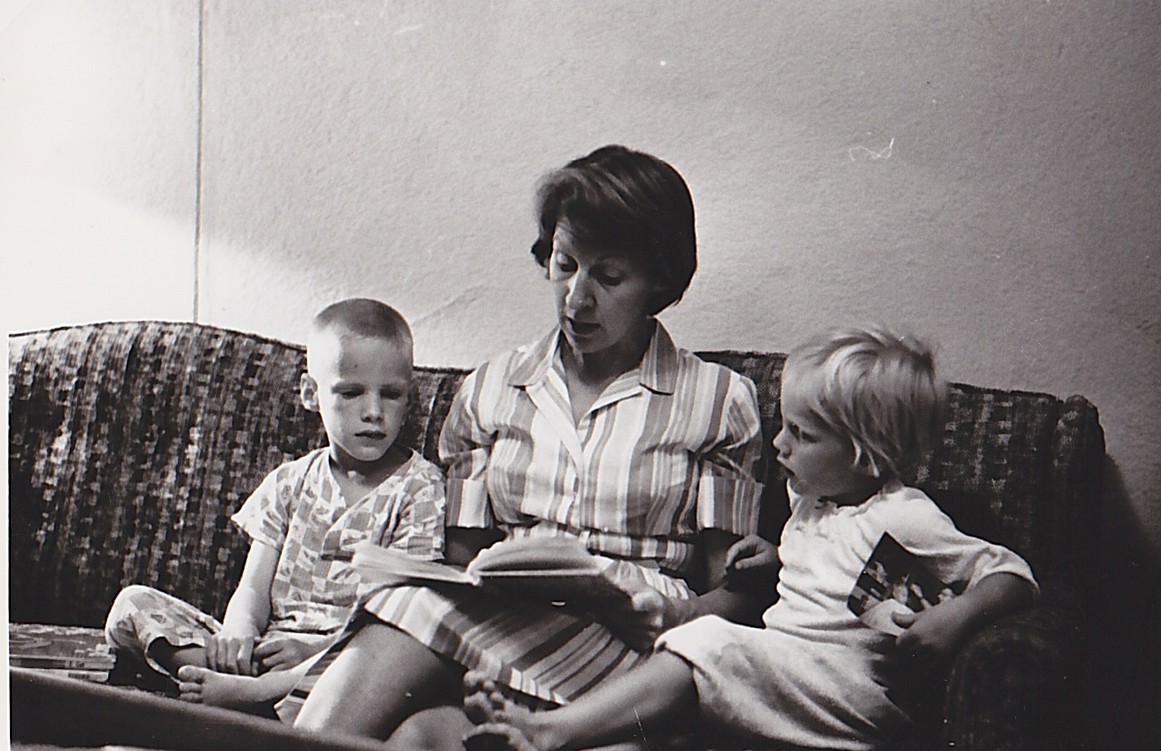
    My mother read to me.
    She read and read and read.
    She taught me to read, maybe so I would stop the pestering.
    One memory, small but big, was a time I asked her to read One fish, two fish, red fish, blue fish
    For the 729th time
    And she sighed, like she didn’t really want to read it, but she did.
    I loved this book.
    It wasn’t the intricate plot.
    It was rhyming words, silliness, and a mother who read it to me over and over.

    One fish
    Two fish
    Red fish
    Blue fish

    Love to look (fish)
    In a book (fish)

    Love to read (fish)
    “MORE!” I plead (fish)

    Snuggle, snuggle next to Mom
    Dr. Seuss? He is the BOMB!

    Reading ’til my eyes grow bleary
    Marguerite Henry, Beverly Cleary
    Jim Kjelgaard, H. A. Rey
    I think I could read books all day

    Late at night, late at night
    I get out my big flashlight
    Hiding underneath bedsheets
    I wander down literary streets

    Mixed Up Files,
    Desert isles,
    Big Red, Misty
    Bring me smiles

    It all began with
    One fish, two fish
    My love for reading
    Grew and grew (fish)


    The W3 prompt this week is to base your piece, a mix of prose and poem, on a childhood memory. I remember my mom reading to me.

    SCN_0276
    Peter, Mom, and me
    poetry

    Garden Fresh

    Summer foods
    Summer eats
    Fresh wholesome
    Tasty treats

    Green beans – yum!
    Dangling down
    Pick and eat
    Best all ’round

    Cucumber
    Love to munch
    Garden yield
    Fresh raw [crunch]

    Yellow squash
    Sliced, sauteed
    Seasoned well
    Makes the grade

    Corn on cob
    Freshly picked
    Butter, salt
    So perfect

    Summer foods
    Summer eats
    Fresh wholesome
    Tasty treats


    This poem is a Cethramtu Rannaigechta Moire.  I can’t pronounce it, but I can tell you that it’s an Irish poetic form that requires 3 syllable lines in quatrains. The second and fourth lines rhyme.

    The W3 prompt this week is to write a food-related poem in any form. Okay, I thought, I’ll just write down everything I eat for the day and make a poem about it. Here was my first verse:

    Farmstand egg
    Whole wheat toast
    Smoked Gouda
    It’s the most

    But I realized that almost everything else I ate was garden-related, so I nixed my egg sandwich and just put verses in that involved fresh produce.

    fiction · poetry

    Cloudy Gray Dullness

    The sky was a cloudy gray dullness making dreary the town.   
    The sun in that nondescript dismal wore no smiley face but a frown   
    The road was a convoy of autos over the drab green moor,   
    And the snake oil man came driving—
    Driving—driving—
    The snake oil man came driving, up to Hotel Moderne door.

    He’d a cowboy hat on his forehead, a bolo below his chin,   
    A coat of angus leather, and Levis of blue denim.
    They fitted with never a wrinkle. His boots had those pointy toes.   
    And he drove his Lexus Hybrid,
    His shiny red Lexus Hybrid,
    His brand new Lexus Hybrid, thus none could admire his clothes.

    Through the streets he piloted and steered his pretentious wheels.
    He waved out the window and honked his horn, but no one fell head over heels.   
    He parked his car at the hotel, and who should be waiting there –  
    But the town’s lone policeman,
    Jeff, the only policeman,
    Ready to write a citation and do it with quite a flair.

    The con artist’s brow – it furrowed – as he looked at the cloudy sky
    Then looked at the Jeff, the policeman. “I’ve got something you want to buy. 
    It’ll make the sky turn sunny on such a dismal day.”  
    But Jeff wrote out a citation
    A rather costly citation
    Yes, Jeff wrote out a citation that the shyster had to pay.


    What’s the citation for, you ask? Could be a bunch of different things. You know the type.

    Honestly, I don’t know though. I write not knowing where I’m going. Then that dang 250 word limits bites. I hit 227 words and knew I couldn’t squeeze another Highwayman verse in with only 23 words remaining.

    Yes, this is my contribution to the Unicorn Challenge. Write no more than 250 words using the photo prompt.

    My apologies to Alfred Noyes who wrote the amazing melodramatic poem, “The Highwayman,” the first long story poem I fell in love with and memorized.

    poetry

    Hip Pain Sucks

    When I rise up from sitting down to standing
    My hip protests, “No! No! You can’t do that!”
    But I’m active — and I’m sick of where I’ve sat
    I actually love the physically demanding!
    My hip protests, “No! No! You can’t do that”
    When I rise up from sitting down to standing


    This was a tough challenge for me! The W3 challenge this week is to write a biolet. A biolet is a six line poem in which the first two lines are repeated as the last two lines, however in reverse. The rhyme scheme can be expressed as ABbaBA (with the capital letters representing the repeated lines).

    Additionally, Sadje challenged us to use the theme of love/hate. I love being physically active. I hate the way this stupid hip pain is keeping me from being as active as I usually am.

    poetry

    Kittens?

    It hit me when I saw them play
    That fuzzy tumbling adorable ballet
    Of baby animals. I was smitten
    But — they’re just a kittens!

    Okay — not kittens. Tiny webbed feet
    Downy feathers, little bills, complete
    The picture — Gosh! I’m smitten!
    They COULD be a kittens

    Actually, I could call them a litter
    But they’re a brood, all a-skitter
    In the lake. I’m smitten
    But no — not kittens!

    These ducklings make me laugh and smile
    No agenda. No politics. No guile.
    Just joyful play. I was as smitten
    As if they were kittens.


    I’ve been swimming in the lake. Of course, I can’t take pictures of the ducklings while I’m swimming, but sometimes when I see them, all I think is that they’re just like kittens — except they don’t have fur and claws and whiskers. Instead they have fuzzy feathers, webbed feet and bills. Other than that they’re pretty much exactly the same.

    This is in response to David’s W3 prompt to write a poem about something that amuses you. Ducklings amuse me. So do kittens.