Life

Step on the Knots

My partner for the ropes course was a cautious woman. She never fell.

I, on the other hand, plunged — literally falling three times — quickly through each element.

She cautiously walked across the wobbly steps. I just — boom-boom-boom — hastily crossed the bridge.

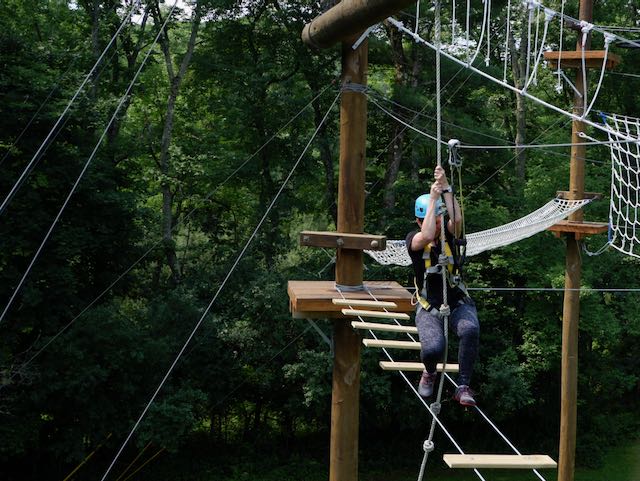
Wobbly steps

She edged her way across the first tightrope. I grabbed each successive support rope and was across in no time.

Tightrope

On the second tightrope, her cautious approach proved better than mine. I fell (caught by my harness, of course) and bore a bruise on my thigh for weeks afterward as a reminder that it’s important to be a little patient.

And so we made our way through the ropes course, each cheering the other on. I recognized her fear. She recognized my foolish haste.

“I wish I had done the Tarzan rope,” she told me later. It was the one element she had skipped.
Tarzan swing

“I wish I had taken my time on more of it,” I confessed, thinking specifically of a net that I should have crawled across instead of trying to just run across it. It was another of my falls.

Before the fall

The element I keep thinking about, though, was one she helped me cross. It was a rope bridge. At this point, she had already seen me fall multiple times.

“Take your time,” she said, as I climbed down onto it.

“One step at a time,” she said, as she saw me looking too far ahead.
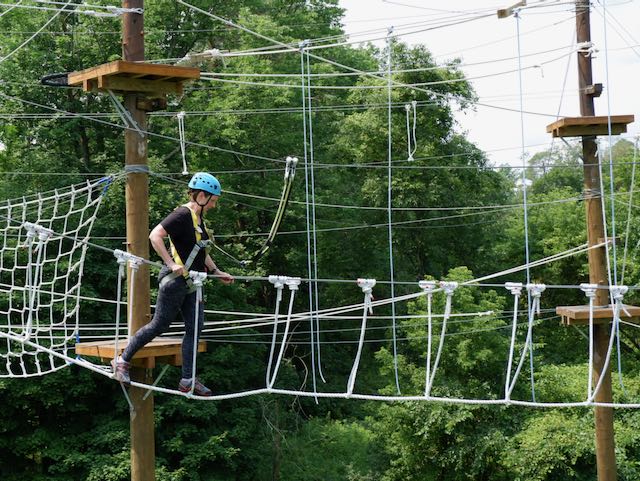
“Step on the knots,” she said, and that advice made all the difference.

I went knot-to-knot across the whole thing, one step at a time, focused not on the far goal, but on where I needed to place my foot next.

Sometimes life can feel so overwhelming.

I don’t know about you, but my life is chock full o’ knots. Some days I want to run past them all and pretend they don’t exist. Some days I just want to sit and do nothing.

But today I will tackle one knot.

And tomorrow another.

Step on the knots. I can do that.
Life

The Bachelor Party

The other day five men came into the sports center together, one of them spinning a shiny new Spalding basketball between his hands.

“Is anyone playing basketball right now?” he asked.

“The gym is available,” I said. “I don’t know if anyone is playing basketball right now though.”

“I think there’s one guy shooting hoops,” my co-worker said.

The guys looked at each other. They looked at what they could see of the facility from the front desk.

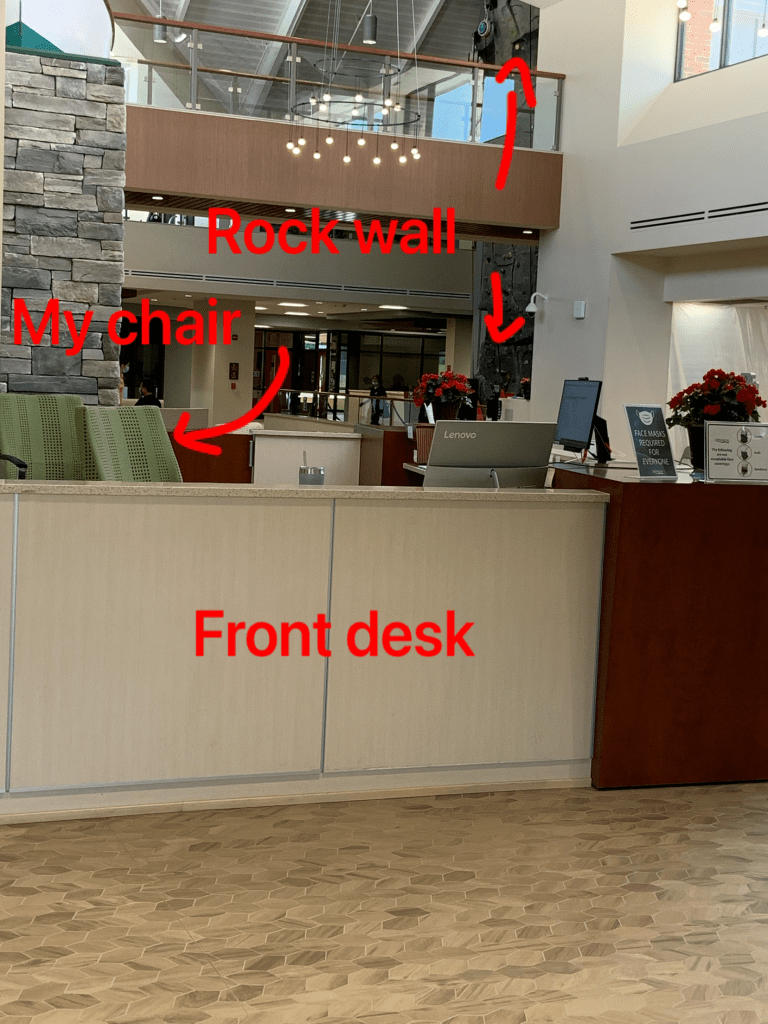
Where I work

“You’ve got a rock wall? Can we climb?” one asked.

“Yep,” I said. “It opens in half an hour.”

“How much does it cost?” another asked.

I explained our day pass system and the two different passes they could purchase — $10 for the facility or $15 to include our fitness center.

“Huddle!” one of them said, and they huddled. Right there in the lobby.

“Okay, we’re going to do it,” they said when they broke their huddle.

“Ten dollars or fifteen?” I asked.

“Fifteen. We’re going to do it all,” said the spokesman.

As they stood at the counter filling out the obligatory paperwork — emergency contact information, waiver forms, etc — I learned a little about them. They were all mid-30s. The five of them had lived together in college. This was a bachelor party.

“Let me tell you about what’s available here,” I said as I collected their papers and their money.

I launched into my spiel. “Our fitness center has two levels. The main floor is traditional equipment, free weights, ellipticals, steppers, treadmills. The upper level has things like kettlebells, ropes, those weight bags that people run up and down stairs with, and other machines. We have the rock wall you can see and a bouldering wall in the gym. There are three pools but you probably don’t have your swim suits with you. There’s racquetball, squash –“

One interrupted — “Do you have racquets we can use?”

“Yes, right outside the courts,” I said, and continued, “There are bowling alleys downstairs –“

“Bowling!” I saw a few high fives. “And that’s open?”

“Yes,” I said, laughing. I loved their excitement.

They headed for the gym first and played a little basketball. Over the next few hours, though, we heard shouts, hurrahs, and bursts of uproarious laughter coming from various parts of the building. We watched them try the rock wall before heading into the fitness center.

When they left before closing, I asked how their day had been.

“Great! Best $15 I’ve ever spent one!” one said.

“We did it all,” said another. “Basketball, bowling, ping-pong –“

“Oh! I forgot to tell you about ping-pong!” I said.

“It’s okay. We found it,” he said.

“And had a great time,” another added.

Their delight became my delight. I still smile when I think about that group of men playing, laughing, having fun, enjoying the time spent together.

I’ve reflected back on this many times. Why did I find it so gratifying? I think it’s because the world has become a meaner place over the last few years. Our laughter is usually at someone else’s expense. Camaraderie tends to devolve into bickering. We don’t listen. We don’t enjoy time together. Everything feels like jockeying for position.

So when two Olympic high jumpers agreed to tie for Gold, it’s an anomaly.

And when five guys, from different places and different walks of life, enjoy each other’s company for a full afternoon, it fills my cup.

Life

Dreadful Beauty

There’s more beauty in the truth, even if it’s a dreadful beauty.

John Steinbeck, East of Eden

I talked to my counselor about East of Eden, telling her how I am being so disciplined about not reading ahead. Seriously, I’m not even flipping a few pages ahead to see how small situations turn out. I’m reading one page at a time.

“Why did you used to read ahead?” she asked.

“The anxiety of not knowing was killing me,” I told her.

“Ah,” she said knowingly. “You struggle with regulating your emotions when you’re reading a book.”

“Only good books,” I told her.

Truthfully, if I don’t love or hate the characters, I don’t need to read ahead. It’s when I’m wrapped up in them that I feel this burning need-to-know.

My brother called me out on it. “That’s cheating,” he said, but then he went on, “Once I was reading a Stephen King book and I hated one of the characters so much that I didn’t think I could finish it, so I put the book down. About six months later, I picked it back up and finished.”

That’s basically what my counselor said, too. “When you feel those emotions rising,” she said, “put the book down and let your feelings settle.”

I’ve made it to page 485 of East of Eden using that technique. It’s slow going, but I’m being an honest reader.

And I love the book.

For so long, I have pushed my feelings aside. They’re like the handblown glass animals I used to keep on a shelf in my room when I was a kid. Occasionally, I would take them off the shelf — usually to dust — and handle them oh-so-carefully. Then I would gently place them back in the same spot they had been standing.

My feelings were too fragile to explore. What if they broke? What if I broke?

I remember one of my high school swimmers holding hours-old baby Laurel. “What if I break her?” she asked me.

“You won’t break her,” I said, knowing that holding my tiny baby wouldn’t harm either of them.

But then again, neither will sitting with strong emotions.

“It’s okay to cry,” my counselor told me early on as I blinked back tears when talking about my father.

“It’s okay to feel angry,” she said, when I told her about a terrible situation I had been in.

I just read the part in East of Eden where Lee tells his backstory. I closed the book and stared at it. It may be a day or two before I reopen it. The strong emotion button has been pushed.

The thing is Lee had known Adam Trask many years before he told him his story, and I had known the two of them for nearly 500 pages of reading. A trust had developed. It didn’t make the story easier. It did make it more beautiful — a dreadful beauty.

And I think that’s partly what I’m afraid of when reading intense books — the dreadfulness. I need to remember there’s a beauty there, too.

Truthfully, we are surrounded by dreadful beauty. Most of the time, we don’t even notice. Our eyes are unseeing and our hearts are unfeeling. Not out of callousness, but out of self-protected-ness, because it hurts to see and feel.

It hurts and yet it is beautiful.

East of Eden is teaching me.

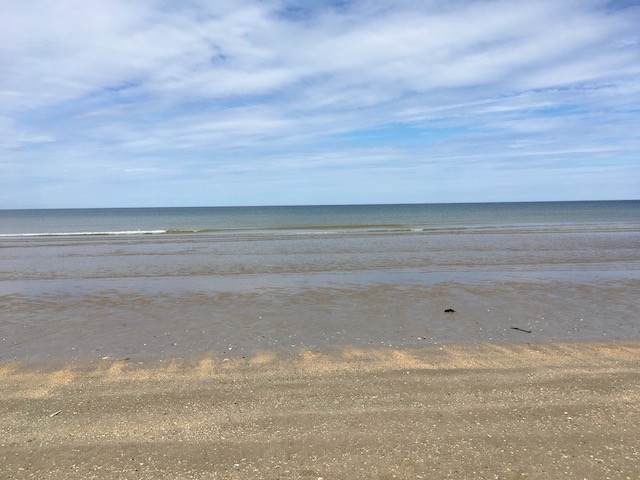
The Beaches of Normandy — truly a dreadful beauty
Life

A Time of Small Letters

The time is come
when the publication of poems
is to be like that
of pale and very light airborne seeds
flowing in the current of forest air
through the blue shadows,
and falling on the grass
where God decrees.
I am convinced
that we are now already
in the time
where the printed word is not read,
but the paper passed from hand to hand
is read eagerly.
A time of small letters,
hesitant,
but serious and personal,
and outside of the meaningless dimension
of the huge,
the monstrous
and the cruel.

Thomas Merton, Seeds of Destruction, “To a Cuban poet”
Every seed is a bit of Optimism.

Last spring I painted this on a sheet of plywood to hang on the barn.

However, when I carried it out to the barn and stood by the road to look at it, the seeds in the breeze were barely visible and the words were a little hard to read.

So I lugged it back to the house, took this one poor photograph of it, and painted over the whole thing — a single daisy and the word HOPE.

I needed hope so much in that season. I missed my father awfully. I was overwhelmed with his estate. I felt like I was failing at everything.

This morning I was feeling that aching need for hope again — but for entirely different reasons.

It is, indeed, a time for small letters — hand-written and from the heart.

For slowing down and noticing.

For seeing, really seeing, what is true and good.

I need some seeds to plant in the ground.

And I need to wait in hope.

Life · Uncategorized

Priorities

The first duty of love is to listen.

Paul Tillich
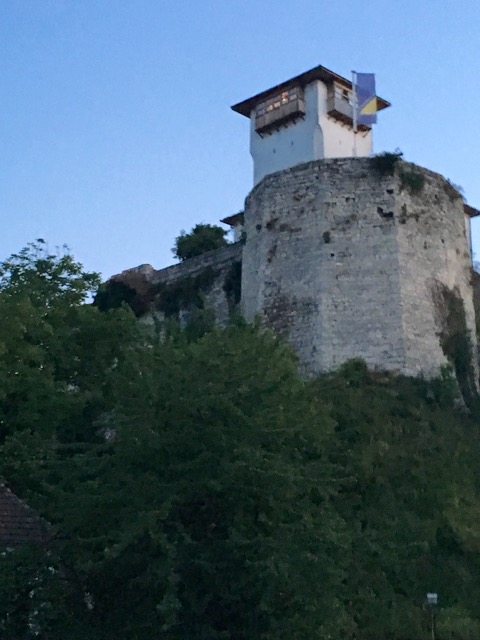
Gradačac castle

(Warning: a late-ish post after a long day. My sole New Year’s resolution was to write every day, and, doggone it, I’m not giving up in the first ten days of January!)

My son came downstairs this morning while I was working on Duolingo. I’ve been using the app to learn Scottish Gaelic. “I find that really inspirational, Mom, that you work so diligently on that,” he said.

Mind you, Laurel, found it less inspirational when she was talking to me yesterday and I opened Duolingo. She was talking away and I interrupted with something profound like, “OH MY GOODNESS! LOOK! LOOK! LOOK!” They had just added a whole bunch more levels of Gaelic and I thought I was finishing the only remaining lesson available to me.

“See? You never listen to me,” Laurel said.

I repeated back to her verbatim whatever it was she had just said to me — but honestly, I was pretty excited that I now could continue learning Gaelic. Unfortunately today, I have no idea what it was she said to me.

I was planning to write a post about learning new languages and tell a sweet little story of an experience I had while in Gradačac, Bosnia. I said something in Croatian (which is close cousin to Bosnian) to a girl in a souvenir shop. She whispered something to her friend and then answered me in English. The friend told me that was the first time she has been brave enough to speak English to an American.

But the Laurel interaction niggles at me.

On the one hand, I connected with a teenager in Bosnia several years ago and remember it, despite the fact that that was the extent of our relationship. On the other hand, I was not giving my own daughter full attention yesterday morning and she felt the sting of it. Which of these people is more important to me?

Laurel. Hands-down, without-a-doubt Laurel.

Yet a connection over a cultural divide is also important. My poor Croatian betrayed my non-fluency and gave a girl a little boldness. I’m glad I was brave enough to risk sounding foolish.

So, if, as Paul Tillich says, the first duty of love is to listen, I need to do better. I need to close my computer, put down my device, and pay attention to the people who are most important to me and right in the room with me.

But somewhere down the line in duties of love, there has to be something about remembering those little moments, those little interactions, when you connect with someone else, maybe even someone from a totally different culture, and you’re both the better for it.

Life

Mid-way Through East of Eden

“…I want to ask you something. I can’t remember behind the last ugly thing. Was she very beautiful, Samuel?”

“To you she was because you built her. I don’t think you ever saw her — only your own creation.”

John Steinbeck, East of Eden

Like most of our country, I’m still trying to understand what happened in Washington on Wednesday. The mob scenes from the Capitol play over and over in my mind. It’s like when every station on the car radio is playing the same song. And it’s not a song you like.

I’m reading East of Eden right now (and not reading the back of the book first). This won’t be a spoiler for those who haven’t yet read it because I’m smack dab in the middle and I don’t know how things will turn out. Plus, who knows? Maybe I’m all wrong in this middle of the book assessment. But here goes —

Adam, the main character, is the one speaking in the quote at the top of this post. He had recently been seriously injured by Cathy, a woman he loves. “I can’t remember… Was she very beautiful?” he asks.

Samuel’s answer to Adam helps me understand Wednesday’s events. “To you she was because you built her. I don’t think you ever saw her — only your own creation.”

Other people saw Cathy, Adam’s wife, for what she was – dark and evil. But Adam was smitten. He saw something in her that wasn’t there.

There are people in my life — some of them family members — who see our president very differently from how I see him. I can’t fathom their vision. It feels twisted. But they may wonder the same about me.

And as I continue to read about Adam working through his feelings, I’ll be working through my own, trying to make sense of something that may never make sense to me.

Life

Melting Icy Fingers

Thanksgiving is not a result of perception; thanksgiving is the access to perception.

Virginia Stem Owens

By taking the time to be grateful, I can melt the icy fingers of fear that squeeze my heart today.

Today I am thankful for my neighbors down the road with the Trump sign in their yard and my neighbors in the other direction with the Biden sign. We co-exist on a single stretch of road in peace.

I am thankful for my co-workers who support different political parties and ideologies. We work side-by-side. We laugh together. We learn from each other. We have common ground.

I am thankful for my family members who believe conspiracy theories and for my family members who honor science. Although we may disagree — PASSIONATELY disagree — on issues we hold dear, at the end of the day, we hold each other dearer.

I am thankful that I live in a country where people can assemble peacefully and voice their opinion.

I am thankful for the thoughtfulness and perseverance of the framers of our constitution. I’m thankful for the many people over the years who have served in our government, hashing out amendments and other acts to guide us through turbulent times.

I’m thankful for mistakes because we can learn so much from them.

I’m thankful for wise decisions.

I’m thankful for the dog sleeping here who is oblivious to any of my internal angst. I’m thankful for the cat who tries to taunt the dog — and still the dog sleeps.

I’m thankful for friends who can reassure me that it will be okay.

I’m thankful for coffee.

I’m thankful for quiet mornings when I can gather my thoughts and offer them to God.

I’m thankful for snow. It’s so pretty.

I’m thankful for slush. It means I’ll get to wash the car.

I’m thankful for a woodstove and wood and a cozy room in a drafty house.

I’m thankful that the more things I list here, the more things come to mind. There is a magic in seeing blessings.

I’m thankful for tomorrow because it will come. And the next day, and the next day.

I’m thankful for you, whoever you are, for reading through all this because no matter who you are and what you think or believe, we can link arms and walk a few steps down the road together.

family · Life

Primary Experiences of Life and Death

Many persons live their entire lives without ever seeing a human being die.

Howard Thurman, “Life Must Be Experienced” in The Inward Journey
My father caring for my mother in her last days

At the time, I didn’t realize what a privilege it was to sit with my mother and then my father as they passed from one life into the next.

In some ways, it felt like an awfulness. Especially with my mother, with that gurgle of excess fluid that the nurse would suction out to make her more comfortable. It’s a sound I won’t forget.

And I prayed in my mother’s last few days conflicting prayers of “Please, Lord, let her live until my sister gets here” and “Please, Lord, relieve this terrible suffering.”

She lived until my sister arrived. We were all gathered around my mother’s bed in the hospital — her living children and my father — as she died.

My father went more quickly. One day he was up, dressing himself, coming out breakfast. Before the end of the day, my children had to help him back to bed. The next day he didn’t get out of it and he died that evening.

My brothers were there. One sister-in-law. One nephew. Most of my children. His home health aide. My sister had not yet arrived. My brother played a song on a CD for him as he passed.

My sister got there in the wee hours of the morning and went to see him as he was laid out in his bed. The hospice nurse who had prepared the body had clasped my father’s hands across his abdomen and it looked so unnatural. He looked so dead, and I wished with all my heart that my sister could have seen him alive one last time. We had Face-timed with her in the afternoon, but it’s not the same.

These days, the stories that come out of the hospitals impacted with COVID are awful — the shortages of rooms, equipment, and personnel. The makeshift morgues. The isolation.

I wept one day in the car listening on the radio to a nurse describe staying over and over after her shift had ended to sit with a dying patient because she didn’t want anyone to die alone. How many patients had she done that with? I don’t remember — but it was many.

And I realized the great privilege I had — to sit with my parents in a non-COVID world and tell them I loved them one last time.

Life

Dry Years

And it never failed that during the dry years the people forgot about the rich years, and during the wet years they lost all memory of the dry years. It was always that way.

John Steinbeck, East of Eden

My one New Year’s resolution was to get back to writing every day.

For me, that means posting here every day. Posting keeps me honest — and humble.

Posting every day means that I’ll probably post 360 of drivel and hopefully 5 days of something worth reading. (You’ll have to keep watching for those good ones.)

Today was a busy day for me. No problem, I thought. I have a ton of drafts available to draw from. (291 to be exact.)

For the past hour, I’ve looked through drafts that date as far back as 2011. I didn’t find a single one that I wanted to post. But here’s what I realized — those years that I thought were dry and hard, when I was helping with my mother and then caring for my father, actually weren’t dry at all. They were rich.

And I had forgotten how rich.

The drought that we call COVID has been the ultimate dry. I feel desiccated.

So lest I forget, here are some photos from a richer time:

Our first day in France, May 2017
My father’s 88th birthday party
Dad playing with his great-grandson
When I accompanied my father to a charity event — 2016
When Helen coaxed a smile out of my mom
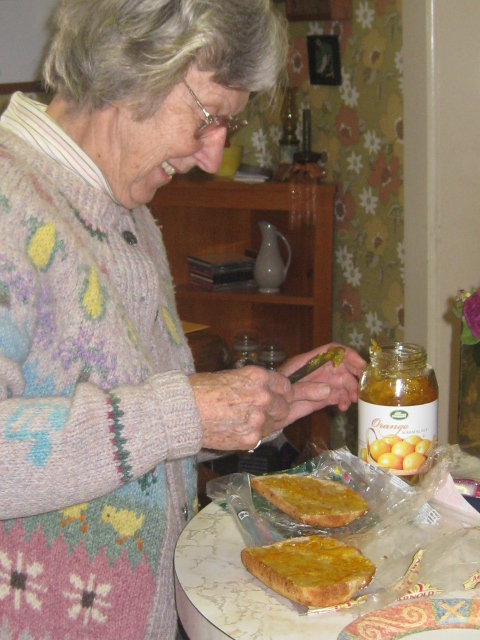
When Mom was putting marmalade on everything

This dry time will pass — and none too soon.

Life

Questions

There are no ugly questions except those clothed in condescension.

John Steinbeck, East of Eden

“I’m showing you this because I think you want to know. You always ask questions,” my co-worker Michelle said to me the other day.

I started a new very part-time job a few months ago. I now work at the front desk of the facility where I’ve worked for years in Aquatics. The new role is mostly people-y. I greet people as they come in the building and I make sure they have a reservation.

The other front desk-ers remark often on the quietness. No kids are allowed with the facility’s COVID restrictions. Members only, no day passes. And everything is reservation only.

My new job also involves administrative work which has been eye-opening for me. This has been the biggest area of learning.

I would learn better if we were busy, but we’re not, so I DO ask a lot of questions. Most of my questions are “How do I do this again?” Some are “Why do we do it this way?” Others are “What if [insert a set of circumstances]?”

The other day when Michelle came to show me something it was because I had wrongly activated a person who was deceased. His widow had mailed in her renewal and I entered it into the computer. The main member was still listed as the husband, and they weren’t people known to me, so I just activated the whole subscription.

“See — he’s listed as ‘inactive.’ That’s because he died last year. But she’s only ‘expired’ so when we mark her as paid, she becomes ‘active’ again,” Michelle explained.

“How did you know?” I asked.

“Well, I know the people,” she said, but then she also showed me a clue on the registration form itself.

“So, let me get this straight. If they’re inactive, they may be dead, but if they’re expired, they’re probably alive.”

Michelle laughed. “I guess you’re right.”

Words are funny things — and fun.

And questions are good — especially when you’re trying to learn.

Another friend once told me that the only bad question is the one you have but don’t ask.

Maybe that’s why I ask lots of questions.

My father used to say we should learn something new every day.

Maybe that’s why I ask lots of questions.

Curiouser and curiouser. That’s me — in more ways than one.