When my parents bought this old farmhouse 50 years ago, it had one closet — a tiny one, at that.
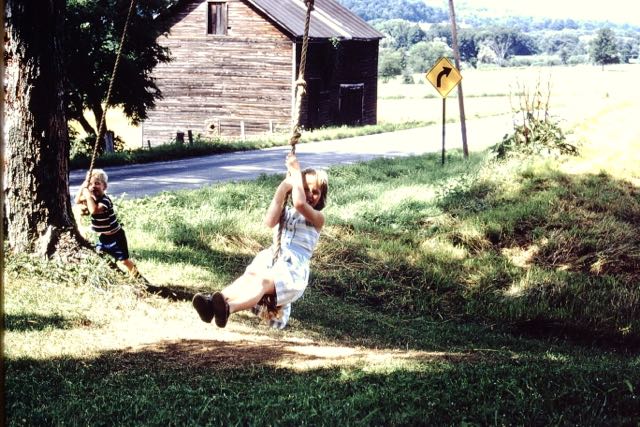
While we kids put up a rope swing, my father put in closets.
Putting up the rope swingSwingingputting in closets
Bi-fold doors must have been in then, because that’s what he installed — in his closet, my mother’s closet, my sister’s closet, and my oldest brother’s closet. The rest of us didn’t get closets; we had cardboard wardrobes.
I stood outside my mother’s closet the other day, hesitating to open the door. It has to be done — the cleaning of it, I mean. She’s been gone over a year and a half. My son is staying in that room. And he sure could use a closet.
But I stood there, not wanting to look again at what’s inside.
The brown wool plaid skirt. The green skirt with Greek meander border. The dress she wore at my wedding.
The ruffled blouses that she wore to dress up.
The sweaters.
The housecoats, even.
They’re housecoats, for crying out loud.
But I can picture her standing in the kitchen wearing them, making our lunches for school.
A woman I know lost her house in a fire recently.
Is that how you want to deal with your mother’s things? a voice whispered in my heart. I knew it wasn’t God, because He didn’t burn my friend’s house down. He doesn’t threaten to burn houses down. I saw, however, in my mind’s eye, my fingers being forcibly pried off the things I’m holding onto.
Is that how I want to deal with my mother’s things? No. Absolutely not.
But they must be dealt with.
Garbage? No. That’s wasteful. My mother was never wasteful.
A yard sale? No — I don’t think I could bear watching people paw through her things.
Donate to the church’s rummage sale? No — same reason.
I think I need to box it all up and take it to a donation point in another city. She would want some good to come of it all.
Then, I’ll have to look at an empty closet.
And mourn a little, allowing the closet’s history to move just a wee bit distant into the past.
Before my son moves his stuff in and the closet has its second occupant.
About a month ago, I received a curious piece of mail.
When I opened the envelope, I found a folded-up piece of yellow construction paper. In red marker, the sender, Juliette, a little girl from our church in Greene, had drawn a heart, an elephant, a waterfall, and some flowers covered in dirt. (Her grandmother wrote explanations for me.)
It also included a dandelion. I actually love dandelions. I loved when my own children were of the age of bringing me dandelion bouquets.
That letter made my day. It was so fun to receive something so unexpected. I knew I needed to respond, but, in the craziness of getting ready for France, I didn’t do it until the other day.
I made a card for Juliette.
The rabbits were just a little too big to fit neatly on my card, so one rabbit’s ear and tail fold around onto the back. I guess you could say its back side is on the back side.
I asked her grandmother for Juliette’s address. She texted the address back and added, “She is fascinated right now with giving everyone the pictures she makes.”
Juliette is learning at a young age that giving is its own gift.
***
Last night at the dinner table, as my father repeatedly repeated himself, I found myself wondering at the wisdom of bringing my children here to live with him.
It can be frustrating and even, sometimes, a little irritating to listen to the same comments about the blueness of the skies and the greenness of the plants.
I’ve heard Mary patiently explain how to operate the remote control to the television and sometimes resort the explanation of “magic” when asked how she found the right channel. The other night I heard Karl trying to explain the remote control. Again.
My youngest children have to live in a house with rooms still full of items from previous occupants. My parents’ house became a repository for so many things from other family members that it’s hard to find space for its current residents.
I wonder repeatedly, is this good for them? Is it good for our family to be a little fractured for the sake of the eldest member? Is it good to stretch between two homes, and in so doing, to almost have no home? Is it good to see their grandfather needy and weak and forgetful?
But I remember my mother caring for her mother and mother-in-law. With patience, sacrifice, and great love, she did for them what they could no longer do for themselves.
I suppose I’m following in her footsteps.
It’s a different kind of giving from sending a sweet greeting in the mail.
Sometimes this kind of giving seems like a terrible gift, but I need to remember that it is a gift nonetheless.
I need to lean in. Embrace each moment. These gifts are good.
When the rain started at 6 AM, I knew that the weatherman had been at least partially correct.
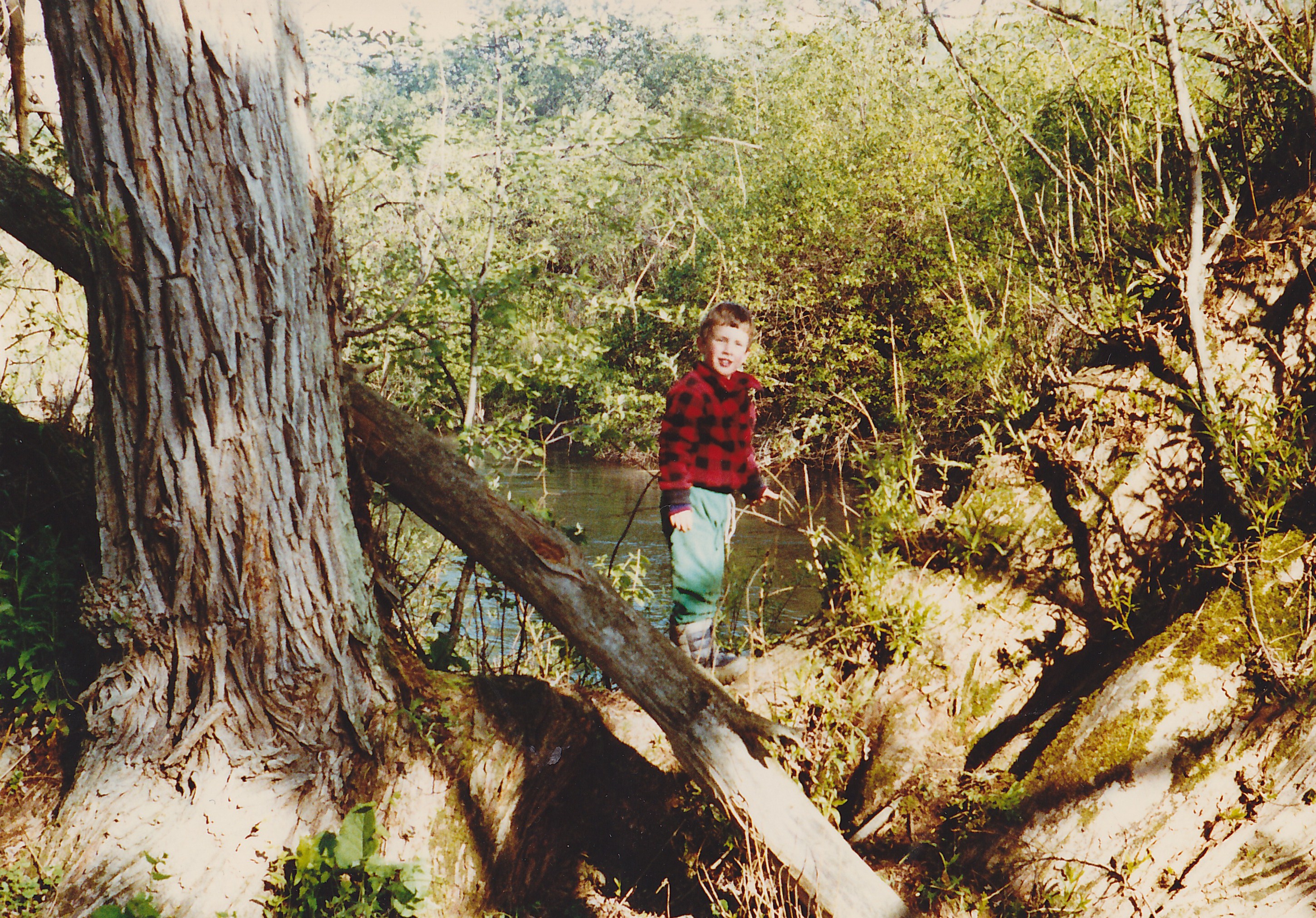
In Cooperstown, a 70 mile canoe race begins early on the lake on Memorial Day. When I was little, I remember running down to the river from our house, crunching through skunk cabbage and violets, to stand on a tree that extended over the river. My family cheered the canoeists on from that secluded spot.
My oldest son at our tree spot — 1989?
When my children were little, we would get up early and go to the bridge down the street that was the site of the first portage. For many people this was the first place to cheer for the racers once they left the lake. Afterwards, my parents would join us for a big family breakfast at our house — eggs, cinnamon rolls, fresh fruit, orange juice, and coffee.
Always a thrill to see the line of canoes coming down the river.Portage — 2005
Now, since I’m staying with my father, I suppose we could go crunching through overgrown pasture and hope to find our tree over the river, but I doubt it’s still there. Plus the idea of getting wet trekking through the tall grass doesn’t appeal to me. We usually drive in to the bridge and follow-up with the pancake breakfast at the Baptist Church.
Except this year.
Oh, the rain! It wasn’t drip-dropping. It was out-and-out pouring.
I pitied the canoeists.
My father and my brother once participated in the race on a rainy Memorial Day. My father told me that in the middle of that miserable race, my brother said, “Dad, if you finish this, I’ll never ask you for anything again.”
They finished. Not sure about the rest.
The things we say in the midst of trials! Another time when they entered, he had accused my father of having no rhythm, but, then, I may have said something similar when my husband and I attempted a different canoe race. In fact, I think I threatened to throw my husband overboard.
We also finished.
Paddling together is a learning experience.
This year, however, with the rain, and with my father having had a small scare (ER visit, one night hospitalization) a few days before, I didn’t ask him if he wanted to watch the regatta. I hoped he wouldn’t remember it.
But, of course, he did. The next day. When the results were on the front page of the newspaper.
“We missed the canoe race,” he said to me, a little accusingly.
“It was pouring, Dad,” I told him, and he acquiesced.
But he brought it up again.
And again.
The last time he said it was when we ran into a lady from his church.
“Did you watch the regatta?” she asked.
He looked at me. “No. We missed it,” he said.
“It was raining,” I offered as explanation.
“Pouring,” she said. “Plus, if you’ve seen one canoe race, you’ve seen ’em all.”
That may be true, but not for the racers. It was their day, their race — and we missed a chance to cheer them on. I still feel a trace of guilt.
Traveling is a weary business. Especially when traipsing across time zones.
When you start in a rural area and end in a rural area, travel time is extended by the road time at either end.
We left Cooperstown around 12:30 PM and arrived in Bayeux around 1 PM the following day — which would have been 7 AM New York time.
A little walk, a little food, a little wine — and I was refreshed. When it got to be dinner time, my father didn’t join us because he wasn’t hungry. My sister stayed with him while the rest of us got some crepes.
The next day was to be our first day touring the Normandy beaches. I had gotten up early and been served a lovely tray of coffee in the lounge area downstairs. My sister joined me and we walked to a patisserie to buy some pastries. So far, everything was absolutely wonderful.
But…
an hour or two later…
I was in our room when my brother pounded on the door.
“I need you,” he said, and we hastily followed him back to the room he shared with my father.
My father was laying on the bathroom floor, his face roughly the same color as his t-shirt — white — and damp.
“I saw him hanging onto the counter,” Peter said, “like he was going to pass out, so I helped him lie down and got you.”
Bud quickly sat on the only available seat — the stool — and elevated my father’s legs.
We got a pillow for under his head.
And we discussed what to do.
Last year, right about this time, my sister stayed with my father, heard a crash, and found him on the bathroom floor.
My brother had gotten more than one call from Lifeline after my father had fallen.
I had seen him near-collapse and called the nursing service we use for home care.
Each of us had seen our father like this before —
And therein lies the blessing.
While it was scary, it was not unfamiliar.
“I think it’s a syncopal episode,” one of us said.
I remembered the nurse telling me that one of the causes can be dehydration. Had he drank enough while we traveled? Probably not.
I ran downstairs and got a glass of orange juice. By the time I got back upstairs, his color was much improved. My father felt like he could sit up, so my husband and brother lifted him to a chair.
Orange juice and pain au chocolat work magic
The episode passed. We had a reprieve. The rest of the trip went without incident.
He had a cardiology appointment when we got home. They interrogated his pacemaker and could tell that it hadn’t been a cardiac event. We had been correct in our assessment.
For one moment, I had visions of getting to know the French health care system — but because of my brother’s quick thinking to prevent a fall and our collective experiences with his syncopal episodes, we weathered that storm.
Sometimes, in the midst of a terrible situation, it’s hard to see the good.
And maybe the good is never really good, but becomes a relative goodness — one where you’re able to say a little thank you for a terrible thing that previously happened.
My sister asked at the beginning of the trip if there was anything special we wanted to do, I said, “Bud and I would like a dinner together, just the two of us.”
It happens so rarely. Still.
On our last night in Paris, we had that just-the-two-of-us time. We talked about asking the concierge to recommend a nice restaurant. We talked about riding on the top of a double-decker bus and touring Paris. In the end, however, we went for a walk.
If I had to pick a metaphor for my life, it would be a walk. One foot in front of the other, over and over and over — sometimes stopping to savor a moment, sometimes ducking and running as a storm blows through, but mostly just walking.
I’m so glad I have a companion for the walk.
If I had to choose a metaphor for Bud’s life, it would be a car. On one of our first dates, we went to see “Coal Miner’s Daughter.” The line was long to get in, and wound out along the sidewalk. As we stood outside trying to make get-to-know-you small talk, Bud started talking about a car. I can still hear him — “It wasn’t really a car — it was a work of art.” He described its leather seats and fancy wheels, and I had barely any idea what he was talking about.
For Bud, automobiles are a combination of utility and beauty. Bud embodies that combination — he is the hardest working person I know but he also pauses to appreciate beauty.
That night in Paris, Bud and I walked down the Champs-Elysées. We stopped at the Peugeot store — yes, there were car storefronts — and while I admired the beautiful ocean-y color of the car, he looked at the specs.
Then we continued walking down. Down, down, down — past the Grand Palais and the Petit Palais.
Earlier in the day we had walked there with my family and toured the fine arts museum in the Petit Palais. The Louvre seemed overwhelming to get to and tour with my father, but this museum was perfect for us.
As Bud and I continued our walk, we found a large event occupying the space between us and Les Invalides. They were preparing for the Paris ePrix, a Formula-1 type race using electric cars.
We walked down pit road. Clusters of people spoke with drivers and I wondered which of these was the Dale Earnhart Jr of eFormula. Bud studied the cars.
Years ago, as our metaphors clashed and life’s bumpy road put stresses on us, we went to see a counselor.
“You two approach life very differently,” she observed, “but you make it work.”
And we do. Both. Approach life differently AND make it work.
Because marriage IS a lot of work.
But walking or driving — it’s worth it.
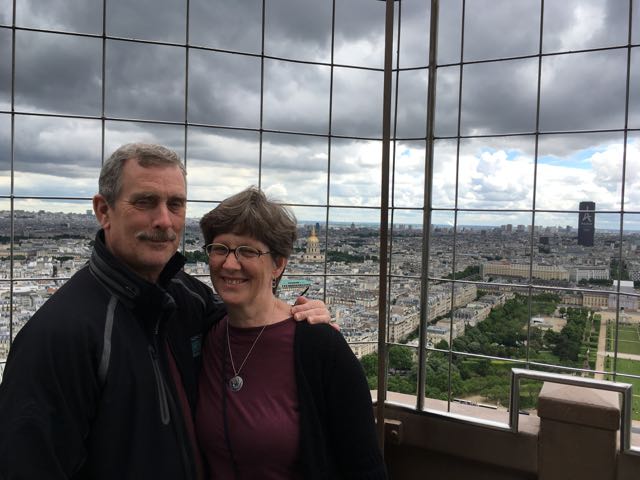
35 years ago I could not have imagined being in Paris with Bud, but this walk through Paris, admiring the beauty of cars, was the perfect way for us was to celebrate our anniversary.
Three years ago today, as we waited word on the arrival of our first grandson, we also watched Karl and his partner, Michael, play tennis for high school sectionals.
In no particular order, here are a few things about my mother.
My mother was the youngest of four. She had an older sister and two older brothers. She was the one who took care of her own mother in her last decades.
My mother and her mother
My mother lived to the age of 87, although Alzheimer’s took her “in dribs and drabs” for years before that.
My mother loved gardening. Her father brought her some pansies when she was a girl and that started her love affair with flowers.
When my mother was weeding the gardens between the fence and the road, she would shake her fist at cars that drove by too fast.
On summer evenings, my mother always had a bowl and/or a bag and/or a cutting board so she could work on shelling peas or cutting up green beans from the garden. She would then freeze them in neatly labeled containers and we would enjoy them all winter.
My mother made the best soups in the world. Leftovers never went to waste. They would appear in soups and somehow tasted delicious. The turkey carcass at Thanksgiving turned into the best of the best soups. It would simmer on the wood stove for days.
My mother often put on her lipstick using the rearview mirror in the car, but she really didn’t wear much make-up besides that.
My mother struggled to tame her hair just like I do. Sometimes she would wet it down, curl it the right way, and put a little hair clip in to hold it while it dried. Then she would pull the clip out before she left the house (or sometimes the car) and quickly brush through her hair, hoping for the best.
My mother clipped coupons. Loads of them. And kept them in her purse in an overstuffed coupon wallet.
My mother lapsed into Boston occasionally when she spoke. “Pahk the cah on Pione-eh Street.” Most of the time she spoke the right way though.
When my mother would ask me to set the table for dinner, and I told her I was right in the middle of “The Brady Bunch” or “Gilligan’s Island,” she would let me wait until the show was over to do the job.
My mother gave me a negligee the night before my wedding. It was long and lacy and had a matching robe. She didn’t say much when she gave it to me, just “I thought you might like this.”
My mother flew to Wyoming to meet her oldest grandchild. I remember the way she carefully cradled his head because of an infant’s weak neck muscles, just the way she had taught me so many years ago in 4-H.
When my mother needed to hem a dress for me, she would have me stand on the dining room table and slowly turn while she used a yardstick and pins to mark the right length.
When my mother answered the phone, she didn’t say “Hello,” she said, “This is Mrs. P–” She taught me to answer the phone, “Dr. P–‘s resident, Sally speaking.”
When my mother drank wine, her cheeks got red.
My mother was registered nurse. When my youngest brother was in 7th grade, she went to work for the Red Cross, drawing blood at bloodmobiles. She was very proud of the fact that sometimes people would wait for her to be available to do the poke because she rarely missed.
My mother knew how to pick up snakes, using thumb and forefinger right behind the head. Her brother taught her, and she, in turn, taught me.
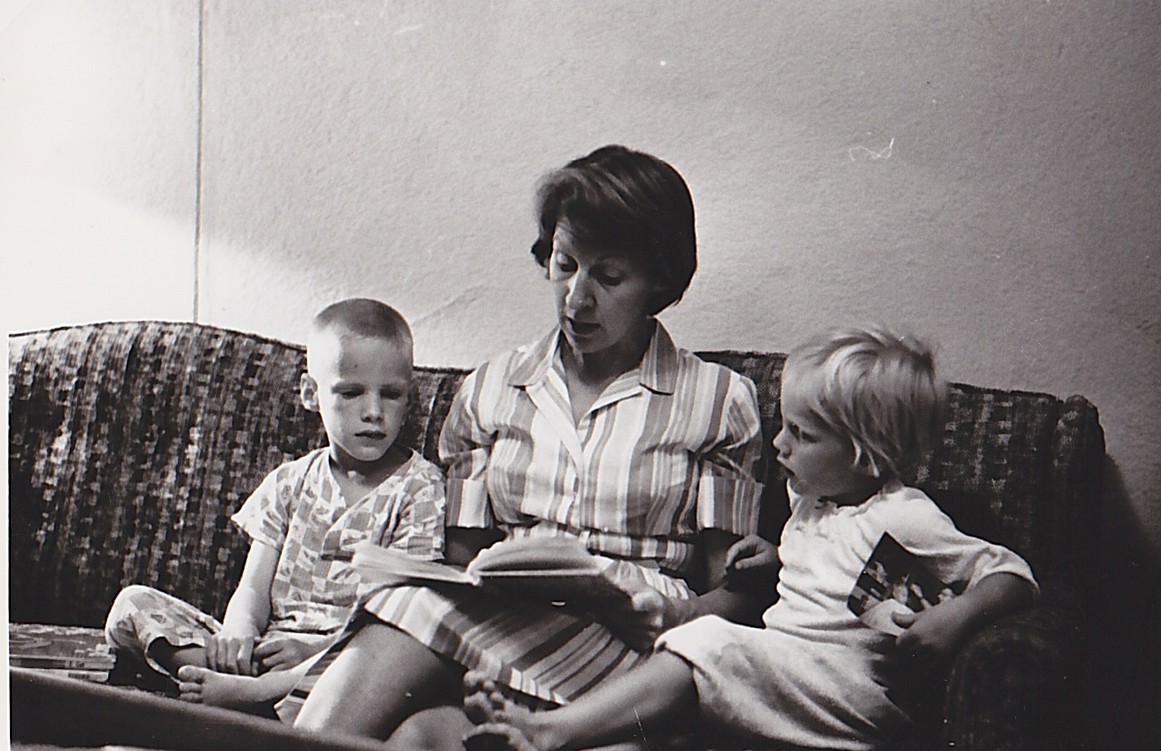
My mother read to me, sitting on the grey couch that we still have. My favorite books were “One Fish, Two Fish” and “The Poky Little Puppy.” I never heard her complain about reading them over and over and over and over.
My mother taught me to read.
I never heard my mother swear, except for “damn” and that was when she really mad or frustrated, and I’m not sure that even counts as a swear word.
My mother knew six ways to anywhere. She liked to drive ways with the least number of left hand turns, and sometimes she would take a longer route in order to avoid left hand turns.
My mother would drive a few extra miles to save a penny per gallon on gas.
My mother knew all the rest areas between Cooperstown and Myrtle Beach, and had mentally ranked them. She knew which ones were “good” — that meant they were generally clean — and which ones were not.
My mother always made us use the bathroom before we went on a car trip. If we told her that we didn’t have to, she would tell us to “go try.” We usually produced.
Once, when we were coming home from Christmas shopping in Albany, our car ran out of gas. My father hitchhiked to get some gas for us. I was convinced that I was going to freeze to death right there in the car, and my mother calmly had me lie down in the Vista Cruiser station wagon while she unfolded a newspaper. She placed the large newspaper sheets over me as a blanket. I’m pretty sure she saved my life, although nobody else seemed to be freezing the way I was.
My mother let me have her wedding dress, although I was nowhere near as tiny-waisted as she had been. The seamstress who made my dress used lace from my mother’s to make the yoke on my bodice and the cap for my veil.
MomDad, me, Mom
My mother wrote notes to herself and made lists, both of them to help her remember. I still find them occasionally. One will flutter out of a book, or be mixed with a pile of papers. I’ll recognize her neat handwriting and the way she underlined words that she wanted to emphasize.
My mother, in the summer, hung our sheets to dry on the clothesline by the chicken coop. When she made the bed with clean sheets, she tucked the corners in so tightly that my feet were squished when I first got into bed. The sheets smelled like green grass and fresh air, a scent no dryer sheet will ever reproduce.
My mother loved to sing. She sang in the church choir for as long as I can remember. When she was dieing, members of the choir came to her hospital room and sang hymns to her. It was some of the most beautiful singing I have ever heard.
This is my second Mother’s Day without a mother. It’s good to remember her.
The other day one of my kids called. “Did you know Mary and Laurel are watching ’13 Reasons Why’?” he asked.
I knew Mary was. The show about a girl who commits suicide had created enough rumblings before the final episodes that I was aware of it and asked Mary about it.
“It’s really well done,” she said.
“Does it glorify suicide?” I asked.
“No,” she said firmly.
When I found out that Laurel was watching too, I cringed a little.
At that point, it was too late though. The lid was off the jar; the fireflies had escaped. I can’t really change that.
“What do you think of it?” I asked Laurel.
“I dunno,” she said, the standard teenage answer for almost everything, not because they don’t know but because it’s hard to articulate thoughts and feelings.
Last night my friends were discussing it, and not favorably.
“Does the show glorify suicide?” I asked Mary again.
“No,” she answered, “it does not glorify suicide.”
“I feel like I shouldn’t have let you two watch it,” I said to them. “I’ll bet so-and-so (and here I mentioned the name of a wonderful mother I know) wouldn’t have let her kids watch it.”
Laurel laughed. She was sprawled on the couch with her head in my lap. For all her grown-up height and attributes, she still likes to snuggle.
“If she hadn’t let her kids watch it, they would have watched it anyway,” she said. “Saying no would just make them want to watch it more.”
It reminded me of when I was around Laurel’s age and “Summer of ’42” came out in the theaters. Everyone was going to see it. Everyone but me, that is. My parents were adamant.
Back in the 70s, I couldn’t sneak up to my room and watch it anyway. I would have had to walk two miles into town and hope the ticket person at the theater wouldn’t question the scrawny pre-teen trying to buy a ticket to an R-rated movie.
Nope, couldn’t do that — so I read the book.
Laurel was right. “No” to a teen means find a way.
I suppose it would have been nice to process Summer of ’42 with someone, but I also suppose if my mother had asked me if I had any questions, I would have said, “I dunno.”
But for my children, especially my daughters who watched a show about a girl who commits suicide, let me give you 13 reasons why not.
I will always love you. There’s nothing you can do to change that.
I will not get tired of you. I won’t push you away. You won’t reach a limit with me.
I will fight fiercely for you. I’ll spend hours on the phone, or in doctor’s offices, or at schools, or wherever you need me to advocate for you as best I can. I will actively pursue getting you help if I can’t do it myself.
I’m not alone in loving you. One of the blessings of a large family is that you have small army at your back. We’re a mighty group of swordsmen who will surround you if needed and fight off your foes.
You fill a spot in my heart that no one else can fill. If you were gone, you’d leave a terrible hole.
Henry. The next generation is here. He thinks you’re pretty awesome.
Grampa. You brighten an old man’s life. You are a blessing to him. Yes, he repeats himself and the things he says to you, but I see his eyes light up when you share your world with him.
You are not the biggest screw-up in the world. That would be me.
If you need me to, I can complete this sentence a thousand different joyful ways — “I remember the day you…..”
Whatever the terrible thing is that you’re dealing with at this moment will someday be a distant memory. Throw the stick in the river and let it disappear down the bend on the way to the Chesapeake. Or, better yet, throw the stick in the fire — you know we’re big on doing that.
Tomorrow is a new day.
You’ve already made a difference in the world. Think about a time when you were kind. If you can’t think of one, I can — and I’ll tell you about it.
Know that I will accept “I dunno” as an answer. I know sometimes it’s hard to put feelings into words. And that’s okay — but I’m here to listen if you ever want to try to find those words.
“Doctor Who is helping you learn Croatian,” Mary pointed out the other day.
I had given Mary this cup in her Easter basket.
Because she likes Doctor Who.
The other day, as I was trying to jam more Croatian words into my head, I threw up my hands, and said, “How am I ever going to remember that daleko means far?!”
Then I saw Mary’s Dalek cup.
I want the Daleks far from me.
Dalek — daleko. I’ll remember it now, even if only temporarily.
The better part of my day — actually, the best part — bringing my father to a pancake breakfast to benefit a local man who was injured in a snowmobile accident.












 Hot Dogs and Marmalade