Faith · family

Shall We Gather At the River

Yesterday morning, when Dad came out for breakfast, he told me that he had composed a song while he was sleeping.

“Really?” I said. “Are you going to sing it for me?”

“Yes, I will,” he replied. “Just give me a minute to remember it.”

He sat there thinking, while I took his blood pressure and got his morning meds for him.

My father has compared his singing with Lee Marvin’s in Paint Your Wagon. In fact, I can remember times when my father would burst into “Wand’rin’ Star,” singing the first few lines. Lee Marvin’s gravelly baritone-bass was just enough off-key that I felt a kinship to him, and just enough on-key that I enjoyed the song — but my father was just off-key. I always smiled, though, when I heard him singing.

My mother was a soprano. Yesterday we sang “Shall We Gather at the River?” at church. I got a little lump in my throat because I could hear her singing this good Baptist hymn. It reminded me of my mother’s Baptist upbringing. I remember her singing it.

Shall we gather at the river,
Where bright angel feet have trod,
With its crystal tide forever
Flowing by the throne of God?

Refrain:
Yes, we’ll gather at the river,
The beautiful, the beautiful river;
Gather with the saints at the river
That flows by the throne of God.

My father was bobbing his head a little, trying to find the rhythm for this song he wanted to sing for me.

“The words are kind of crazy,” he said. “I don’t think I can remember them all.”

“Just sing what you can,” I said, getting more curious by the moment.

He closed his eyes and sang, “Humpty-backed camels and chimpanzees…” He swayed to some internal music, then finished with, “but there ain’t no uni-corn,” and opened his eyes to see what I thought.

“I hate to break it to you, Dad,” I said, “but that song has already been written.”

He laughed, “Well, isn’t that the darnedest thing.”

I sang The Unicorn Song for him, (not nearly as well as The Irish Rovers)

There was green alligators and long-necked geese
Some humpty-backed camels and some chimpanzees
Some cats and rats and elephants, but sure as you’re born
The loveliest of all was the unicorn*

He mouthed the words with me and nodded, remembering them better as he heard them.

“That’s right!” he said.

“You were listening to it last night,” I said. “It probably got stuck in your head and played in your dreams.”

He shook his head, “The brain is an amazing thing, isn’t it?”

The funny thing about the Wand’rin’ Star song is that my father was born under the farthest thing from a wandering star. He was born under a stay-put star. Fifty-some years ago, when he left the Army, he bought a house and settled in.

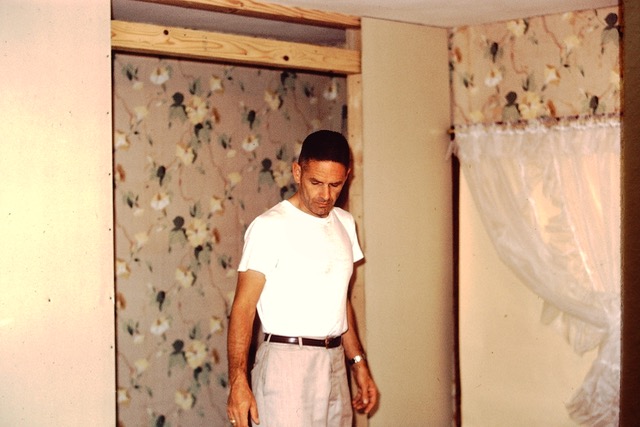
He put closets in the house.

The house had only one closet when he bought it — not nearly enough for a family of seven.

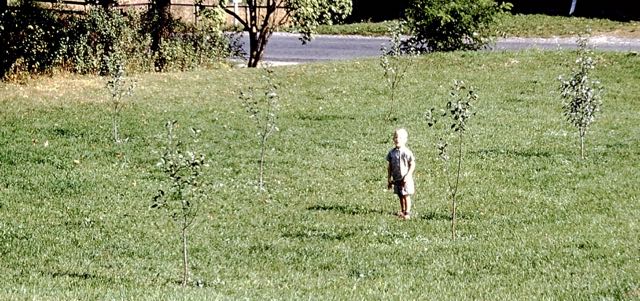
He planted trees, putting down roots.

My brother standing by the newly planted orchard – 1968

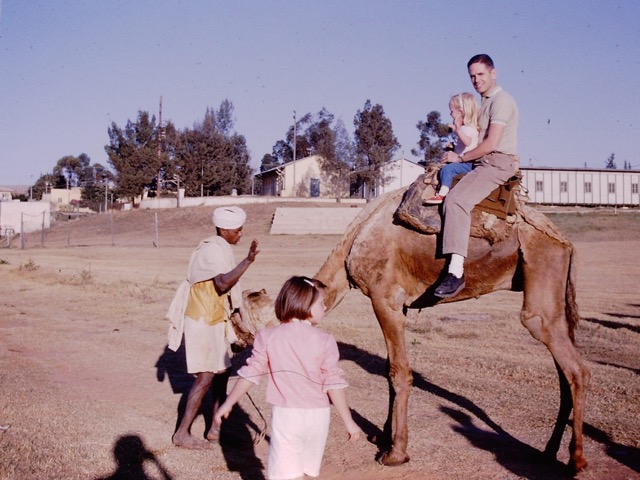
Those humpty-backed camels — I suppose they were a part of his life, too — but only a small part.

My father and I riding a camel

The last verse of Shall We Gather says —

Soon we’ll reach the silver river,
Soon our pilgrimage will cease;
Soon our happy hearts will quiver
With the melody of peace.

Perhaps it’s there that we’ll find those missing unicorns.


family · photography · Travel

Sweet

Our trip to France was sweet.

I’m not talking about the food, which, of course, was amazing.

My food pictures leave something to be desired — not the food, my pictures.

Like this dessert — I don’t remember what it was, but it was delicious.

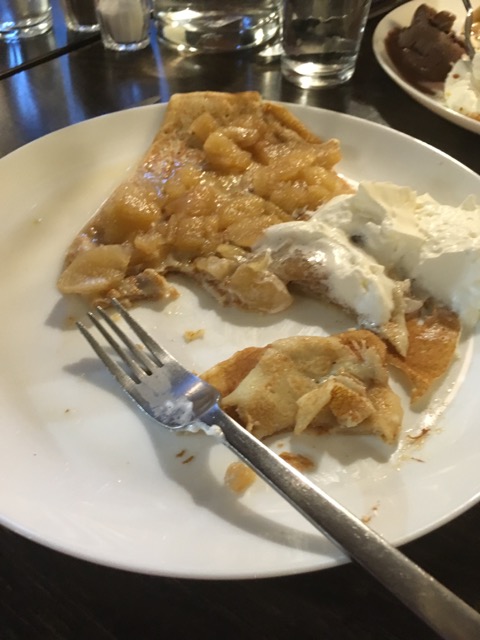
Or these crepes — which looked so wonderful that I started to eat them and then remembered to take a picture.

I took a picture of these meringues on Day 1 because I had never seen such large meringues. The patisserie was closed but I wanted to remember to buy some later. Unfortunately I forgot.

This pastry with apricots was really good but I can’t remember the name.

The sweetest thing about that pastry, though, was that my siblings and I sat outside on a bench to enjoy our selections from the patisserie together. We talked and enjoyed the morning sun before heading back to our hotel.

For years, I had heard my father say that he really wanted to see the beaches of Normandy — so we made it happen.

He probably doesn’t remember the trip today — at least not without the aid of the photo book we put together.

But we remember.

For one week last May, we fulfilled one of my father’s dreams — and had a good time doing it.

That’s the sweetest part.


family

A Privilege

Yesterday I ran into someone at the pool that I hadn’t seen in years — Bridget‘s father.

Bridget was on the first team that I coached and I still think back on her fondly. In fact, I had just been telling Laurel about Bridget the other day.

Bridget held all her team records with open hands. When Helen was quite young, Bridget told her to go break all those records. It was such a gift, so encouraging. Helen went on to break quite a few of them.

Anyway, Bridget’s father, Mike, asked about my father. I told him that I was staying with my father to take care of him.

“It’s such a privilege, don’t you think?” he asked.

I nodded in agreement.

Those were words I needed to hear.

Sometimes caregiving doesn’t feel like a privilege. It feels more like a chore. When I was home with small children, there were days when I would  look out the window and long for the freedom to go do something, anything besides laundry and cooking and changing diapers and wiping noses.

I used to bring my kids to the gym for a playtime we called “Kiddie-gym.”  The pre-schoolers would climb around on the mats and throw balls and scoot on scooters. The moms would sit and talk.

One day one of the moms talked about trying to find childcare for her twin two-year-olds so she could go back to college for a graduate degree. The mom next to me leaned close and whispered, “After all she went through to have those children, she’s abdicating her responsibility.”

It’s true that the woman with the twins had used in vitro fertilization. It’s true her husband had a good job so she didn’t need to work. But abdication? It seemed like a strong term to describe a mother furthering her education. Abdication was what a king did when he gave up his throne.

My take-away from that conversation, though, was that motherhood was on par with royalty. It was an honor and a privilege to be a mom. On my looking-out-the-window days, longing for something else, I would remind myself of that. I would lean in and embrace the wearisome work because not everyone has that privilege.

This morning a woman complained to me about the child-care hours at the gym.

“They don’t open until like 8:15 AM and they aren’t even open every day,” she said. “What if someone wants to work out before they go to work?”

“Maybe their spouse or significant other can watch the children,” I suggested.

“That discriminates against single moms,” she replied.

“Being a parent involves a lot of sacrifice,” I said, but I could see that she didn’t appreciate my answer.

I was glad for my conversation the previous day about care-giving being a privilege. It reminded me to stop thinking about the things I can’t do, but to appreciate the things that I can.

I can find the Jumble in the newspaper.

I can change the channel to Jeopardy.

I can fix over-easy eggs.

I can help with crossword puzzle clues.

I can drive him to the doctor or to get a haircut.

I can rescue photographs from the garbage.

I can remind him of people’s names.

I can tell him at 3 AM that it’s time to go back to sleep.

I can keep him in the home where he has lived for over 50 years.

Yes, it’s a privilege.


Faith · family

Lent 2018

My sister messaged me yesterday, “…about Tuga… has he returned to your pocket, or was he so last year?”

Tuga, the little brown bunny who stayed in my pocket for Lent 2017 as a reminder of the sorrow in the world, is not so last year. He’s so in Bosnia.

I have other Tugas. Three sets, as a matter of fact, of Tuga and Aleluja, sitting on my shelf. One set is promised to someone. The other two are at-the-ready, for when I meet someone who needs a mindfulness token of sorrow and joy.

Ash Wednesday, the first day of Lent, has had new meaning for me since 2014. That year, early in the morning of Ash Wednesday, my sister called with the news that my oldest brother had unexpectedly passed away after a heart attack.

Yesterday I read through some of the posts I had written in the subsequent days. Most are private now — as in, you can’t read them; I took them down because they were too personal — but the Ash Wednesday one is public.

When I’m telling someone about Stewart, I almost always refer to him as brilliant. Hamilton College undergrad — their first Russian Studies major. Yale Divinity School for his M. Div. and then Syracuse Law for his J.D. He had a home computer before that was a thing — like in 1983. He had set it up to run tessellations — which, of course, has nothing to do with Russian or Divinity or Law.

In the last few years of Stewart’s life I had been frustrated with him.  He had been nearly job-less, doing pulpit supply and seemingly little else. Every month my father sent him money to pay his rent.

In the meantime, I was running myself ragged, driving back and forth between Greene and Cooperstown, trying to help my father take care of my mother.

“Why can’t Stewart move in with Mom and Dad?” I griped to my sister. “He could be of real help to them and Dad wouldn’t have to keep sending him money.”

It irked me.

It seemed unfair.

But when Stewart died, and I met the many people whose lives had been touched by Stewart’s, I realized that I only knew part of the story. Stewart lived in a low-income area. He drove neighbors to doctor’s appointments and listened to their lives. His congregation gathered every evening in the apartment complex’s gazebo.

“That’s where Stewart sat,” one lady told us, pointing to a bench at one of the picnic tables. “He was always here for us.”

He had a church, unrecognized by anyone, because it was so informal, yet so personal. It didn’t pay the bills. It paid in intangibles.

I couldn’t see it — I don’t think anyone could — until he was gone, and we slowly unknotted the knot that was his life.

In his book, Great Lent, my Lenten reading for this year, Alexander Schmemann said,

If God loves every man it is because He alone knows the priceless and absolutely unique treasure, the “soul” or “person” He gave every man. There is no “impersonal” love because love is the wonderful discovery of the “person” in “man,” of the personal and unique in the common and general. It is the discovery of the unique in each man of that which is “lovable” in him, of that which is from God.

I looked around my room this morning for something to carry in my pocket for Lent. Tuga had been a good companion last year, but I wanted something to remind me of the hidden person, the God in each person I meet.

I settled on a Monkey’s Fist that had been sitting on my dresser. It probably belongs to one of my children — but it’s mine for this season. A knot, the heart of which is hidden from me.

Wikipedia says, “Monkey’s fists are commonly used as a convenient and unobtrusive method of storing and transporting precious gemstones.” What can be more precious than God?

God wears a costume of human flesh. He’s in the guy at the gas station, and the friend that encourages me.

But He’s also hiding somewhere in the woman who irritates me, and the man sitting on the couch in the other room, rifling through papers again and again.

I’m going to be on the lookout for Him.

family

When Boys Become Men

The other day I worked a few hours in the mid-day so that the full-time staff could attend a meeting together. Karl was heading into the gym anyway to work out so I grabbed a ride with him. I made arrangements with “Fred” to pick me up, which turned out to be a good thing since I had forgotten my phone.

When I finished work I headed to the front door to wait for my ride. A number of welcoming couches sit in the lobby with a good view of the circle where cars pick up and drop off people. I thought about sitting — I tend to stand and pace when I lifeguard — but a man was sitting on one of the couches and I didn’t feel like making small talk so I stood at the door.

I stood.

And waited.

And watched.

Fred must have forgotten me, I figured. Fifteen minutes had passed and there was no sign of him. Sometimes he gets involved in his reading and loses track of the time. Really, don’t we all do that when we’re in the midst of a good book?

I walked back to the pool and called the landline at the house. No one answered, so I left a message, and walked back out to wait some more.

My feet were tired. I wanted to sit, but that darn man was still sitting in the lobby, his back to me, engrossed in a book. I sighed and decided to chance the small talk.

When I rounded the couch, I realized that the man was Fred!

How can a mother not recognize her own son?

One minute a little boy’s eyes are twinkling with mischief. His hair is tousled or buzzed right off. His t-shirts reveal what he had for lunch that day — or dinner the night before. His knees are covered with Buzz Lightyear bandaids. His feet are bare.

And the next minute, he’s six foot something, with hair cut by a stylist and clothes carefully coordinated for the activities of the day.

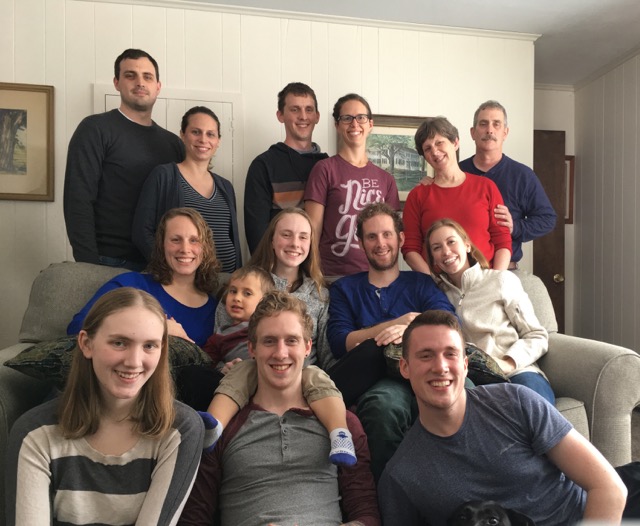
My whole family was together this past weekend. The kids all went into the sports center to play squash and swim. One of the ladies at the front desk stopped me on Monday.

“I saw some of your boys at the gym this weekend,” she said.

“They were all at the gym,” I told her.

“Even Sam?” she asked. She knows he lives thousands of miles away.

“Yes, even Sam,” I replied.

I pulled out my phone to show her a picture I had taken while everyone was together.

“Oh, my,” she said as I identified each of my children. “They’re all so grown up!”

Back row: Philip, Amanda, Sam, Donna, me, Bud
Middle row: Helen, Laurel, Owen, Emily
Middle row .5: Henry
Front row: Mary, Karl, “Fred”

Yes, they are.

Boys become men.

Girls become women.

Family remains family — and grows.

I am so blessed.


dementia · family

Old Photographs

One of my kids told me, “I pulled some pictures out of the garbage by Grampa’s chair yesterday.”

“What?!” I said.

I knew my father had been going through old photographs. It’s something he enjoys. He’ll sit there for hours sifting through and resifting.

“Hey! Have I ever shown you this one?” he’ll ask as I walk past.

I’ll pause and squint to see the glossy black-and-white snapshot in his hand. “This is the house I used to live in,” he’ll explain, and sometimes launch into a story of how his cousin lived right next door and that there was a path worn through the trees, or how he and his father hid time capsules under the floorboards or in the walls.

“This is my father,” he’ll say. “He was a pretty handsome fellow, don’t you think?”

“Here’s one of my old girlfriends,” he’ll say, and my stomach gets a little squeezy because I don’t want him thinking about old girlfriends even though I know that’s silly.

As my son was telling me about the photographs that had been in wastebasket, he looked in. “Here they are again,” he said, and he pulled several out.

I was upset and a little bewildered. Why was my father discarding these old photographs?

“I think it was just an accident,” my son said, reading the unhappy look on my face.

No, the first time could have been an accident, but twice in two days seems pretty intentional.

I’ve heard my father say, in very general terms, “I don’t know who’s going to want all this stuff.”

“What are you wondering about?” I’ll ask.

“That Johnny Damon statue,” is a common reply. He went through a period convinced that we needed to take Johnny Damon to the Baseball Hall of Fame. Surely they would want it. 

I’m not so sure.

Maybe he was thinking that no one would want these old photographs.

I looked at the most recent batch pulled from the garbage. They were all taken in Seligman, Arizona, in 1924.

The story goes that my grandfather and some friends had driven a car across the country in 1924, stopping in towns along the way to sell advertising on the side of the car and work for a short stint to earn money for the next leg of the journey.

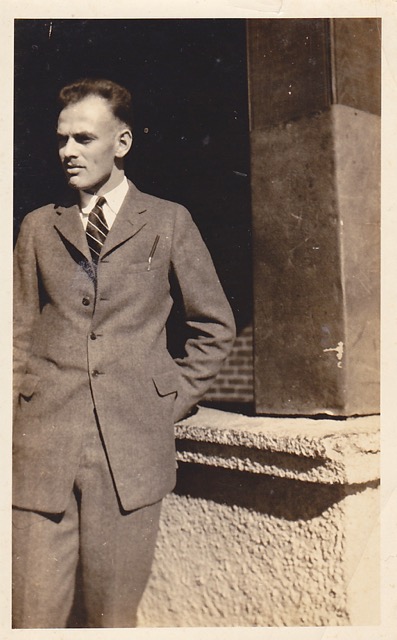
Here’s my grandfather.  He is a handsome fellow.

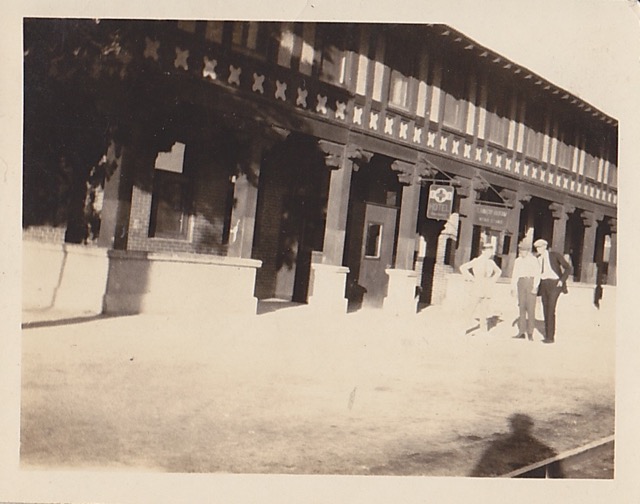
This is the Harvey House where I think they stayed. I know that because my grandfather was very good about writing words on the backs of photographs to identify the picture.
Except he didn’t identify this one but I think it’s him and his friend and the car and a roadside picnic.

I’ll have to ask my uncle or my aunt.

My father’s memory is dwindling.

And his thinking is muddy.

Otherwise, I doubt he would have thrown out the pictures.

In any event, they’re safe now.

family

Zaengle Family Gift Exchange 2017

This is for Leah. She said she wanted to hear about our family gift exchange this year.

We do two gift exchanges within our family. Sam nicknamed them — Nifty and Thrifty.  The Nifty exchange is a “real” gift, with a spending limit of $50 (although we aren’t terribly strict about that). The Thrifty has a spending limit of $10 and can be something from a yard sale, thrift store, or something homemade (and we aren’t terribly strict about that one either).

We draw names about two months before Christmas and then commence with plotting, planning, and fretting. We’re a family of givers — and everyone wants to give the best gift.

This Christmas Eve, when the family was gathered — although some joined us from afar through the magic of FaceTime — I asked, “How do we begin this?”

Donna and Sam on the big screen

Someone started giving me the history of the whole thing. “I think we decided to draw names, like, five years ago when…”

But I interrupted. “No. How do we begin? Like, how do we begin the gift-giving?” I honestly couldn’t remember. I’m not sure anyone else could either, so we drew names out of a hat. And then, because my memory is poor, I’ve already forgotten who went first.

Helen was early on. I remember that. Philip handed her a huge box.

She sat in front of the camera so our Canadian family members would have a good view as she opened it.

“This is every little kid’s dream,” she said, “getting the giant box for Christmas.” It’s not every child’s dream to get a crockpot for Christmas, though. That would be a young adult’s dream — to come home to a delicious-smelling apartment with dinner ready to eat.

I had drawn Owen’s name for the big gift and gave him chickens. Not actual chickens then and there. I gave him a feeder, a waterer, and some other chicken paraphernalia. My father gave him a gift certificate for a place that sells chicks. I had debated between chickens and bees, seeking advice from knowledgeable friends, and the chickens won.

Laurel had drawn my name. She gave me spatulas — the one thing on my list — and then teamed up with Donna (who had drawn Bud) to give us a gift certificate for a nice restaurant in town so Bud and I can go on a date sometime. I really appreciated that. Bud and I don’t have enough time together.

You know your children are adults when some of the nifty gifts are bourbon. Others got clothes.  All in all, the big gifts are always an opportunity to purchase one nice thing for a family member.

My favorite, though, is the thrifty. It’s an opportunity for thoughtful creativity. Laurel made bath bombs. Mary made homemade oreos. Emily gave Mary her old ukulele.

Amanda had drawn my name. She gave me some maple candy from Mexico. Mexico, NY, that is. Upstate New York is delightfully confusing with towns named Cuba, Poland, Chili, and Mexico, not to mention Copenhagen, Rome, Amsterdam, and Warsaw.

I purchased a groupon for a photo book (to stay within the spending limit) and made a little photo book for Philip with poems to go with each photo.

Each poem tells a little story about young Philip. My hope is that he’ll read them to Henry.

Here’s the poem that I’m reading in the picture. The last line is what Philip said to me when I went to the hospital in labor for Owen:

Mommy had a baby growing in her belly.
Little Philip said to her, “I want you to tell me –
Where did the baby come from?
How did he get in there?
When will I get to meet him?
What will the baby wear?
Can the baby see me?
Can he peek out somehow?
Will you let me hold him?
Why can’t we see him now?”

So after months of questions
And Mommy growing rounder
One day she went to hospital
And Philip waxed profounder –
“I don’t know what to call this thing
That you’re about to do
But it has to do with baby,
and it has to do with you
And from everyone’s reaction,
it’s a GOOD thing, there’s no doubt.”
So he kissed Mommy and whispered,
“Have a good baby-coming-out.”

And that’s pretty much it. Any questions?

family · photography

Best of 2017

Every year is filled with ups and downs, unexpected trials and undeserved mercies.

My favorite time in 2017, was the week in May when my brother, my sister and her husband, and my husband and I all traveled with my father to tour Normandy and Paris. The picture is of Bud and me in the Eiffel Tower. Our time together is so limited. Having a whole week together was amazing.

My second favorite time was this, learning to shred cabbage the Bosnian way.

I love my home, but traveling sure was fun. I may have to do it again in 50 years.

Merry Christmas everyone. Looking forward to the adventures of 2018.

family

Carpet

“How long do you think the new carpet smell will last?” one of my co-workers asked.

I had to leave work early because the carpet guys were coming.

“I have no idea,” I replied. “Is that like the new car smell?”

My family replaces carpet every 45 years or so whether it needs it or not. This particular carpet had reached replacement age. It was the color of cat vomit, which, I suppose, was both a pro and a con. The new carpet, grey-ish brown, will hide dirt well, but probably not cat vomit. Oh, well. I guess you can’t have everything.

When my husband and I bought our first house, we immediately tore all the carpet out. Lovely hardwood floors were hiding beneath it and we wanted to enjoy them.  Bud hacked the carpet into manageable size chunks to roll up and put in the alley for the garbage man.  About halfway through the task, he noticed that the rolls were disappearing from the alley. Back in the house, he watched as our new neighbor on the other side of the alley went out to scavenge the latest roll. She was carpeting her garage with our discards.

The second house we purchased had green plush carpet throughout the second floor. When we first looked at the house, Bud said, “We can pull this up and replace it.” I agreed. Seventeen years later, when we moved out, it was still there.

The third house had mostly hardwood floors, but upstairs, in one bedroom, a previous owner had laid orange shag carpet. It was hideous. “This has got to go,” Bud said. I agreed. Eleven years later, it’s still there.

The carpet we replaced is at my father’s house. As we reclaimed this particular room — it had become the depository for so much stuff that there was no place to sit — everyone has enjoyed it, even my father. Maybe especially my father. Whenever we have a fire in the fireplace, he loves to sit back there and enjoy its beauty and warmth.

Yesterday he asked about going back there.

“They’re putting in new carpet,” I told him.

“Can we walk on it yet?” he asked after the installers left.

I had no idea. My experience with new carpet is pretty meager. Actually, it’s pretty non-existent.

This morning I vacuumed so we could move the furniture back in. Pay no attention to the shelf of books that fell down during the night.  Or the fact that I didn’t vacuum neat straight lines, something Bud liked to do with that old green plush carpet when we were showing the house. Just note the carpet that’s NOT the color of cat vomit and picture a crackling fire in the fireplace.

Ah — new carpet for Christmas.

It smells okay — but once we put our Christmas tree in there, it will smell like Christmas.

And then, hopefully, it will begin to smell like home.

dementia · family

Roots

I need to apologize to Osyth. A few weeks ago in her blog, Half-Baked in Paradise, she wrote about moving. Something about her words broke my heart. Maybe it was this:

My heart felt the leaden weight of sorrow because my safe-place, my home, my warm hug, my protective cloak, call it what you will has gone.

When she posted again, I didn’t even go read it. I couldn’t — I was still grieving over her move. Then she posted again, and I read it. In fact, she started re-blogging a series about her home, and the renovations there, and I binged. She’s posting day by day. Like a glutton, I looked the whole series up and read it, laughing — actually revelling with her — at the great adventure she has been on for some time. (Start here: Coup de Coeur: Part One)

Sorry, Osyth, for not waiting for you to repost them all. I’m just the kind of person who likes to read the end of the book before I read the middle.

Home is something so dear to me. One of my many started-and-discarded blogs had the tagline, “I love where I live.”  And I do. I love upstate New York.  I love Cooperstown. I love the four seasons, the Susquehanna River, Otsego Lake, the trees, the village streets, the country roads, the people, the cows, even the tourists. This is my home — and the thought of living elsewhere is almost unthinkable.

My father keeps asking me what brought me to Cooperstown.

“What do you mean?” I ask him.

“What made you come here?” he’ll say, as if that clarifies anything.

“Are you asking about why I first moved to Cooperstown?”

“Yes,” he replies.

“We moved here as a family in 1967,” I say. “You took a job at Bassett Hospital as the head of their General Services department.”

“Yes, that’s right,” he replies, every time, remembering, or acknowledging the plausibility of this story.

“I was a child,” I remind him, “your child. I didn’t have a choice.”

“Where did Bud come from?” my father asks, trying to piece together my family.

We’ve gone through this many times now. I know the questions that are coming, but it’s sad because he has lost a large chunk of my life.

“I took a year off from college and met Bud while I was working at Bassett,” I say.

He nods, but I’m not sure he remembers anything about this.

Long pauses punctuate our conversation.

“Where did you come from?” This question often comes next. It’s another one that needs clarification. I’m sure he’s not asking about the birds and the bees, so I name the army base where I was born.

“How long did you live there?”

My mom and the children she moved with all by herself

“Six weeks,” I tell him. “When I was a baby, Mom loaded me, Stewart, Donabeth, and Peter into a station wagon to join you in Fort Riley.”

Yes, I was 6 weeks old. My oldest brother was 5 years old, my sister not quite 4, and my middle brother only 21 months old. Whenever I asked my mother about my birth and first year of life, all she would say to me was, “That was a hard time.” I’ll bet it was. The legend of a super mom.

“I don’t remember any of that,” my father says, and, of course, he wouldn’t because he was busy working at his fledgling career as an army doctor.

Another long pause. I begin to focus on whatever it was I had been doing before this conversation began.

“So what made you come here?” my father will ask, and we’ll start the whole thing again.

“You did, Dad,” I tell him. “You did.”