Helen looked at my Bosnian-Croatian-Serbian textbook sitting on the table.
“Do you really think you’ll use this?” she asked when I told her it was mine. “When I went to France, even though I was taking French at the time, I was too afraid to try to say anything.”
I understood what she was saying. “I think there are some useful phrases,” I replied. “In my last set of words, I learned ‘I understand’ and ‘I don’t understand’ — it’s like, hmmm…” I tried to remember. “Rooma-zooma….?”
“Ramen noodles?” she asked.
“No, it’s roomy-something. I have time to practice though. I just learned it.” I replied.
I practiced it later on my walk. Razumijem — pronounced ra-zoo-me-yem. I guess it’s sort of like Ramen noodles.
Ne razumijem — means I don’t understand. That one will come in handy, I’m sure.
Also, Gdje je kupaonica? — Where’s the bathroom? — very important. Except that one is pretty hard for me to pronounce.
Try it, English-speaking friends, say “guh-duh-yay yeh coo-pa-on-itz-ah” really fast. It rhymes with pizza, in case I’m not writing it phonetically correctly.
Last night as I walked, I practiced my Croatian, ruminating on the rhyming words. I came up with a poem.
Cesta, ulica
Gdje je kuaponica
Kada?
Sada.
Kava?
Hvala.
Oprostite.
Sviđa me se.
Dječak, djevojčica
Road, street
Where is the bathroom?
When?
Now.
Coffee?
Thank you.
Excuse me.
I like it.
Boy, girl
The more I practice, the braver I’ll be when I get there.
8 & Under swimmers swarm around the pool deck like ants on a sidewalk. Some are aimless, while others seem to know where they are going.
Clueless. That’s often the word I use to describe 8-and-unders.
Mama can’t hover on the deck. Only those who are supposed to be there can.
Guards — aka Meet Marshalls — protect the entrances. Most coaches and officials wear their credentials on a lanyard. Swimmers enter through the locker-rooms; their suits and goggles are their credentials. The other support staff — the timers, the timing table, the meet marshals themselves, the ribbon writers and heat winner awarders — are either known to the people running the meet or wear a lanyard identifying their role.
Of these, my heart always goes out to the timers.
Timing is the first role most parents get to play to help at a meet.
“What if I do it wrong?” new parents ask.
“We’ll train you,” is the usual response.
Start – Stop – Reset. Those are the only three buttons that really matter on the stopwatch for the timers.
Start the watch — not at the sound of horn but when you see the strobe. It’s important for parent/timers to understand this for two reasons — 1) since light travels faster than sound, it may be slightly more accurate, and 2) the strobe is why no flash photography is allowed at the start of a race. Swimmers who learn to watch for the strobe may react to a flash from a camera and be charged with a false start.
Stop when you see the hand touch the pad. That means you have to stand where you can see that happen which isn’t behind the blocks.
Reset. Write the times on the clipboard as fast as you can and reset; the next race starts almost immediately.
One of the officials I work with loves to tell the story of how he decided to become an official. “I couldn’t write fast enough,” he says, laughing. “After I got yelled at one too many times, I said, ‘Hang this — I’m going to become an official!'”
Timers are the unsung heroes of swim meets. They are moms and dads who come out of the stands and work the deck. Their feet get wet. They miss their own child’s finish because they have to watch the lane assigned to them. They get yelled at and blamed for all sorts of stuff. They are expected to make sure swimmers are in the right heat and the right lane, get up on the blocks, and have their goggles on. And all of that is mostly the swimmer’s responsibility.
Which brings me to yesterday.
I was standing on the side of the pool as a stroke official. That means I walked along the side watching the strokes to make sure everything was in accordance with the rules of that stroke. No flutter kick during butterfly, stay on the back for backstroke, toes pointed out for breaststroke kick, and so on.
The referee blew the whistle for 8 & Under girls 50 backstroke. Seven girls hopped in the water and grabbed hold of the wall. One lane was empty.
I looked at my program to see who was missing. It was a little girl from a team in our league. I could see her standing behind the timers, wrapped in her towel, shivering, looking clueless. I wished with all my heart that the timers would turn around and see her, but they were talking.
The starter said, “Take your mark.”
Then, “WHHHHHAANK.”
After the horn, the timers parted and saw the little girl. I watched them look at the clipboard and start talking. I shifted my attention to the swimmers in the water.
“What just happened?” her coach asked.
“She was right there behind the blocks,” I told her. The coach bustled over to the meet referee to see if they could get her in another heat, but no dice.
The ruling was that it was the swimmer’s responsibility to get in the water. The timers didn’t prevent that. The swimmer didn’t try to get through.
She was clueless as to what was going on probably because other people are always looking out for her.
Which is part of why I love the sport of swimming.
From an early age, swimmers learn to take responsibility for themselves. They have to pay attention.
It’s small stakes when they don’t. A missed race. A possible missed ribbon.
But the world keeps spinning and another race will come.
Or you can blame the timer and teach kids that they are never responsible for the things that happen.
It’s those blasted volunteers with wet feet who sacrificed something who are at fault.
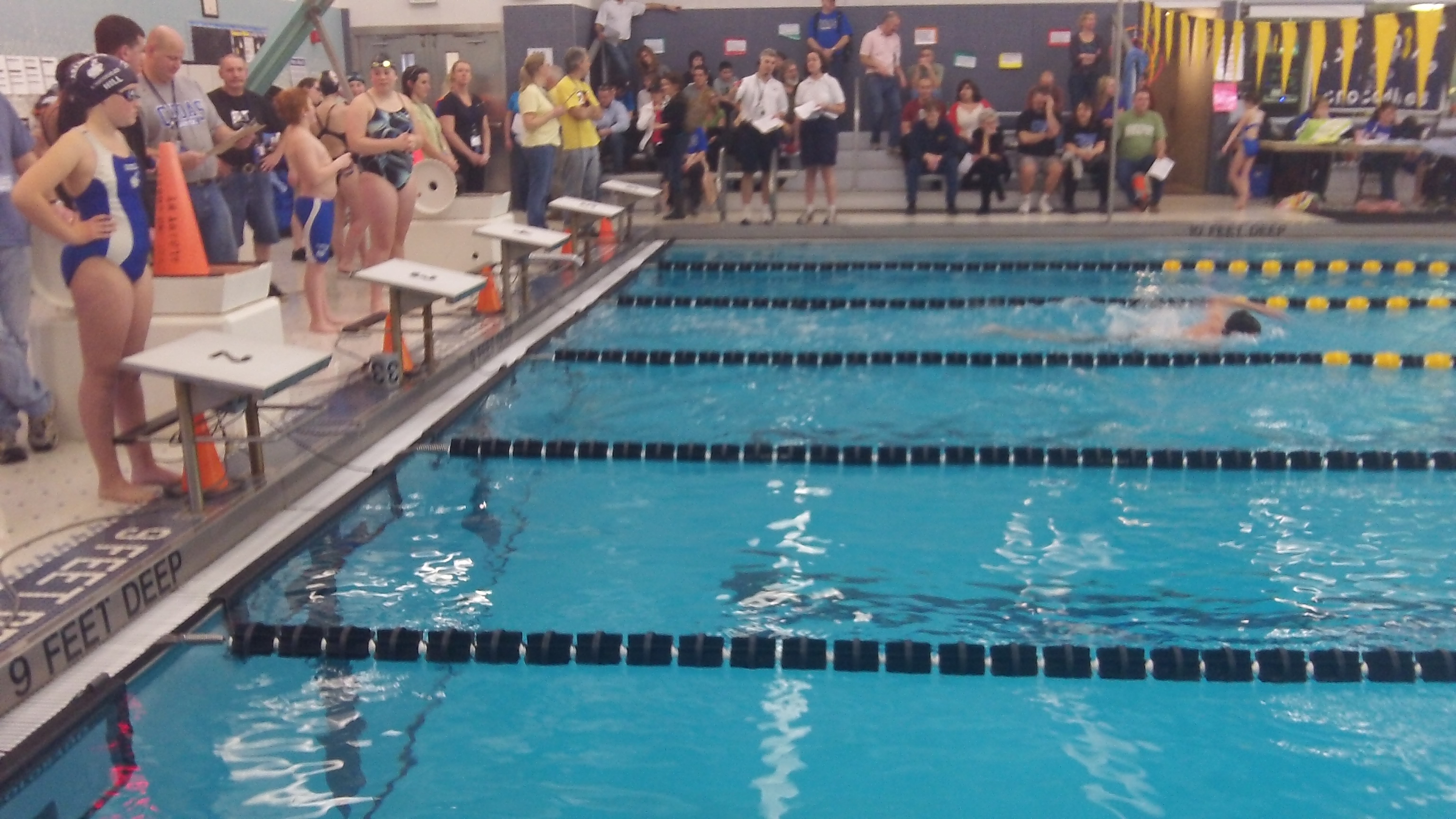
This is the pool where the meet was held in which Laurel swam:
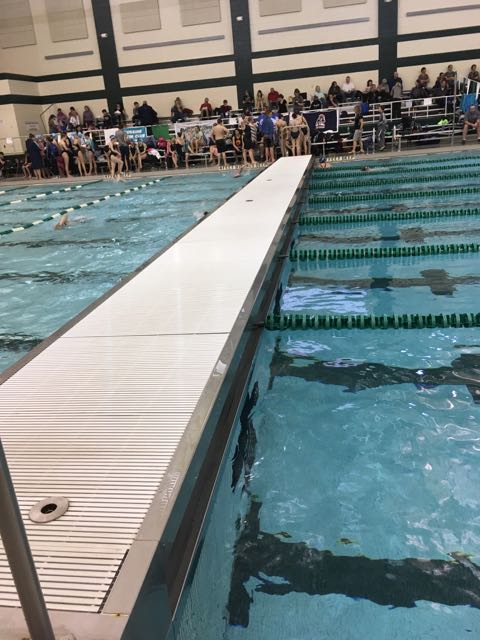
This is the bulkhead upon which I stood judging the turns of competitive swimmers who swam in the pool where the meet was held in which Laurel swam:
This the coffee that lacked flavor and oomph that I drank before I went to the pool and stood on the bulkhead judging the turns of competitive swimmers who swam in the pool where the meet was held in which Laurel swam:
This is the bed where I didn’t get much sleep so I needed the coffee that lacked flavor and oomph that I drank before I went to the pool and stood on the bulkhead judging the turns of competitive swimmers who swam in the pool where the meet was held in which Laurel swam:
If we were having coffee, I sure would like it to be a better cup of coffee than what I got at the hotel free breakfast this morning. It was hot, I’ll give it that, but it had no flavor. Lousy coffee is a small inconvenience, though, for spending the weekend with my daughter.
I guess I’ve gotten used to drinking good coffee made from freshly ground beans. I’ve turned into a coffee snob.
My mother drank instant coffee. Whenever I served her coffee from my drip coffee maker, she would wrinkle her nose and comment on how bitter it tasted. I never thought it was bitter, but maybe that’s because, in those days, I also added plenty of cream and sugar.
My mother drank her coffee black. Her Maxwell House or Folgers. Instant. Decaf. Yuck. I mean, what’s the point?
I’m still not a black coffee drinker, but I have stopped adding sugar. Freshly ground coffee bean coffee doesn’t need sugar.
I’m not sure sugar could have helped this morning’s coffee.
On my way to the pool for the swim meet this morning, I passed a Dunkin’ Donuts. That would be a step up from hotel coffee. Tomorrow, I’ll swing through there.
Today at the meet one of the other officials talked about how he had given up coffee for Lent.
“I don’t think I could do that,” said another official. “That would be too hard.”
The coffee-giver-upper said, “That’s the whole point. You’re not supposed to do something that’s easy.”
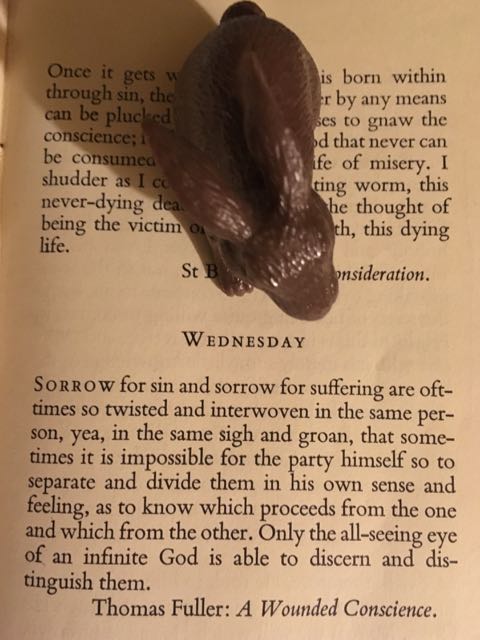
I touched my pocket where I could feel Tuga, my little plastic bunny. Had I taken the easy way out, I wondered.
Maybe.
Or maybe I’m not ready to tackle giving up coffee.
Besides, then I couldn’t participate in the weekend coffee share.
While still in my pajamas yesterday morning, I carried the laundry downstairs, holding Tuga in my hand. His rigid little ears poked into my fingers and palm. I tried to shift him to a better spot but it was impossible to carry the basket and the bunny without a little discomfort.
“Could you just not?” I asked him, but he didn’t answer.
The lesson was easy to see. Sorrow is uncomfortable.
In today’s society, we are fairly averse to discomfort. We desire to be always at ease.
Have a headache? Take some ibuprofen.
Are you cold? Grab a blanket or a sweater, or turn up the heat.
Too hot? That’s why God invented A/C.
Plastic rabbit ears poking your hand? Put the silly thing down. It’s a dumb exercise anyway.
C.S. Lewis, in The Problem of Pain, said,
Everyone has noticed how hard it is to turn our thoughts to God when everything is going well with us. We ‘have all we want’ is a terribly saying when ‘all’ does not include God. We find God in an interruption.
Tuga is an interruption. He interrupts my day to remind me that there are people in pain all around me, if I would only open my eyes to them. Maybe this discomfort of my own will remind me.
I set Tuga on top of the dryer while I threw the clothes in the washer. An hour later I remembered him. See how I am?
Tuga is a mindfulness prop.
I know people who carry special coins in their pocket and I’ve given my own children fidget-toys to carry, but Tuga isn’t just for fiddling with when I’m bored. He’s there to remind me of the sorrow in this world, the sorrow people carry unseen in their hearts, the sorrow I carry in my own heart.
“I suppose I should take a picture of you,” I said to Tuga, pulling him out of my pocket yesterday while I walked around town.
He said nothing, which felt almost like a dare. I dare you to take pictures of a plastic rabbit. Won’t you look foolish!
Ah, but I knew better. I was on the last leg of my walk, going down the path. Nobody walks on the path, especially after it rains because of the mud and it had just rained. I doubted anyone would see me photographing my plastic bunny.
I set him in a dry patch of grass.
He laid his ears back and didn’t look happy.
Oh, wait, his ears are always back.
He’s not supposed to be happy.
“Tuga,” I said, “you’re supposed to teach me something this Lent.”
I was hoping for a little more cooperation.
“How about you look out at the river?” I said, moving him a little and stepping back. I was thinking of the scene from Watershed Down where the rabbits must escape across the river.
But the blue sky with its big puffy clouds reflected so beautifully in the water that I took another step back to include it. Tuga, my little sorrowing bunny, all but got lost in the shot.
It struck me — isn’t that the way it is with sorrow? In the bigness and busy-ness of life, the sorrowing one can get lost.
I picked him up and tucked him in pocket, knowing I would have to ponder that a little more.
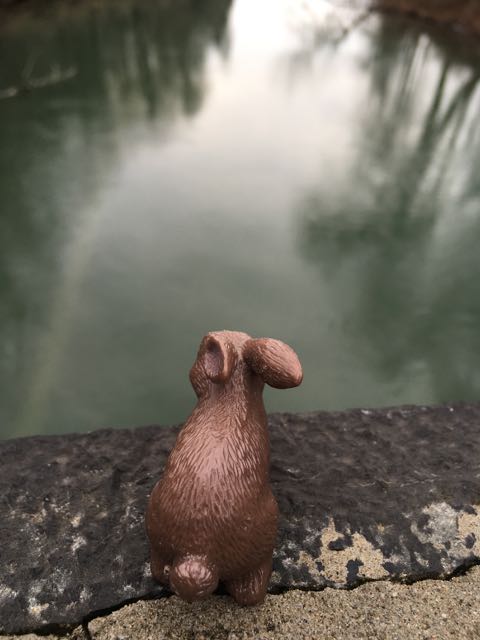
When I reached the stone bridge, I set Tuga on a parapet.
He looked rather lost in there, too. So small.
That’s when I saw the man on the stone bridge talking on his cell phone. We briefly made eye contact before I grabbed Tuga and stuffed him in my pocket again, hurrying on down the path.
Once again, I was struck by the picture of sorrow. How often do sorrowing people stuff their emotions away because they’re embarrassed or self-conscious?
If nothing else, Tuga is teaching me an awareness for the sorrowful. In my own busyness, I may pass them by, or, in their self-consciousness, they may hide their feelings.
Warning: This is probably one of the most boring posts ever. I walk around town and take pictures of the sidewalks.
“Now this is a sidewalk,” Bud said to me as we started our walk the other day.
We parked at the Clark Sports Center and headed out on the route I usually go around the perimeter of Cooperstown.
Susquehanna Ave
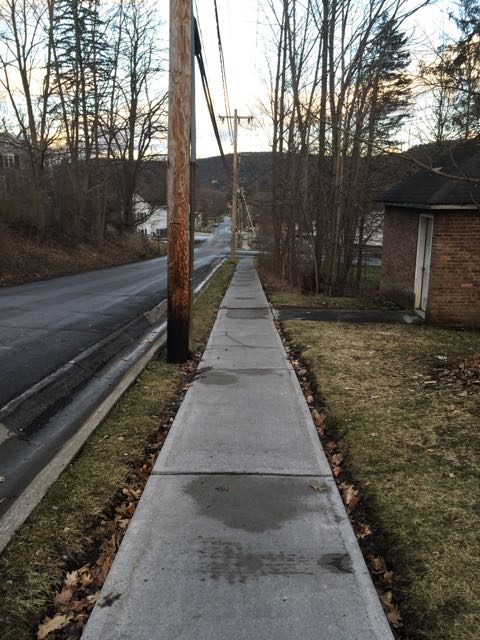
The sidewalk on Susquehanna is wide and new. Little kids ride their bikes on it, with plenty of room for mom or dad to walk beside them. The fellow in the distance was on his skateboard. It’s not unusual to see friends walking 3 or 4 abreast on it.
This sidewalk used to look like this:
The other side of Susquehanna
On the east side of the street, this sidewalk reminds me of what we used to walk on.
I always turn up Walnut Street. There are shorter ways to get downtown, but when I’m going for a walk, I’m not looking for shortcuts. I’m looking for the long-cuts, to prolong the experience.
Walnut Street
From Walnut, I turn onto Delaware Street. One of the joys of living in a small town is that so many of the houses also contain memories — friends I went to high school with, kids I’ve coached on swim team. The house represents a person or a family, and I treasure them as I walk past.
Delaware Street
Delaware to Beaver. Beaver Street is a direct shot between Rte 28 (aka Chestnut) and the hospital. At the juncture of those two roads, it’s really hopping with two gas stations, Price Chopper (the only grocery store in the village) and the new location for a giant CVS.
Beaver Street
I take a little jig-jag on Chestnut, quickly turning off it onto West Beaver.
West Beaver Street
West Beaver kind of turns into Maple Street.
Maple Street
At the end of Maple Street, I cross Route 28 again — except now it’s Glen Ave. Oh, the joy of small older villages! Streets take twists and turns and change names — just because they can.
I have to cut through a parking lot here. In the summer, it’s busy, but the rest of the year only a handful of cars park there.
Credit Union parking lot
On the other side of the parking lot is the top of Main Street. It’s a nice walk down, but tourists don’t know that. They shell out their $2 per person to ride the trolley, which actually is pretty cheap entertainment. The trolley makes a circuit around Cooperstown, and some trolley drivers give spiels about the village which are often full of alternative facts.
Upper Main
Just past the ugliest office building in the history of beautiful small villages, I turn onto Nelson Ave, a street of beautiful homes. It’s another stretch of homes that I identify with people I know or knew.
Nelson Ave
From Nelson, I turn onto Lake Street.
Lake Street
Oh, look! There’s the Otesaga! That’s where the Hall-of-Famers stay for induction weekend.
I walk a long stretch of Lake Street, all the way to where it ends at the Susquehanna River and River Street.
River Street
One block on River, and I reach Main Street again — but this is lower Main.
Main Street (going east from River Street)
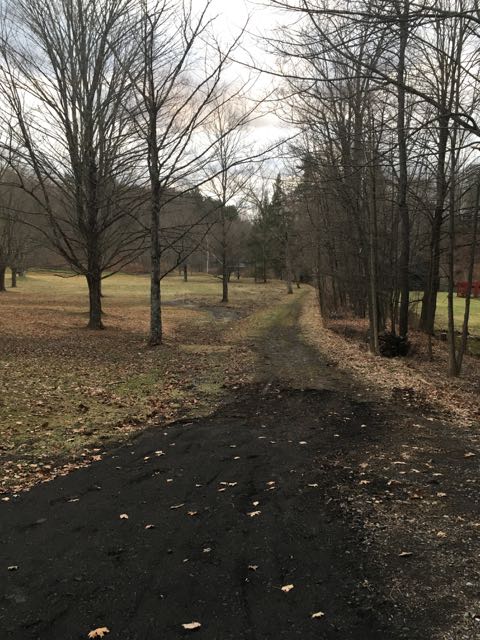
The sidewalk ends just after crossing the bridge, but that’s okay. I’m heading to “The Path” — no sidewalk at all, but one of my favorite places to walk.
“The Path”
The Path goes along the river, past where Cooperstown’s hanging tree was in the early 1800s (or so I’m told), past the stone bridge (gosh, it’s lovely), past the Sugar Shack (where I suppose someone used to make maple syrup), past a colorful pile of kayaks and canoes, all the way to Mill Street/Brooklyn Ave.
I choose Brooklyn Ave. We used to live here. It is a wonderful street.
Brooklyn Ave
The sidewalk doesn’t go all the way down Brooklyn Ave. It ends as I leave the village. The condition of the road changes, too. It’s easy to tell where the demarcation between Village of Cooperstown and Town of Middlefield falls.
I walk all the way to the end, back to Susquehanna Ave, but now I’m at the end of Susquehanna that doesn’t have wide new sidewalks. In fact, it has no sidewalk at all, but that doesn’t stop me from walking along the shoulder, back to the gym, and back to my car.
The road taken by me is usually a sidewalk. I love walking.