Two cats share an old chair by the woodstove An orange tabby and a calico They stretch and bask, sometimes paws interwove One wakes and grooms the other, licking slow
They eat their food together from a bowl Or crouch together watching some poor bird Sometimes they argue ’bout who gets the mole Mostly they don’t care who gets the last word
Companions would be an inadequate Description for this cat-relationship So bonded in a way that’s not clearcut Expressing joy wtih purr and lick and nip
They are true friends — someone with whom they can Just be themselves without ulterior plan
This is my submission for the W3 prompt this week: write a sonnet on the theme of friendship.
She was waiting for me when I came out of the bathroom this morning.
No, no — not one of my children, although, as you can imagine that has happened to me more times than I care to remember.
Every mother quickly learns that the bathroom is a refuge.
Every child learns just as quickly that if he (or she) waits long enough outside the door, Mom will eventually emerge.
And she can hear you if you talk to her through the door.
If a sibling is being mean and Mom is in the bathroom, a note under the door will sometimes expedite her emergence.
But she may not be terrible happy about it.
Bathroom = Sanctuary
I imagine, if Quasimodo hadn’t had Notre Dame to carry Esmeralda into as he rescued her from the gibbet, if he hadn’t had that great cathedral to escape to, he would have found a bathroom.
I no longer have to use the bathroom as a hideout from my children, though.
Yes, young moms, your children will one day learn to leave you alone in there.
Or they will be so busy with their lives that they won’t care one whit if you’re in the bathroom, the bedroom, or any other room in the house. As long as they are fed and the wi-fi is working, the natives will not be restless.
Now I have a cat that waits outside the bathroom for me.
Yes, a cat.
She follows me around the house. Down the hall. Into the kitchen. Into the living room. Up and down the stairs — not on quiet little cat feet, like the fog, but thumpity-thumpity, like an angry rabbit.
She loves the bedroom where she can hide under the bed and pounce on my feet as I walk around it, straightening the sheets and blankets. I think she especially loves that she can still surprise me
I draw the line at the bathroom.
Her litter box is just around the corner. She likes to supervise my cleaning of it, patting her paws on the scooper as I sift the litter and, um, the other stuff.
But, no, I don’t want her in my bathroom.
It’s that sanctuary thing.
So she sticks her paws under the door a few times to let me know she’s out there and then she waits.
Several years ago I was walking Maggie in our little town and ran into a woman who was walking Maggie’s twin, a mostly black dog with some white markings.
“What kind of dog is yours?” the lady asked.
“They told us that she was a shepherd-boxer-akita mix at the shelter where we got her. Basically, she’s a mutt,” I said.
The woman smiled and said, “Mine, too!”
We stood and talked for a few minutes about how similar our unrelated dogs were. Unrelated, yet entirely related.
“Don’t you think,” she said, “that if we took all the dog genes in the world, put them in a big bag, shook them up and then pulled out a dog, it would look like this?”
Yes, she has crooked ears.
I laughed and agreed.
Since that conversation I have noticed so many dogs that look like Maggie.
I suppose that would say that she’s a common dog.
But she isn’t.
Our neighbor who walks Maggie for us while we’re away — and sometimes, even when we’re aren’t — often comments on what a smart dog Maggie is. “I usually only have to tell her once and she minds right away,” she tells us.
Maggie is smart. And fun. And energetic.
She can sit, stay, shake, lie down, die, and come. She carries a fish on her walks, chases snowballs and squirrels, and howls at the noon whistle. When we come back from being away, she races around the house in a doggy-happy dance. What more does a dog need to do?
Catching a snowball
Balancing a dog biscuit
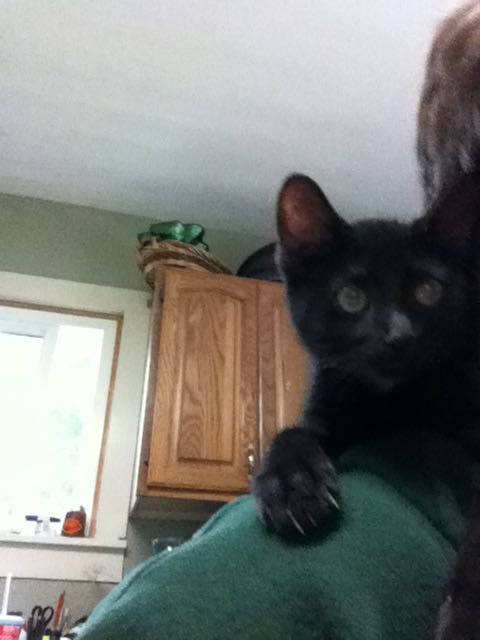
This past summer we got a kitten. She’s supposed to be a working cat, taking care of the mouse problem at my father’s house, but she’s still in training, slaying ladybugs and cluster flies in abundance.
She’s all black with a few white hairs like a little bow-tie.
Once we went on a field trip to a cat rescue organization and their shelter was full, mostly with black cats.
“They’re the hardest to adopt out,” the lady told us, “and seem to be the most common color.”
Our Piper was a freebie from a farm. When I took her to the vet, they asked for her breed.
“She’s just a cat,” I said.
I’m guessing that if you took all the cat genes in the world, put them in a bag, shook them up and pulled out a cat, it would be black.
But Piper likes to sit on my shoulder and lick my ears. She pounces on my feet from under the bed while I’m getting ready for bed. She snuggles on my lap in the morning, and rolls onto her back when my brother stops by so he can rub her belly. She is a special cat.
Perched on my shoulder
Sleeping in the sun
Conquering cluster flies
All this is to say that I think the least aspect of any creature is pedigree. Or color. Or any other externals.
What’s inside is unique and wonderful, waiting to be discovered and nurtured into maturity.




 Hot Dogs and Marmalade