A to Z Blogging Challenge · Hutchmoot

Ego

Hutchmoot does not predetermine a theme for each year, but every year a definite theme emerges. That theme, though, may be different for each participant. Once, when a friend was asking me about Hutchmoot, I said that Hutchmoot meets you where you are.

I was reading through all my notes for 2012 and noticed a definite theme that I don’t know that I picked up on at the time. Here are some quotes:

It doesn’t matter what you think of me. It doesn’t even matter what I think of me. The only thing that matters is what God thinks of me — and He loves me.

Russ Ramsey — Friday chapel devotion

How did you become you? Pain.

Jason Gray, Recovery Through Song

I need to show up in my own life.

Andrew Osenga, Recovery Through Song

…to be nobody-but-yourself in a world which is doing its best, night and day, to make you everybody else.

e.e. cummings, quoted by either Lanier Ivester or Sarah Clarkson, The Art of Spiritual Subcontext

Over and over, I was reminded to lean into my own story and that who I am is known and seen by God. The pain in my life shapes me. I need to be present. I need to be me.

Looking back, I remember the horrendous year I had had leading up to my second Hutchmoot. I had started this blog in 2011, I think, but by mid-2012, I had acquired a most un-welcome follower. The verbal attacks caused me to really question who I was and ask myself if anybody could possibly love me. I had stopped writing in this blog.

The ego is a person’s sense of self-worth or self-importance. Mine was beaten down.

Yet, there were the words spoken by a variety of people that were a balm to my soul.

Yes, Hutchmoot met me where I was that year. And it was good.

A to Z Blogging Challenge · Hutchmoot

Dish Duty

Hutchmoot has grown substantially.

For the first few years, it was limited to 100 attendees. Then, through a weird glitch in 2012 or 2013, it expanded to 130 attendees. In 2017, it moved from Church of the Redeemer in Nashville to Christ Community Church in Franklin, TN where, I think, they could accommodate 300. Last year, when COVID forced Hutchmoot to go virtual, they had over 3000 people “attend.”

But, back in the old days, when it was small, the meals were coordinated by a multi-talented woman named Evie Coates. She is an art teacher and a visual artist. Her Hutchmoot food was delicious and beautiful.

On the first day, a sign-up was available to help in the kitchen. There was absolutely no pressure, just a quiet here’s-an-opportunity-to-serve.

I pounced on it.

On my schedule, I wrote “dish duty” next to lunch on Saturday.

I remember going down to the bustle of that kitchen and trying to help in whatever way I could. I wanted to give back in some way. I wanted them to know how grateful I was (and am) for what they do.

Since growing and moving to Franklin, the kitchen crew became a well-oiled machine. They turned out amazing meals. But they didn’t ask for volunteers from the general riff-raff. I couldn’t volunteer there.

Not that they would want me, of course. I don’t remember being especially helpful when I volunteered for dish duty. I wanted to be helpful — but, you know, sometimes lost people just get in the way.

Don’t get me wrong — no one made me feel like that at all. I remember feeling lost, though, in that unfamiliar kitchen, and wishing I knew my way around it better. I see now how it makes so much more sense to have an actual kitchen crew.

Still — I’m glad I had the opportunity that I did in 2012.

A to Z Blogging Challenge · Hutchmoot

Conversation

Good conversation is a hallmark of Hutchmoot.

We eat our meals together. At my first Hutchmoot, we ate in the basement of The Church of the Redeemer at long tables lined with metal folding chairs.

I actually wrote a cheesy poem about my experience that year.

In a metal folding chair
At the end of table two
I met some friendly people —
Could one of them be you?

For every single meal
My chair was there for me
Always just the same
At table two, not table three.

’cause a moot of hungry rabbits
Can be a daunting sight
For one who’s always awkward
And never fits quite right.

For a timid little bunny —
Oh dear! What will I say?
My chair at table two
Gave me comfort every day.

So if I didn’t meet you —
And there were quite a few —
It may be that you never sat
And dined at table two.

As hungry as I am for good conversation, I’m also terrified of saying something stupid that reveals the fool that I am. That first year, I chose to sit at the same chair for every meal. It gave me comfort. It was a decision I didn’t have to make again. I just got my food and headed to “my” chair.

The food was amazing. I should write a post on that. Maybe I will.

But what I loved most about the meal times was the conversation. Even when I wasn’t engaged in conversation, I was listening to the buzz of fascinating talk going on around me.

Sometimes friendships begin with a commonality of something that both people love, and sometimes they begin with a common dislike or pet peeve. CS Lewis’ quote — “Friendship is born at the moment when one person says to another, ‘What! You too? I thought I was the only one!'” — is oft repeated at Hutchmoot. When conversations — really respectful conversations — occur between people with different viewpoints, each person leaves better and wiser. Sometimes friendship is born of that, too.

That first year, I didn’t know it was what I was looking for, but I found the conversations to be a highlight. It’s been that way every year since. The conversation is substantive. It feeds me. While the food is nourishing my body, those words are filling my soul.

I think it was at Hutchmoot that I learned to be a true lover of good conversation.

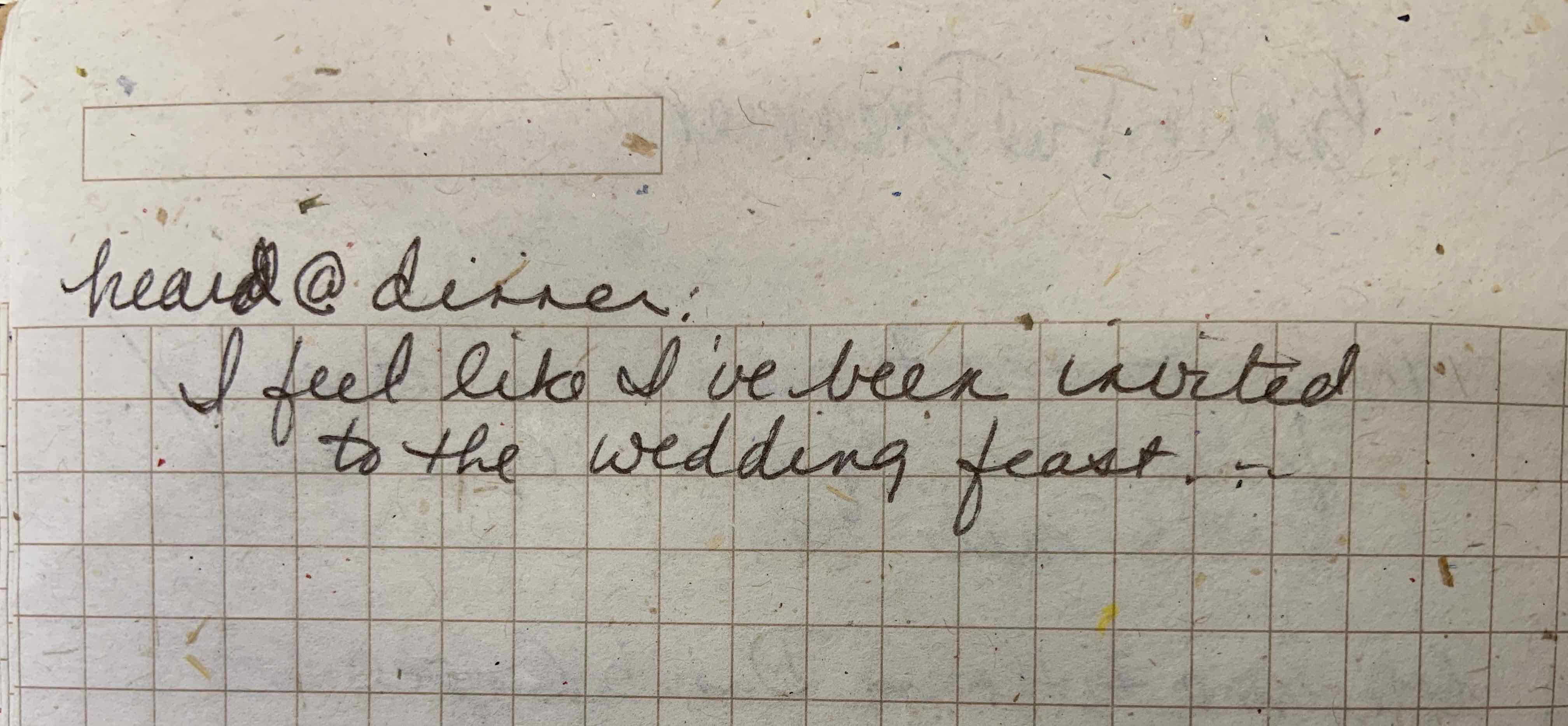
From my Hutchmoot 2011 notebook

A to Z Blogging Challenge · Hutchmoot

Beach Boys

Malcolm Gladwell did a fascinating two-part episode on memory in Season 3 of his Revisionist History podcast. He began with memories of 9/11 and how, if you ask someone today where they were and what they were doing, they can recount precise details of that morning. However, sometimes those memories are incorrect. When shown written evidence — a journal entry or an email that they wrote that day — saying that they were actually in a different place or with different people when the planes hit the towers, people will say, “I don’t know why I wrote that. I remember that morning so clearly.”

I had one of those moments this morning when I was getting ready to write this. I have a few crystal clear memories from that first Hutchmoot, one of them involves a session Ben Shive gave called “How to Smile: the Fine Art of Loving Brian Wilson.” Brian Wilson, the creative genius behind the Beach Boys, struggled with mental illness. As soon as I saw the write-up about the session, I knew it was one I wanted to attend.

When I opened my notebook to read what I had written during the session, I thought, That’s not right.

There on the page, in my scrawly handwriting, it said, “- walked with one hand covering his soul.”

For nearly ten years now, I’ve thought of it as one hand covering his heart. I thought he was afraid his heart would fall out.

In fact, when I’ve been near the bottom, my hand finds its way there, over my heart, feeling its rhythm, reminding me that I’m still alive. I first remember doing it after that session.

Because there were times over that weekend when I thought my heart was falling out.

If it fell out, and I fell apart, everyone would know.

And that couldn’t happen because it wasn’t my story.

It turns out, though, that it wasn’t my heart after all. Or rather, it wasn’t Brian Wilson’s heart. It really was his soul that he held in — confirmed by my notes and by the handout Ben Shive had given us. Ben had been doing some serious research on Brian Wilson.

I probably changed it in my head because I was less worried about my soul — I knew it was in safe hands — and more worried about my heart that weekend.

On another page of notes, I had written short summaries of each of the sessions I attended. For How to Smile, I wrote three words — “Grace, grace, grace.”

Grace for those with mental health struggles.

Grace for myself.

Grace for all.

Hutchmoot planners don’t come up with a theme and tell their presenters to focus on it. The theme comes on its own, and may be different for each attendee. Grace was my theme that year. It began with Ben Shive talking about Brian Wilson.

Then, either Russ Ramsey or Justin Gerard, in a session called “Interview with a Dragon Maker,” said, “I called you to your story. I didn’t call you to perfection in your story. My grace is sufficient for you.”

And finally, Thomas McKenzie, in morning chapel, said, “Grace flows from the hard places.”

A to Z Blogging Challenge · Hutchmoot

Apprehension

I really shouldn’t be here.

That thought ran through my head over and over during my first Hutchmoot in 2011. It was a two-pronged accusation:

  1. I wasn’t like most of the attendees. They were accomplished creators of music and/or books and/or art (or so I thought). I was just a mom with a blog.
  2. A member of my family had just gone through a serious mental health crisis. I knew I should be home. First and foremost, I was (and am) a mom.

My first fear was quickly laid to rest. Hutchmoot is put together and attracts a very warm, friendly, accepting group of people. I felt encouraged. I felt challenged (in a good way). I felt like my cup was filled just by virtue of being there, hearing the music, sitting in the sessions, eating delicious meals in a church basement on a metal folding chair, being surrounded for a whole weekend by loving people who longed for substantive conversation the same way that I did.

My second apprehension was a little harder to allay. Mental health issues are tough. They are private. They are scary. They are misunderstood. They carry a stigma. They hit too close to home sometimes.

But I think that I’m getting ahead of myself. Some of you are probably wondering what a Hutchmoot is. The short answer is that it’s a conference.

From my notes from that first Hutchmoot: “Hutchmoot is the intersection of faith and folks.” And that’s about as good a definition as any of them, but go ahead and google it. Hutchmoot is famously hard to explain. That’s partly why I decided to do my A-to-Z Challenge on it. Maybe enough little stories will help someone understand it in a bigger way.

So, back to September 2011. Early in the month, I had gotten one of those phone calls that parents dread. I had a child in crisis. It upended my life. Most of that story isn’t my story so I won’t tell it, but about two weeks before my flights to Nashville, I was sitting in a counselor’s office and had this conversation:

Counselor: What do you have going on for the next few weeks?

Me: When I get home, I need to cancel some flights for a trip I was planning.

Counselor: What was the trip?

Me: I was supposed to go to this thing in Nashville, but I don’t feel like I can go now. [I think I fumbled around with words trying to explain Hutchmoot.]

Counselor: Why aren’t you going?

Me: Ummm. I can’t. I need to be here.

Counselor: No. You need to go. You need [child’s name] to see that life still goes on.

And, with that, the decision was made.

Sometimes, what looks like a selfish decision — going off to a conference — is actually a selfless decision. Honestly, I didn’t really want to be there. At the counselor’s insistence, and against my own heart, I went.

It was the best thing ever.

More on that tomorrow, when B is for the Beach Boys. Aren’t you curious how they play into Hutchmoot?

A to Z Blogging Challenge · Grief

Blessed are those who Understand

The sympathy cards have slowed to a trickle. In the beginning it was a deluge.

Many of the cards said things like this:

Your dad was an amazing man, and I consider myself very lucky to have worked with him.

What a class act!

Don was a wonderful person: friendly, compassionate, smart and extremely generous…

I felt privileged to know him.

Here’s a sampling from his church:

Don and Elinor were two of the first people I met at church and I’ll never forget how welcome they made me feel.

His church will miss him much. I think he held at least every position twice and always took on the most challenging parts.

And a few of the many from the hospital:

He was one of the “Old Guard” at Bassett and embodied all of the wonderful good things of a medical career.

He was the one who recruited me to Cooperstown. He looked after me at work and worked so hard to make sure that our department ran smoothly. I’ll always remember how much he cared about the patients and making my early years there successful.

The more specific people were in what they wrote about my father, the more it touched me. For example, this story made me laugh because it captured his frugality:

Many years ago he asked me (chairman of building and grounds) to help him dig a trench across the driveway from the church house to the manse. If we put in the wires to connect a new manse computer to the one in the secretary office ourselves, we could save a lot of money. Although he was much older than I was, he outworked me with his pick and shovel!

After I graduated from high school I learned that my father had followed each one of his little league players all the way through graduation and had given each one a baseball necktie as a graduation gift. Apparently, he continued that baseball-themed gift-giving pattern into his later years as this person mentioned:

Our son loved baseball and Don often gave him baseball-accented gifts.

The words and stories people shared became a salve for my grieving heart. I read stories of him making housecalls,  of mentoring, of swapping “sappy stories,” of his Red Sox fanaticism, of his sweet tooth.

I also received cards from people who had never met my father but who only knew him through me. People who read this blog but that I never met in person. People I met at Hutchmoot or on other travels. Even people here in Cooperstown who know me through my church or my involvement with the swim team, but never met my father. I was so grateful. I felt so loved.

Two cards that especially touched me were from people who had also recently suffered loss:

Deepest sympathies and equally deep gratitude for all the love and care you shared with your dad. I know firsthand that is a gift that goes both ways and lives in memory always. (from another caregiver whose father had recently died)

We have a wonderful hope of  resurrection, but the grief is still so real right now. (from a grieving spouse)

Blessed are those who understand for God will give them words to ease another’s pain.

A to Z Blogging Challenge · swimming

Blessed are Too and To

The hardest thing about swimming laps is —

1.) Leaving the house. Walking out into the real world is cold.

2.) Getting in the water. If leaving the house is cold, getting into the water is doubly so. Changing in the locker room. Taking a shower.  Walking, dripping wet, out onto the deck. Cold. Really cold. Finally sitting on the edge and sliding into the water.

3.) Counting the laps. I’ll come back to this one.

4.) Leaky goggles. It’s annoying to have one side fill with water so that you swim like Popeye the Sailor — with one eye closed.

I asked Laurel what was the hardest thing about swimming laps. She said, “when you can’t see where the wall is because you’re crying because it hurts so bad knowing you’re not gonna make the interval even though you’re trying so hard and your legs hurt and you can’t move your arms any faster :)” She’s a teenage girl, a little overly dramatic, but speaks from her heart. Swim team workouts are rough.

Back to counting laps, though.

Swimming can be monotonous. It’s also very zen. A lap swimmer — and here I’m talking about the adult lap swimmer who isn’t trying to make the interval and crying and can’t see the wall — can get lost of the rhythm of the thing.

Splash-spalsh-splash-breathe-splash-splash-splash-breathe

I wrote the vast majority of my college papers in the pool. I organized my thoughts, sifted through ideas, tried out sentences, rearranged the words. All the while I was splash-splash-splash-breathing.

Sometimes people would ask me how many yards I did and I would have no idea. I was more worried about words than yards.

When I no longer had papers to write, I tried to count my laps the old fashioned way — with numbers. It was a struggle. I finally settled on my own system: the alphabet plus the Ten Commandments.

You may laugh, but it worked. 36 laps in a 25 yard pool comes out to just over a mile.

Each letter of the alphabet got a whole lap. I would think of words or people that began with that letter. I would pray or think on things that began with that letter. Then I would move on to the next.

I did that for years.

Until, about 15 years ago, life got in the way of my lap-swimming.

Recently, I started lap-swimming again. I was so out of shape that I didn’t try to count laps at first.

The third morning I realized I needed to focus on something other than simply reaching the wall. My mind was overactive, my body tired.

I decided to work on memorizing scripture — Isaiah 61. Each length got a word.

Lap 1: The Lord

Lap 2: has anointed

Lap 3: me to

Me to. Me to. The words rattled around with familiarity because of #metoo.

The #metoo movement had stirred up memories, memories of experiences that gave me common ground with many women.

But #meto — that involves purpose.

The Lord has anointed me to… Isaiah 61 lists seven things.  I found myself pondering instead, what does the Lord want ME to do?

My life is changed. To care for my father had been my purpose — and it was so fulfilling. I confess to being a little lost now.

Blessed is Too — the common ground we share with others through experience.

Blessed also is To — as in an infinitive verb suggesting purpose.

Like a college paper, I’ll use the pool to sort through my thoughts and figure things out.

First I have to leave the house, though — and sometimes that’s the hardest part of swimming laps.

A to Z Blogging Challenge

Blessed are those who Stretch

I once had a pastor who loved to talk about stretching.

Not like downward dog yoga stretching, more like standing-on-tiptoes-and-reaching-a-book-off-the-top-shelf stretching.

Stretching, as in, moving beyond what you thought was possible.

He was generally talking about being uncomfortable in a situation and choosing to do the right thing. That stretches a person.

Or hardships. Those are stretching experiences — when we don’t allow them to make us brittle.

I was thinking about stretching the other day at a swim meet while watching swimmers coming into the wall. The person who won the race — often by a mere fraction of a second — was the one who reached the longest and fastest, stretching their fingers to touch the pad first.

Regular stretching can lead to increased flexibility.

An interesting thing about flexibility is that of all the types of fitness, it takes the longest to gain, but it also stays with a person the longest. A person can build up cardio ability relatively quickly, but, when aerobic exercise is abandoned, cardio gains leave fairly quickly. Flexibility, on the other hand, can take months to years of consistent stretching to improve, but that increased flexibility also lasts a loooooong time.

The other day I read this:

When the monasteries of the Middle Ages lost their fervor, the last observance that ceased to be properly carried out was the choral office. (Thomas Merton, Contemplative Prayer)

Regularly-practiced liturgy sticks.

And yet, liturgy is certainly NOT flexibility.

Liturgy is like the roots of a tree that stretch down, down, down to water in the driest of seasons.

Flexibility is like the tree branches reaching up, up, up, reaching for the sun and sky and rain, moving with the wind.

Blessed are those who stretch both up and down. They gain both flexibility and roots.

*****

Side note: this piece has sat in my draft folder for, um, I don’t know how long. Part of me wants to finish strong — finish these darn beatitudes that sounded like such a good idea at the time, but now feel like a weight.

Golly, it’s been a tough few months!

Perhaps, sometimes, finishing strong simply means finishing. I stare at my drafts and don’t know how to finish them.

I’ll be that girl crawling across the finish line —

So forgive the upcoming half-written beatitudes.

I’m crawling.

But, dog-gone it, I’m going to finish.

It’s a stretching experience, I suppose.

A to Z Blogging Challenge · Grief

Blessed is Resurrection

When my father passed away at home, I didn’t know what would happen next — so I went for a walk.

That Sunday spent watching him decline, decline, decline — sitting by his bed — pacing — calling hospice and family and hospice again — trying to make the best decisions based on what he had said he wanted — it all made for an incredibly long day.

Yet, at the same time, the day was too short.

Suddenly he was gone.

I cut across the yard when I left the house, walking past the red maples he had planted 40 years before. Their burgundy leaves were half on, half off —  trees caught mid-way through their fall undressing.

The oak tree I passed was barer. Its brown leaves and acorns littered the ground. Many of the acorns were cracked and broken. I wondered if the damage had been done by squirrels or the fat woodchuck I often saw in that corner of the yard or the heavy equipment that had driven through there earlier in the week to replace our septic system.

The acorns held no promise of a mighty oaks, just broken pieces with jagged edges.

The walk refreshed me, but, back at the house, we moved in a thick fog.

While I had been walking others had left, or come and gone, or stayed, waiting to say good-bye to me.

My two grandsons had been in the house when my father passed. When I heard them playing in the other room, I thought about an article I once read about Irish wakes and how healthy they are for children — to be around death and see that it is a part of life.

In the midst of life we are in death.

Book of Common Prayer

I said good-bye to the grandsons and to my oldest son who looked so weary and so grown-up. I wished he was the size of his boys and this hurt was a boo-boo a bandaid could cover.

A knock on the door surprised me. The man identified himself as a hospice nurse. “I’m here to clean the body,” he said.

I showed him to the room where my father lay. My father’s face looked ashen and waxy.

“Do you have some clothes I could dress him in?” the nurse asked.

My father was still wearing his old red Fenway shirt. He liked to wear Red Sox apparel when he watched their games, and the last game of the season had been on when he passed away.

I chose a favorite flannel shirt and a pair of corduroy pants that went with it.

Leaving the room, I re-entered the family fog. Pea-soup fog, my mother would have called it, so thick you can’t see your hand in front of your face. People may, or may not, have talked with me. I may, or may not, have responded.

The nurse finished. He ushered us back in the room with my father.

My father’s hands were folded on his abdomen. It was a pose I had never seen him in before. He looked so dead.

I look for the resurrection of the dead and the life of the world to come.

Nicene Creed

*****

It has now been 3 1/2 weeks since my father passed. When I close my eyes, I see that dead body. I see my sister coming out of his room, closing the door behind her, at 2 AM. She had just arrived and wanted to see him. I see the funeral director arriving at 8 AM and using the front door to remove the body.

I close my eyes and see death.

Ah, but the Nicene Creed. “I look for the resurrection…”

When I look for resurrection and life, it’s there.

The new grass pushing through the straw where the lawn was dug up for the septic. The two stubborn Shasta daisies that refuse to give way to fall. The geese flying south, calling my attention to them with their noisy honking.
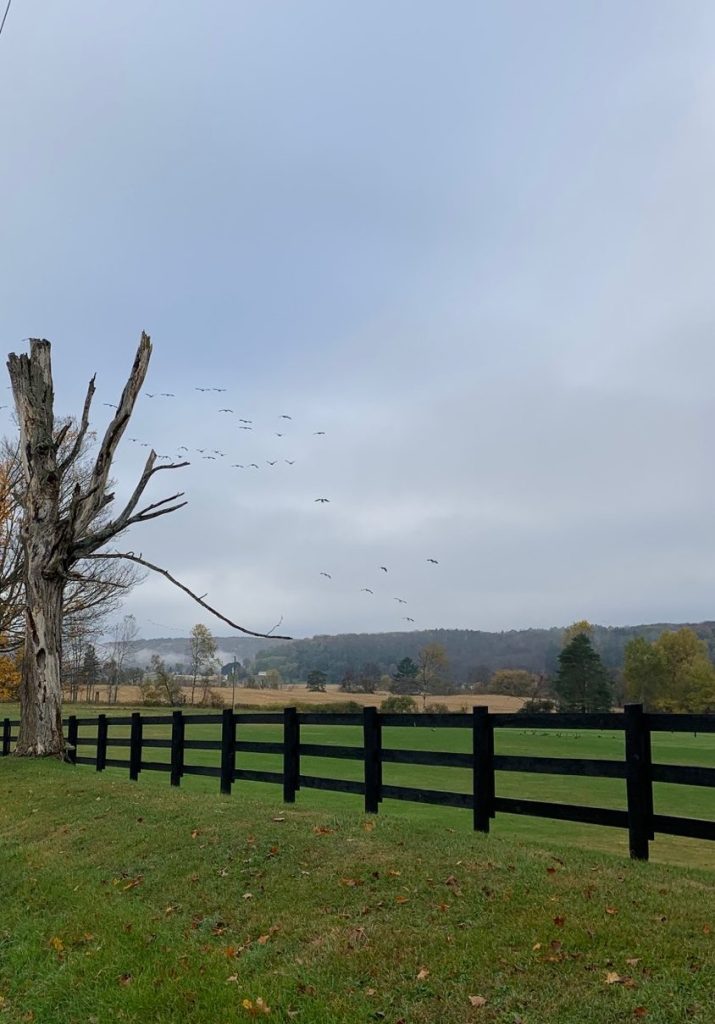
It’s a beautiful sound.

At the memorial service, my son Owen read Wendell Berry’s poem, Wild Geese.

… Geese appear high over us,
pass, and the sky closes. Abandon,
as in love or sleep, holds
them to their way, clear
in the ancient faith: what we need
is here. …

I am surrounded by life in all its beautiful and terrible stages.

Many trees in the yard are already bare, but I’ve lived long enough to know that, in the spring, new leaves will appear.

I know the geese will return, too.

On my walks I see woolly bears hurrying across the road. Sometimes I help them along — picking them up and watching them curl into a ball in my palm, then gently placing them on the other side of the road. I figure it’s one less death for the day.

And I sort through a few of my father’s things.

Life goes on.


A to Z Blogging Challenge · Grief

Blessed is the Quiet

I turned the monitor off Sunday morning not knowing it would be the last time.

For three and a half years I have slept with one ear open, listening to the monitor, learning the sounds of the different creaks of the hospital bed in the room below me.

One creak meant he was getting up. It was followed by the shuffle-thud of him walking with his walker into the bathrooom.

A different creak meant he was getting back into bed. I could hear the soft rustle of the bedding as he rolled onto his side and pulled the blankets up above his shoulders.

If I didn’t hear the back-to-bed creaks but heard the click of the light switch, I knew I needed to go down and redirect. He would be heading to his closet to choose clothes for church — no matter what day of the week it was. Sometimes that happened at 11:30 PM and sometimes in the wee hours of the morning. Sometimes it was every hour throughout night.

The monitor sat on my bedside table where its yellow light showed me it was on and its faint buzz served as a secondary reminder.

Now I hear the deep breathing of my husband sleeping beside me.

Just the other day I had been telling someone that I hadn’t heard the coyotes all summer. With the monitor off and the insomnia on, I could hear them, their long lonesome howls coming from somewhere farther away than previous years, but still there.

I hear a bird I can’t identify.

I hear gentle rain hitting the wide leaves of the hydrangea.

I hear the obnoxious sounds of vehicles driving on wet road. I can identify the milk truck, the speeding pick-ups, the cars. I can tell it’s foggy because everyone drives so much slower.

It’s so quiet, though, without the monitor.

Too quiet.

I want to hear the bed creak and the shuffle-thud.

My father passed away Sunday night.

He had dressed himself Saturday morning and eaten a bowl of cereal. Mid-afternoon he vomited brown-black — a sign of a GI bleed. He went to bed before dinner, and never got out of it again. The next day he was gone.

Thomas Merton said, “Prayer and Love are learned in the hour when prayer has become impossible and your heart has turned to stone.” (Seeds of Contemplation)

Prayer and love are learned in the quiet of a monitor that been turned off.

Merton also said, “The monk faces the worst, and discovers in it the hope of the best.” (Contemplative Prayer)

I’m facing the quiet.

I’m looking for the blessing.