My mother always used to say, “The older you get, the better you get, unless you’re a banana.”
~~ Betty White
This post brought to you by JusJoJan, One-Liner Wednesday, and bananas.
Salty like hot dogs (and tears). Sweet like marmalade (and life).

My mother always used to say, “The older you get, the better you get, unless you’re a banana.”
~~ Betty White
This post brought to you by JusJoJan, One-Liner Wednesday, and bananas.
A man named Harry McBubbish
Wrote a novel he wanted to publish
But all those who read it
Suggested no edit
But said, “This book is rubbish!”
Spinster/publisher Mary Contrary
Read the book that was written by Harry
“Oh, Harry,” she sighed
“Make me your bride
And I’ll publish The Blueberry Fairy.”
The JusJoJan prompt for the day: rubbish
“RAWRGWAWGGR“
Chewbacca, Star Wars: Episode IV – A New Hope
This post brought to you by the JusJoJan prompt: chewy
I’m struggling — like most Americans these days. I watch the news and think I know beyond a doubt what I’m seeing. Yet, I have family members who watch the news and see something completely different.
I force myself to look at different news sources: Fox, CNN, Reuters, AP
I try to mentally sidestep to a different vantage point.
Personally, the immigrants I know are wonderful people. They have escaped repressive regimes. They have stories to tell. They love living and working here.
One friend, though, from Cuba, a naturalized citizen of the US, is afraid to leave her home these days. I told a family member about her.
“Why would she be afraid?” I was asked.
Umm… racial profiling? Her life experiences before the US? I could make guesses, but my life in no way mirrors her. I will never fully understand. But she’s my friend, and I can try to support her.
This shooting in Minneapolis? The videos are out and available, but everyone watches them differently. I see a woman who blocks the street with her vehicle, but then smiles at the officer, hands in plain view, and says, “I’m not mad at you.” Her partner is more aggressive, more profane. Is the driver trying to kill or harm the ICE officer? Judging her demeanor seconds before, I would say not. And someone (the officer?), after the shooting, can be heard saying “F*cking B*tch”. AND they won’t allow a doctor to attend to her.
But that’s how I see it. That’s my opinion.
An impartial and thorough investigation would be wise and prudent, but it doesn’t look like that’s going to happen either.
Judgments have been made.
I often wonder about Nazi Germany — and I know that even bringing it up sounds hostile. Still, at what point was the evil of Hitler clear? Was it when they were requiring yellow stars? Or was it when they were rounding people up onto cattle cars? Or was there some other trigger? What did mothers tell their children when this was happening to their neighbors?
I have family members — people I love — who see the ICE and Minneapolis thing differently. I found myself thinking about this poem this morning. Am I missing something? Am I not seeing the whole picture?
by John Godfrey Saxe
IT was six men of Indostan
To learning much inclined,
Who went to see the Elephant
(Though all of them were blind),
That each by observation
Might satisfy his mind.
The First approached the Elephant,
And happening to fall
Against his broad and sturdy side,
At once began to bawl:
“God bless me!—but the Elephant
Is very like a wall!”
The Second, feeling of the tusk,
Cried: “Ho!—what have we here
So very round and smooth and sharp?
To me ‘t is mighty clear
This wonder of an Elephant
Is very like a spear!”
The Third approached the animal,
And happening to take
The squirming trunk within his hands,
Thus boldly up and spake:
“I see,” quoth he, “the Elephant
Is very like a snake!”
The Fourth reached out his eager hand,
And felt about the knee.
“What most this wondrous beast is like
Is mighty plain,” quoth he;
“‘T is clear enough the Elephant
Is very like a tree!”
The Fifth, who chanced to touch the ear,
Said: “E’en the blindest man
Can tell what this resembles most;
Deny the fact who can,
This marvel of an Elephant
Is very like a fan!”
The Sixth no sooner had begun
About the beast to grope,
Than, seizing on the swinging tail
That fell within his scope,
“I see,” quoth he, “the Elephant
Is very like a rope!”
And so these men of Indostan
Disputed loud and long,
Each in his own opinion
Exceeding stiff and strong,
Though each was partly in the right,
And all were in the wrong!
MORAL:
So, oft in theologic wars
The disputants, I ween,
Rail on in utter ignorance
Of what each other mean,
And prate about an Elephant
Not one of them has seen!
This is my response to JusJoJan’s prompt today: opinion
Don’t get me started.
Family size is a personal decision.
I can’t tell you the number of rude things that have been said to me because of the number of children I have. I have eight.
“When are you going to stop?” — said to me by a woman at church when I was pregnant with #4. She later said to me after that baby was born — a daughter after three sons, “You got your girl, thank God. You can stop now.”
Another woman told me, “You have too many children.” This was when I had, I think, six. I responded by asking, “Which one should I get rid of?” I received no answer.
I haven’t gone to high school reunions, in large part because I didn’t want to spend my evening answering questions about my family size. That — plus the fact that while my classmates went on to pursue careers, I chose to be a stay-at-home mom. I didn’t really want to spend an evening at reunion answering the question, “What do you do?”
I chose to be a mom.
And it was, without a doubt, the right choice for me. It shaped me. It allowed me to be creative and loving and strong. I developed patience. I learned that I LOVE taking care of people.
So much so that I took care of my parents, too.
Did I resent doing that? Never. Not even for half a second.
Now, while my age-cohort is retiring, I’m just a few years into my first full-time job since 1984.
I have an office where I work. People stop in a lot to say hi, to talk, to complain, to suggest. I have an open door. Just the other day I was telling someone how being a mom prepared me for the constant interruptions of having an open-door policy in my office. When you’re a mom, you learn that your interruptions ARE your work. The same is true for me today.
A man stopped in my office yesterday. He often pokes his head in to say hello. He was a caregiver for his disabled wife the last few years of her life. He used to bring her to the gym and wheel her around in her wheelchair so she could have contact with other people.
Then she died.
And it turns that by coming to the gym he was building his own support system. He comes every day — not to work out so much as to visit with people. He makes the rounds, and I’m on them.
Anyway, he poked his head in, chatted about nothing, and then asked about my necklace. My youngest daughter gave it to me and I always wear it.

It has three discs: one that’s a tree, and two progressively larger ones with the names of my children around the edge. When you have a large family, you have to be creative about mother’s jewelry.
I explained the necklace to him.
“You have eight children,” he said incredulously.
“Yes,” I replied.
“Did you adopt some?”
“No.”
“Did you have twins or triplets?”
“No,” I told, “they were born one at a time.”
I turned around to grab the photo I have of them on my bulletin board.

“There’re all adults now,” I said, showing him the photo.
“You have eight children?!”
“Yes, this is them,” I said.
He was shaking his head. “You have eight children?!?!”
“Yes –”
He was backing out of the doorway. I was feeling rattled and small and angry and sad.
“You have eight children?” he said again. “I need to process this.”
“I’m still the same person you’ve been talking to for a year,” I called after him, but I don’t think he heard me.
Don’t get me started.
There are so many things that can define a person. Mistakes made while young. How they invested their life over the past four decades. What they are doing today.
I have eight children. They are amazing people and I’m so proud of them.
Really. Don’t get me started.
This overly-wordy post is my response to the Stream-of-Consciousness prompt: don’t get me started.
Linda Hill got me started on a rant.
Aging is not an illness, a tragedy, or a problem awaiting a solution; aging is the price we pay for life which is a greater gift than we deserve.
Will Willimon, Aging: Growing Old in Church
I can’t remember names very well
But faces stick with me. And voices.
I’m still mobile and active.
As Monty Python said,
“I’m not dead yet” — so
Today I will
Celebrate —
Life is
Good!
Yes, I’m a senior citizen. No, I’m not old.
True story: I DO recognize people better by their voice than their face. And I remember their face better than their name.
Celebrate was the prompt for JusJoJan today. The nonet was just for fun.
I grew up in this old famhouse. Here
I stumble over memories
Stub my toe on them even
Sorting is quite daunting
This house is haunting
Daily I try
To get one
More box
Done

This is my response to TWO prompts!
The JusJoJan prompt for the day is stumble.
The W3 prompt is: Write a Nonet about the new year — 2026. How does this year feel to you so far? Are you hopeful, uncertain, energized, reflective? Have you set any goals or intentions? Are there resolutions you’re excited (or nervous) about? My goal for the new year is to wrap up dealing with my parents’ estate.
It certainly sounds more realistic for people in darkness to dream of God’s day of vengeance, finding satisfaction in the hope that at the Last Judgment all the godless enemies who oppress us here will be cast into hellfire.
But what kind of blessedness is it that luxuriates in revenge and needs the groans of the damned as background to its own joy?
To us a child is born, not an embittered old man.Jürgen Moltmann, The Power of the Powerless
Okay, it’s not one, not two, but three lines that I’m using for One-Liner Wednesday. I read these words this morning and they spoke to me.
My faith is a struggle these days, what with all that’s going on with our government and the focus on retribution, and the callousness towards humt
Still, I read every morning, trying to start my day off with the right mindset.
To us a child is born. To us a child is born. To us a child is born.
God didn’t come in wrath, seeing to punish. He came as a helpless baby.
Once upon a time I did a whole bunch of research on my hometown, Cooperstown, which is also the home of the Baseball Hall of Fame.
Tourists come here in droves in the summer for baseball stuff — but the village is so much more than baseball.
Years ago, when I was taking care of my father, the home health aide came and shoo me out of the house. “Go do something for yourself,” she would say.
So I would go to the research library. I mean, isn’t that where everyone would want to go?
I researched the town, the old homes, the founders, etc. I made up a walking tour of the village and walked it a gazillion times with one of my daughter. She knew the tour better than I did, I think.
Then I was talking with one of my sons and asked what he would call a non-baseball tour of Cooperstown. He thought about it, and then said, “An Intentional Walk.”
I loved it.
(For those who don’t know, an intentional walk IS a baseball term for when the pitcher decides to throw four balls and intentionally walk the batter because he would rather face the next guy in the line-up. These days, the pitcher doesn’t even have to throw the four balls. They can just declare it. Where’s the fun in that?)
But life happened.
My father died.
We had a pandemic.
I took a full-time job.
The Intentional Walk fell by the wayside. Maybe I should resurrect it.
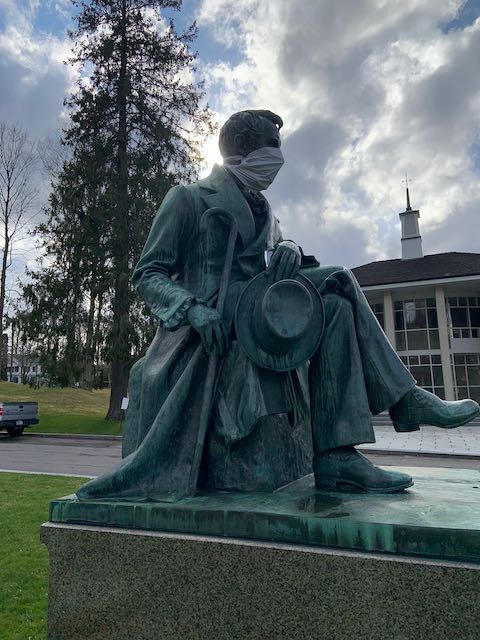
This post is brought to you by the JusJoJan prompt: Intentional
Philomena Cunk’s thoughts are always priceless:
The whole bear vs bare debacle (leaving the arms out) is further complicated by Fuzzy Wuzzy.
You remember the poem, right?
Fuzzy Wuzzy was a bear
Fuzzy Wuzzy had no hair
Fuzzy Wuzzy wasn’t fuzzy
Was he?
Clearly Fuzzy Wuzzy was bare. A bare bear.
But did he have arms?
This bit of nonsense is brought to you by the JusJoJan prompt: arms.
 Hot Dogs and Marmalade