Hey, look! You’re full I’m holding my arm up high You put that gas in and I pull Up to the “F” — up to the sky
Okay — I’m not there anymore You drove a bit, the gas level is down But hey! That’s what I’m for! So you don’t hit empty driving ’round!
’tis such a simple task that I perform Positioning myself in such a way From “F” to “E” – yes, I inform How many miles you can go today
This is my response to this week’s SoCS challenge: use full/empty in a post.
The idea was very stream-of-consciousness, but I confess, I didn’t write the post without any edits. Rhyming poems take an edit or two.
This is also my response to this week’s W3post which challenged us to write a poem with a subject that “must be an unimportant, non-emotive object that carries no nostalgia, metaphorical uplift, or symbolic gravitas. It simply is.” I’d say the gas gauge on my car fits the bill.
Look. Take a snapshot and frame a moment: [The deer too near the road frozen in fear] [Tourist on black tarmac, the bestowment Of a lei, Hawaii’s first souvenir]
A magnifying glass serves as a frame That convex lens enlarging [blades of grass] If dry, the grass might swiftly burst in [flame] [The magnifier aims sun rays en masse]
I can make [a frame with fingers and thumbs] And raise them high, see [bits of sky and cloud] [Wispy white] turns [thunder gray] as [storm comes] See [lightning flash], hear thunder crash too loud
The best of poems (I think you’ll agree) Capture something intangible and small A dumb thing overlooked you wouldn’t see Unless there was a frame that brooked it all
Be mindful. Stop whatever else you’re doing and notice. Allow yourself to be seized by this…
~~ Frederick Buechner, The Remarkable Ordinary
This is my response to this week’s W3 Challenge. The Poet of the Week instructed us to write a poem that utilises internal rhyme where possible and keep the length between 8 and 16 lines.
Is there comfort in a lump, Or something that is lumpy? Lumpy screams out IMPERFECTION Or something that is dumpy
Lumpy gravy is the worst I think most would agree But lumps in mashed potatoes With smooth gravy? HARMONY!
This week’s W3 challenge is to write about a food or drink that brings you comfort.
Form: Any
Length: Up to 24 lines
Include: The word “comfort”
Last night I went out to dinner with a friend. One of the sides that came with my dinner was mashed potatoes with gravy. The potatoes were lumpy — and I loved it.
The fog on little cat feet creeps Hunting, hunting for some prey The bustling world, not busy, sleeps The fog pea-soups as it nears day
Unaware of imminent danger Deer are swallowed up quite whole Then it gets even stranger As fog moves up and down the knoll
A flock of turkeys — gobbled down! Now I see a wayward pup Disappear — I’m looking ’round Sun battles fog to come up!
Tall trees battle, disappear Birds of every shape and size So many things that were just here Meet fog-filled fearsome demise
In my heart alarm is growing Could I possibly be next? I think it best that I get going If I’m swallowed, I’ll send a text.
This is my response to this week’s W3challenge where we are asked to write a poem of any form, no more than 240 words, that weaves a mystery—delightful or frightening—into its lines. Further, we are asked to have landscape and/or weather be a character in our poem
I happen to love the foggy mornings we’ve been having here. The fog is beautiful and mysterious.
Also, the first non-kid poem that I remember memorizing was Carl Sandburg’s poem, Fog, which begins “The fog comes on little cat feet” — hence the first line.
You hold so much filled to the brim Morning hope, solace, peace Unfortunately these days are grim You hold so much filled to the brim In you I find grim’s antonym One soothing sip brings release You hold so much filled to the brim Morning hope, solace, peace
This week’s W3 challenge is to write a Triolet about something ordinary.
What’s a Triolet? It’s an 8-line poem where lines repeat in a beautiful rhythm:
Lines 1, 4, and 7 are the same, and lines 2 and 8 are also repeated.
The rhyme scheme looks like this: ABaAabAB (uppercase = repeated lines).
I start every day reading and drinking a cup of coffee. It sets my day right.
I close my eyes to the darkness It’s easier that way to not see The suffocating night With its lack of light Where even shadows can’t be It’s a deafening deaf abyss
Open your eyes; find the light
Sticking my head in the sand I can neither see nor hear Nor taste nor smell Nor live my life ’tis its own hell Sans peace, sans strife This existence of living in fear — I must be willing to stand
Open your eyes; find the light
I rise and lift my head high I open my eyes to the dark A slim shaft of light A glimmer, yet bright Catches my eye like a spark — Engagement is how I defy
Open your eyes; find the light
This is my submission to this week’s W3 challenge.
Kerfe challenged us to write a bop poem titled “Instructions on Not Giving Up.“
A bop poem has three stanzas and a refrain that repeats after each stanza. It tells a story or explores a problem, a bit like a mini-drama.
First stanza – 6 lines Present a problem or situation.
Refrain A single line that repeats after each stanza. Think of it as the poem’s chorus.
Second stanza – 8 lines Expand on or explore the problem in more depth.
Refrain Repeat the same line.
Third stanza – 6 lines Show a solution or a failed attempt to solve the problem.
Refrain Repeat it one last time.
The other night I listened to an artist describing her process. She said that painting has taught her to look for the light. I need to remember to do that.
At the beginning Of my journey into conservative Christianity I heard this sermon:
“If Christians were rounded up and put on trial, would there be enough evidence to convict you?”
And I thought, Of course there would be. I know my Bible. I pray. I have memorized countless verses.
But then, at the beginning of the AIDS crisis, when Christians were condemning homosexuals and saying this disease was proof of God’s judgment on their immoral lifestyle, my brother, a Presbyterian minister, honored people with AIDS and their caregivers by having a dinner for them at his church. I thought about that action for years. Now there’s a conviction.
In the middle Of my thirty years of homeschooling I heard a homeschool convention speaker say:
“Ninety percent of homeschoolers vote in national elections when they are old enough to vote. That fact alone should have politicians shaking in their boots.”
And I thought, That’s a pretty remarkable fact. That’s a lot of power. Dear God, may they use it wisely.
But then, I watched my own homeschool convention heroes fall one by one. Joshua Harris renounced his faith. Cheryl Lindsey was excommunicated. Doug Phillips had an affair. They all are, after all, very human. And that voting power is a little scary.
And now, I watch “Christians” Wielding a sword and showing no love.
Dear God, I pray, convict me of compassion. May there be evidence of that in my life. Not power. Not judgment. Just kindness.
This is my submission to SoCS where the challenge was to write a stream-of-consciousness post using the words, “at the beginning.“
It’s also a response to the W3 Challenge this week in which the poet of the week challenged us to use one or both of the following images and write Prosimetrum or Versiprose: both forms combine alternating passages of prose and verse.
The water laps at Liberty Island Give me Your tired Your poor New York bustles on the mainland Huddled Masses Yearning My friend huddles in her home O Mother of Exiles Lift your lamp Amen
This is in response to this week’s W3 challenge. The italicized words are all from The New Colossus by Emma Lazarus which appears on a plaque inside the base of the Statue of Liberty. The poem is familiar and haunting.
I have a friend who is a naturalized citizen. I met her at the gym where I work and have known her for her journey as an immigrant — the trips back to her home country to see her children and to bring food; finally being able to bring her children to live here in the USA; studying, taking, and passing the citizenship exam; buying a home here.
I hadn’t seen her in a while so I asked a mutual friend about her.
“She works [at her housekeeping job] and goes straight home every day,” the friend said. “When she gets home, she cooks and eats. She has put on a lot of weight, so now that’s another reason not to come to the gym.”
I asked why, although I was pretty sure that I knew the answer.
“She’s afraid.”
I understood that also. She looks Hispanic (because she is). Her English is heavily-accented, and gets worse under pressure.
Mechanical? I am not! Any cogs? Not in my brain! Gears clinking? Pshaw! I forgot – No – machinery’s a bane I truly don’t get motors. Laugh at my utter absence Of comprehension. Rotors? Quite a puzzle. I’ve no sense! Use this gizmo? Okay — yes Explain its operation? No way! — I’d rather address This flow’r than mechanization
The W3 challenge this week involved a dive into “vintage mechanical marvels: music boxes, paddle steamers, tractor engines, grandfather clocks, fob watches, steamships, penny-farthings—you name it.” We were told to “Craft a poem inspired by these bygone mechanisms—let your mind whirl and tick with poetic possibility. And here’s the twist: be sure to include the word ‘magniloquent’ somewhere in your poem!”
For the record, “Magniloquent describes language that is intended to sound very impressive and important, or a person who uses such language.” (From Merriam-Webster)
This poem doesn’t use magniloquent — but I did make it an acrostic.
I really DON’T understand mechanical anything. Music boxes are beautiful for the sound that comes out of them. I like tractors because I love the smell of freshly mown hay and the neat rows of it in the field. Fob watches can have beautiful cases, but better I like the way it feels — the ways its curves nestle into my palm, its weight in my hand.
To the ocean I would go Just to see the water flow Whooshing in and pulling back Hearing shells go crickle-crack
On a lakeshore I could stand Digging toes into the sand Watching mallards swimming by Ospreys, eagles in the sky
Rivers also beckon me On their way to far-off sea Current flowing, rushing on By an unseen power drawn
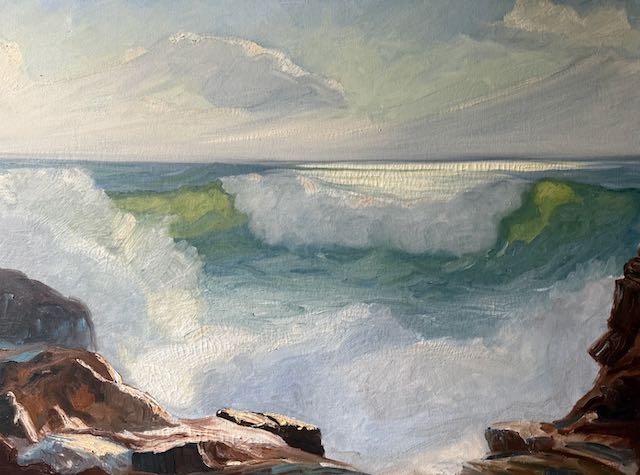
Water is my great escape So I have an oil seascape When I’m home and cannot go Painted ocean soothes my woe
This is my response to this week’s W3 prompt. Poet of the Week Marion Horton challenged us to
“…turn our gaze outward—to scapes. Your scape might be a landscape, seascape, cityscape, dreamscape—any view that stirs something in you.It could be drawn from memory or daily life, from a photograph or a painting, from what still stands or what’s long gone.Write in any form that helps you say what you need to say. Somewhere in your piece, be sure to include the word scape.“
The painting used to hang in our sunporch. I had to move it recently because I noticed it was being damaged by the sun and heat in that room.


 Hot Dogs and Marmalade