A to Z Blogging Challenge · Hutchmoot

Conversation

Good conversation is a hallmark of Hutchmoot.

We eat our meals together. At my first Hutchmoot, we ate in the basement of The Church of the Redeemer at long tables lined with metal folding chairs.

I actually wrote a cheesy poem about my experience that year.

In a metal folding chair
At the end of table two
I met some friendly people —
Could one of them be you?

For every single meal
My chair was there for me
Always just the same
At table two, not table three.

’cause a moot of hungry rabbits
Can be a daunting sight
For one who’s always awkward
And never fits quite right.

For a timid little bunny —
Oh dear! What will I say?
My chair at table two
Gave me comfort every day.

So if I didn’t meet you —
And there were quite a few —
It may be that you never sat
And dined at table two.

As hungry as I am for good conversation, I’m also terrified of saying something stupid that reveals the fool that I am. That first year, I chose to sit at the same chair for every meal. It gave me comfort. It was a decision I didn’t have to make again. I just got my food and headed to “my” chair.

The food was amazing. I should write a post on that. Maybe I will.

But what I loved most about the meal times was the conversation. Even when I wasn’t engaged in conversation, I was listening to the buzz of fascinating talk going on around me.

Sometimes friendships begin with a commonality of something that both people love, and sometimes they begin with a common dislike or pet peeve. CS Lewis’ quote — “Friendship is born at the moment when one person says to another, ‘What! You too? I thought I was the only one!'” — is oft repeated at Hutchmoot. When conversations — really respectful conversations — occur between people with different viewpoints, each person leaves better and wiser. Sometimes friendship is born of that, too.

That first year, I didn’t know it was what I was looking for, but I found the conversations to be a highlight. It’s been that way every year since. The conversation is substantive. It feeds me. While the food is nourishing my body, those words are filling my soul.

I think it was at Hutchmoot that I learned to be a true lover of good conversation.
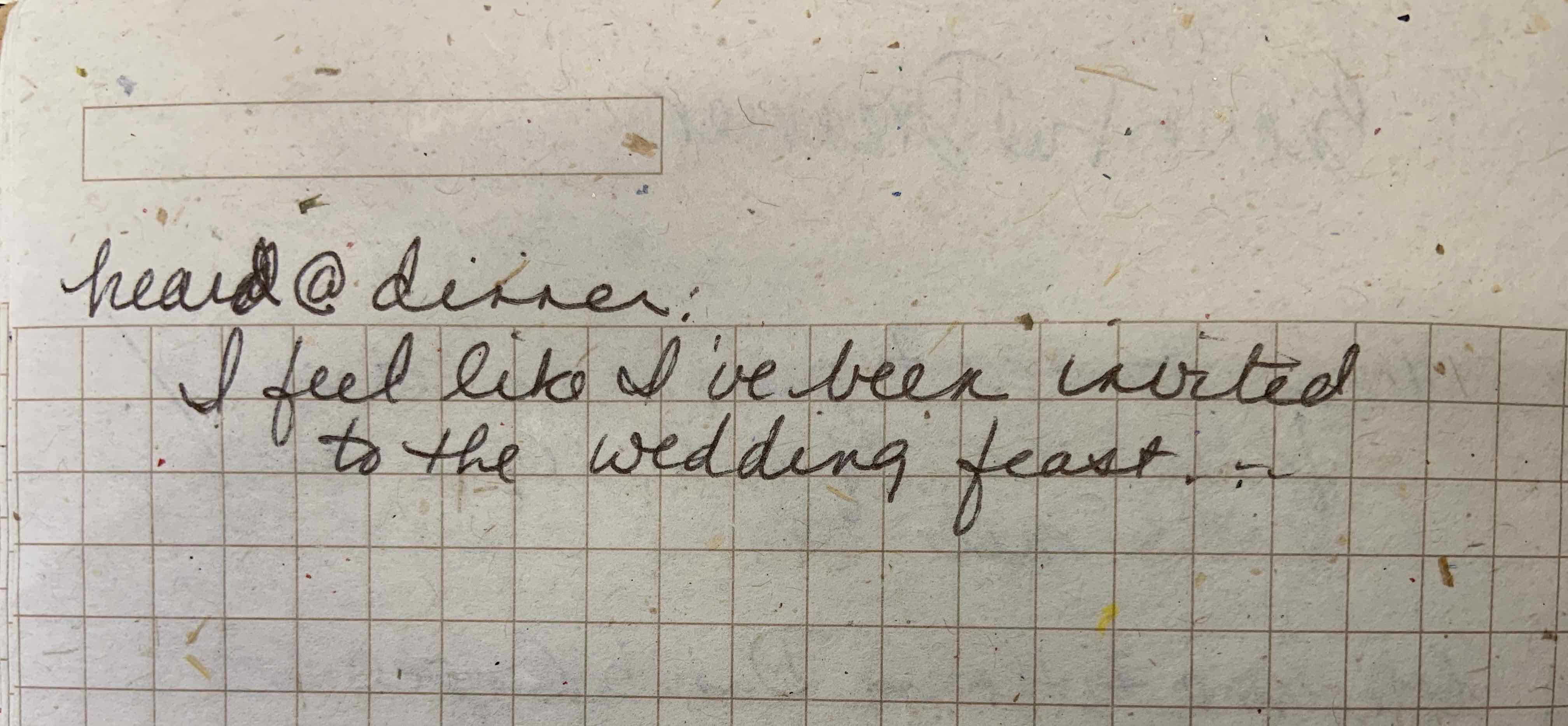
From my Hutchmoot 2011 notebook

A to Z Blogging Challenge · Hutchmoot

Beach Boys

Malcolm Gladwell did a fascinating two-part episode on memory in Season 3 of his Revisionist History podcast. He began with memories of 9/11 and how, if you ask someone today where they were and what they were doing, they can recount precise details of that morning. However, sometimes those memories are incorrect. When shown written evidence — a journal entry or an email that they wrote that day — saying that they were actually in a different place or with different people when the planes hit the towers, people will say, “I don’t know why I wrote that. I remember that morning so clearly.”

I had one of those moments this morning when I was getting ready to write this. I have a few crystal clear memories from that first Hutchmoot, one of them involves a session Ben Shive gave called “How to Smile: the Fine Art of Loving Brian Wilson.” Brian Wilson, the creative genius behind the Beach Boys, struggled with mental illness. As soon as I saw the write-up about the session, I knew it was one I wanted to attend.

When I opened my notebook to read what I had written during the session, I thought, That’s not right.

There on the page, in my scrawly handwriting, it said, “- walked with one hand covering his soul.”

For nearly ten years now, I’ve thought of it as one hand covering his heart. I thought he was afraid his heart would fall out.

In fact, when I’ve been near the bottom, my hand finds its way there, over my heart, feeling its rhythm, reminding me that I’m still alive. I first remember doing it after that session.

Because there were times over that weekend when I thought my heart was falling out.

If it fell out, and I fell apart, everyone would know.

And that couldn’t happen because it wasn’t my story.

It turns out, though, that it wasn’t my heart after all. Or rather, it wasn’t Brian Wilson’s heart. It really was his soul that he held in — confirmed by my notes and by the handout Ben Shive had given us. Ben had been doing some serious research on Brian Wilson.

I probably changed it in my head because I was less worried about my soul — I knew it was in safe hands — and more worried about my heart that weekend.

On another page of notes, I had written short summaries of each of the sessions I attended. For How to Smile, I wrote three words — “Grace, grace, grace.”

Grace for those with mental health struggles.

Grace for myself.

Grace for all.

Hutchmoot planners don’t come up with a theme and tell their presenters to focus on it. The theme comes on its own, and may be different for each attendee. Grace was my theme that year. It began with Ben Shive talking about Brian Wilson.

Then, either Russ Ramsey or Justin Gerard, in a session called “Interview with a Dragon Maker,” said, “I called you to your story. I didn’t call you to perfection in your story. My grace is sufficient for you.”

And finally, Thomas McKenzie, in morning chapel, said, “Grace flows from the hard places.”