Faith

Coracle Moon

The moon was a luminous coracle adrift in a cloudy sea.Aviary Photo_130505071358153409

Gosh, it was pretty. Early in the morning, the waning moon drifting in and out of clouds. Dawn broke, soft and pink, full of clouds that were fluffy like cotton candy, but I was still pondering the pre-dawn moon.

Recently I heard the story of Columba, a 6th century saint, about how he was banished from Ireland, set adrift in the North Irish Sea in a round boat known as a coracle.  The story was meant as a way of explaining liminal space, that place where we are unsure of everything, where we are “unmoored.”  Part of the legend of Columba was that in this round boat he had no means by which to steer and that his fate seemed hopeless.

I wish the speaker had told the rest of the story — how Columba had landed his coracle on the Isle of Iona, how from there he worked spread the news of Christ to the people of Scotland, and how his “unmooring” actually advanced the church.

In C. S. Lewis’ book, The Voyage of the Dawn Treader, Reepicheep the mouse sailed off in a coracle.   Strangely, he did not feel unmoored.  While he didn’t know his final outcome, his sole purpose was to pursue Aslan’s country.

“My own plans are made. While I can, I sail east in the Dawn Treader. When she fails me, I paddle east in my coracle. When she sinks, I shall swim east with my four paws. And when I can swim no longer, if I have not reached Aslan’s country, or shot over the edge of the world into some vast cataract, I shall sink with my nose to the sunrise.”

~~ Reepicheep the Mouse

My coracle moon, drifting in and out of the clouds that morning, seemed unmoored.  Yet I knew that it was held in its orbit with the earth by that invisible magic we call gravity.

And the earth is held in its orbit with the sun by that same unseen tether.

When I feel unmoored, like a coracle tossed on the sea, I know that, despite what I feel, I am being guided by a mighty unseen Hand.

Like Columba, like Reepicheep, I can rest in God’s great plan.
Faith

Maggie and the Rabbit

Maggie bolted out the door this morning when I went to sit on the deck for my quiet time.  She loves laying in the cool morning grass.

When she was a puppy, I had to be vigilant about watching her because she would take off chasing a squirrel and end up three blocks away.  Or worse, she would (re) discover the stream and splash up and down it becoming a muddy mess.

Now, she’s much more mature and self-controlled. She runs out, lays down in the grass, and waits.  I’m never quite sure what she’s waiting for, and I can’t break myself of the habit of being vigilant over her. So I sit on the deck and watch her while she waits in the grass.

I read and pray and watch her. And she waits.

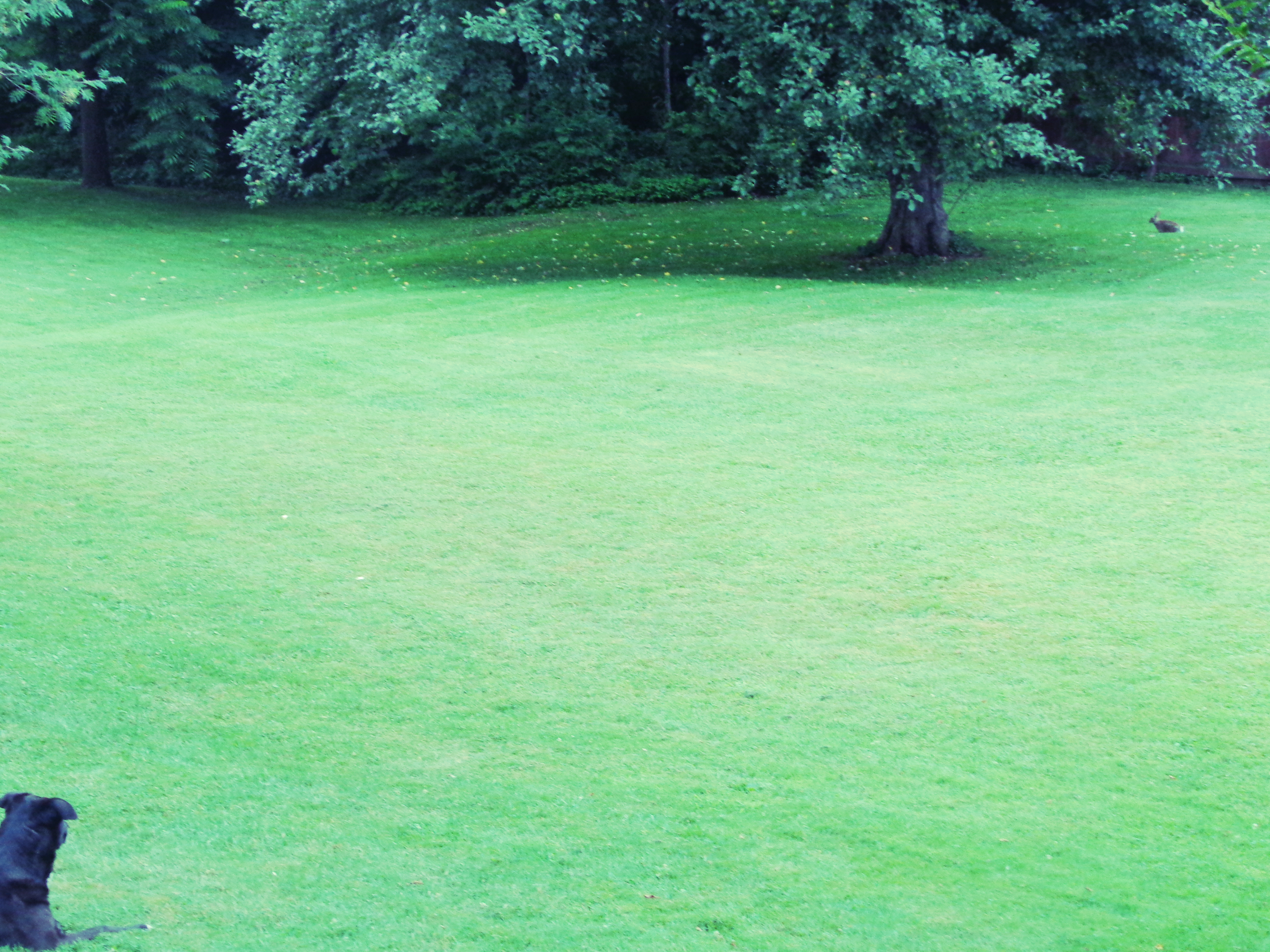
This morning Maggie suddenly perked up her ears, and her head, and her whole body, alert to a visitor in our yard. Off in the distance, under an old apple tree, a wild rabbit hopped, lippity-lippity, along.  It was also enjoying the dewy early morning grass.

Maggie, at the very least, would have loved chasing the rabbit.  The rabbit seemed oblivious to its danger.  It nibbled the grass and hopped around the apple tree.

Maggie, tethered only by her own self control, watched its every move.

And so the little non-drama played out for a good half hour.Aviary Photo_130503424926524578 Maggie was a good dog.  Though she watched, she never made any move to chase.  She showed the same self-control that I’m attempting to exercise around sweets these days.

The rabbit, though, the rabbit fascinated me. Unaware of any danger, so engrossed in its little patch of clover and the few green apples that had fallen, it didn’t seem to see the dog watching its every move.

And I got to thinking, how often am I like that rabbit?  I lippity-lip along in my own little world, unaware of those who want nothing more than to destroy me, or, at the very least, make me run for my life.

But therein lies a bigger truth.

Maggie can run fast.  When our neighbor got a Doberman, we were very happy to discover that Maggie can outrun the Doberman.  Not that we want her to have to do that.  It’s just nice to know that she can.

Still Maggie could not have closed the distance between herself and the rabbit fast enough to catch the rabbit. So, in fact, what looked like a dangerous situation for the rabbit really wasn’t dangerous at all.

And I think that is true for me as well.

Sometimes I see the scary monster and am immobilized by fear.

But God is always watching, and He has equipped me for whatever comes.

Perhaps I misjudged that rabbit, too.  It wasn’t quite as heedless as I thought.  As soon as Maggie rose to her feet to join me in the house, the rabbit scampered to the safety of the brush.

For a good half hour, though, it had enjoyed the coolness of the early morning in spite of the presence of a predator.  It didn’t live in fear.

I, too, have nothing to fear.

Faith

Communion

Communion is a joyful time at our church.

For so many years, I was used to a different way of celebrating communion.  A somber, sober way.  A stay-in-your-seat kind of way.  A contemplative, inward-looking way.

Not that those are bad things.  Communion — eating the bread and drinking the cup — shows forth the Lord’s death until He comes again.  Death is a somber, sober thing.  It calls for contemplation and looking inward.

IMG_2808[1]At our church though, we walk to the front and receive the bread, a chunk torn from a small white loaf, with the words, “This is the Bread of Life.”  Next, we dip our bread into the challis and hear “This is the Cup of Blessing.” The bread, now soggy with grape juice, must be eaten immediately, unless it is so large that it takes several bites.  Children love this.

At first, I was critical of this method.  I mean, really, everyone knows Jesus didn’t use leavened bread, I would scoff to myself.  But the reality is that Jesus also didn’t serve wine in cute little cups that could be used later for VBS crafts.  No, modern communion only recalls that Last Supper; it doesn’t replicate it.  And that attention to the outward details is exactly the pit into which the Pharisees fell.  What’s important is what’s going on in the heart.  More precisely, for me, in my heart.

Once I set my inward Pharisee aside, I could laugh and enjoy communion.  It’s a little chaotic. Children grin broadly and sometimes laugh when they are handed a large piece of bread.  More than once bread has fallen into the challis.  One parishioner’s guiding eye dog, not always in harness, but still in church, sniffs the floor hopefully for a few crumbs.

Yesterday, I went forward for communion.  The pastor said, “This the Bread of Life,” and tore a piece from the loaf.  I looked up into eyes that were warm and tender.  This was someone who knows me and loves me.  The young acolyte lifted the challis for me.  His little voice was timid and sweet as he said, “The Cup of Blessing.”

Afterwards, as I sat in my seat, I thought about that last supper Jesus shared with His disciples.  I’m sure He looked them in the eye and smiled at them as He gave them the bread.  Maybe it was a little messy sharing the cup.  I know for certain, though, that the love was palpable.

It reminded me of something Frederick Buechner once wrote about a communion experience.  I’ll leave you with that.

… I was receiving communion in an Episcopal church early one morning.  The priest was an acquaintance of mine, and I could hear him moving along the rail from person to person as I knelt there waiting for my turn.  The body of Christ, he said, the bread of heaven.  The body of Christ, the bread of heaven.  When he got to me he put in another word.  The word was my name, “The body of Christ, Freddy, the bread of heaven.”

…There was nothing extraordinary about the priest knowing my name — I knew he knew it — and there was nothing extraordinary about him using it in the service because he evidently did that sort of thing quite often.  But the effect on me was extraordinary.

… For the first time in my life, maybe, it struck me that when Jesus picked up the bread at his last meal and said, “This is my body which is for you,” he was doing it not just in a ritual way for humankind in general, but in an unthinkably personal way for every particular man or woman or child who ever existed or someday would exist.  Most unthinkable of all, maybe he was doing it for me.  At that holiest of feasts we are known not just by our official name but by the names people use who have known us the longest and most intimately.

from Spiritual Quests:  The Art and Craft of Religious Writing,
edited by William Zinsser

Food for thought the next time you partake in communion.

Alzheimer's · Faith

Knowing My Name

When Maggie can’t find her fish, she carries a different toy.

“You’re the lady with the dog,” a woman said to me at church the other day.

“The dog with the fish?”  I responded, half-questioning, half completing her sentence.

“That’s right,” she said excitedly.

Our dog is famous around Greene.  She carries a toy, usually a fish, with her on walks.  At Christmas, she carries a Santa.

And now I’m known as the lady with the dog with the fish.  All my life I’ve been identified by others — Dr. Pollock’s daughter, Bud’s wife, Philip’s (or Owen’s or Sam’s or Helen’s or Jacob’s or Karl’s or Mary’s or Laurel’s) mother.  It’s really okay — I kind of like being in the background.

The outdoor high ropes course at the Clark Sports Center in Cooperstown.

Yesterday, Mary did an outdoor high ropes course.  She said, “There were two rules.  The first was that you couldn’t call anyone ‘Hey, you’ so we had to learn everyone’s names.  If we couldn’t remember their name, we were supposed to ask them to tell us again because it’s disrespectful not to try to learn someone’s name.”

“What was the second rule?” I asked.

“I don’t remember,” she said.

When we visited my mother at the Manor, she was still in bed.  It was 11 AM.

“She’s being a stinker,” the nurse told us.

“Hi, Mom,” I said as I entered her room.

She turned and looked at me.  “Oh, hi,” she said.

“Are you going to get up today?” I asked.

“Not yet,” she replied.

“Do you know who I am?” I asked.

“Yes, I know who you are.”  She smiled at me.

“Okay, then,”  I challenged, “who am I?”

“You’re Sally.”

What a sweet little pleasure to realize that she still knows my name!

She knows my name.  I’m not the lady with the dog, or the one with a bunch of kids.  She knows my name.

Alzheimer's · Faith

My Inner Porcupine

One of the most precious lessons I have learned (and am still learning) from my mother’s Alzheimer’s is not to take things personally.  I have such a tendency to do that!  When people say or do little things, and sometimes big things, that are mean or hurtful, I dwell on them.  With my mother, when she scolds or is angry, I just tell myself that it’s her illness talking.

The other day, I found myself doing it again — focusing on someone’s hurtful words and actions.  The thing is, other people may not have an Alzheimer’s problem, but they have a human problem.  We are all so painfully human.  Just as I excuse  my mother with her Alzheimer’s, I need to excuse others because they are just people.

Grace, grace, grace — so abundantly given to me, I should be able to share it.

There’s a porcupine within me
That bristles up at certain things
And I cannot quite control it
Or the turmoil that it brings.

When frightened, angry, hurt,
The little spears come into play,
And they prickle and they stab –
They make people move away.

Sometimes life is lonely,
With this porcupine inside.
Sometimes I don’t like me,
And I want to run and hide.

Why can’t I have a bunny
Hiding inside me?
With long soft ears and fluffy tail,
Huggable as can be.

Why can’t I have a puppy
Hiding there instead?
With wiggles, fun and energy –
A thing no one would dread.

But no, I have a porcupine
That I must learn to keep,
And the lessons that he teaches me
Are hard and sometimes deep.

But the lessons that I learn,
Painful though they be,
Help me to grow in grace, grace, grace –
And become a better me.